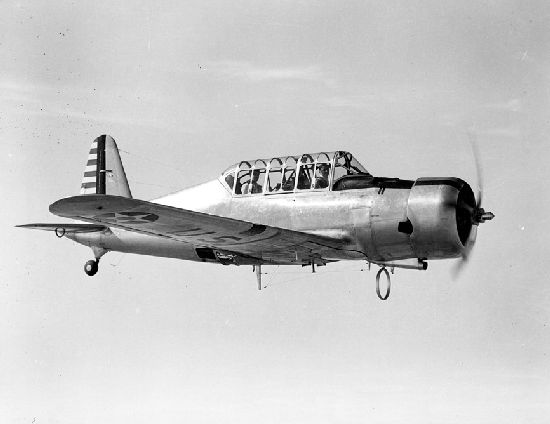
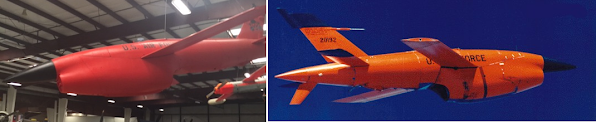
Monday, June 28, 2021

Drone converted F-86s and F-100s

The operational histories of the F-86 Sabre and F-100 Super Sabre jet fighters have been well-documented in the literature with emphasis on not just their wartime combat careers but also operational use by foreign air arms around the world, including US allies. However, lost in talk regarding the F-86 and F-100 is the fact that these iconic jet fighters were also specially used as drones to give pilots and Army personnel experience against real aerial targets after the US Air Force retired the F-86 and F-100 from active combat duty.

The first QF-86E prototype (civil registration N74170) in Mojave, California, after completing its first flight in May 1975. This aircraft was built under license by Canadair as a Sabre Mk. 5 with RCAF serial number 23320. 

In 1973, while attending a Targets Conference at Point Mugu, California, Bob Laidlaw, a graduate from the Massachusetts Institute of Technology (MIT) with an advanced degree in Aeronautical Engineering and the founder of the Newport Beach-based company Flight Systems Inc. (FSI), investigated the idea of modifying vintage F-86 Sabre jet fighters into pilotless drone targets. In December, FSI submitted an initial proposal for a drone-converted F-86 to the US Army Target Branch in Huntsville, Alabama, and a contract was immediately signed for development of a proof-of-concept F-86 target drone. Laidlaw secured a purchase option on a lot of 55 ex-Royal Canadian Air Force Canadair Sabre Mk. 5 aircraft owned by Dave McEwen, a native of Moncton in New Brunsvick, Canada, and in 1974 one Sabre Mk. 5 (RCAF 23320) was acquired by FSI from McEwen to be modified into a proof-of-concept Sabre drone, and it received the civil registration N74170 after arriving at Mojave. In June 1974, another ex-RCAF Sabre Mk. 5 (RCAF 23096) which had been used by Boeing as a chase plane for airliner test flights and bore the civil registration N8686F while in that role until its replacement by a Sabre Mk. 5 with Sabre Mk. 6 wings (ex-RCAF 23363) was acquired by FSI and ferried from Seattle to Mojave, receiving civil registration N74180 and becoming the second Sabre drone prototype. The designation QF-86E was assigned to these two Sabre Mk. 5s, and in February 1975, FSI personnel began modifying N74170 with remote flight control systems while creating as very little modification to the basic airframe of the aircraft as possible, and after being fitted with these systems, N74170 made its first flight in April, when conversion of N74180 to a target drone began. In May-June 1975, the QF-86E prototypes were transferred to Holloman AFB in New Mexico for range integration testing, and after the two aircraft completed 60 flight hours of full-scale target presentations, the US Army awarded FSI a production contract for the QF-86E. Beginning in late 1976, several Canadair Sabre Mk. 5s were converted by FSI to QF-86E production standard, being fitted with a transponder, an interface control unit, a flight control and autopilot system, flight Termination set, a maneuver programmer, a television camera, and mission-related systems, and deliveries of QF-86Es to the US Army's White Sands Missile Range in New Mexico began in mid-1977. More than fifty production QF-86Es were delivered to the US Army, including the one Sabre Mk. 6 (ex-RCAF 23454, ex-N186F) that had been acquired in the early 1970s by Laidlaw, and they retained the RCAF serials on their vertical stabilizers despite being given a new paint scheme. A great majority of QF-86Es were destroyed by surface-to-air weapons, with the first anti-aircraft kill against a QF-86E being scored on October 12, 1978 with a Patriot SAM, and the Army ended the QF-86E drone program in June 1986.

Left: Four QF-100Ds and one QF-100F lined up in a row at Tyndall AFB in western Florida, April 25, 1990.
Right: QF-100D serial number 56-1341 on outdoor display at the Planes of Fame Museum, photographed by me on April 13, 2019.

Just two years after the US Army began operating the QF-86E, in August 1979 Sperry Flight Systems was awarded a contract to convert nine F-100s into target drones and evaluate them as replacements for the QF-102/PQM-102 drone conversion of the F-102 Delta Dagger, with eight F-100Ds (serial numbers 55-3610, 55-3669, 56-2912, 56-2978, 56-2979, 56-3048, 56-3324, and 56-3414) and a single F-100F (serial number 56-3984) designated QF-100D and QF-100F respectively. The first two F-100Ds to be converted into drones were designated YQF-100D and fitted with cockpit controls so that they could be flown by pilots for system evaluation, and the other six F-100Ds were modified to standard US Air Force target configuration and Army requirements, while the F-100F chosen for conversion became QF-100F. Takeoff of a QF-100 drone was directed by two ground-based controllers positioned at the end of the runway. Once airborne, the drone was handed off to a third controller sitting in a fixed-base ground station and a dual redundant system was used to get the drone to the mission area and to select the maneuvers, which were pre-programmed into on-board computers. If the drone survived the mission, it was flown back to the handover point, where the two controllers at the end of the runway brought it back in for a landing. The YQF-100D first flew from Tyndall AFB in northwest Florida on November 19, 1981, and after successful flight trials of the QF-100, Sperry was contracted to convert 99 additional F-100Ds and F-100Fs to QF-100 configuration, with deliveries to the USAF's Tactical Air Command being made in late 1983. In May 1984, FSI received a contract to modify 209 F-100Ds and F-100Fs as QF-100Ds and QF-100Fs, and the first QF-100s to be made by FSI were delivered in mid-1985. Sperry finished QF-100 conversions in April 1985, while FSI's conversions of its F-100Ds and F-100Fs to QF-100s until the end of the 1980s. The QF-100s themselves sported a bright red-orange paint scheme and had a few extra blade antennas for the transmission and reception of radio signals from remote-controllers on the ground. Each QF-100 drone had a lifetime of  ten flights before being destroyed, and the QF-100s were flown over the Gulf of Mexico and used as live firing targets for F-15 and F-16 training. Many were shot down with air-to-air missiles fired by the F-15 and F-16, and some either crashed on landing or lost in flight for other reasons. The last QF-100 flight was made in July 1992, and the remaining QF-100s went back to the boneyard at Davis-Monthan AFB, by which time the US Air Force was deploying the QF-106 drone conversion of the F-106 Delta Dart.

Left: A QF-86H (serial number 52-5747) in flight, 1972.
Right: QF-86H serial number 53-1351 on outdoor display at the Planes of Fame Museum, photographed by me on April 13, 2019.

The US Army was not alone in using F-86 drone conversions as live firing targets for training aircrews flying more modern aircraft. In the early 1970s the US Navy acquired about three dozen retired F-86Hs which were converted into target drones under the designation QF-86H, and it used those aircraft for target practice by Navy fighter pilots at NAS Point Mugu and NWC China Lake in southern California. Some of the QF-86Hs were shot down with anti-aircraft, and others were retired by the end of the 1970s or lost in accidents, with a few now on static display at museums. In addition, more than 130 F-86Fs formerly operated by the Japan Air Self-Defense Force (including five license-built by Mitusbishi) were modified into target drone aircraft with the designation QF-86F, and deliveries to US Navy units began in 1980, with more than 20 F-86Fs formerly used by Japan and other US allies being used as spare parts for the QF-86F fleet. During the 1980s and continuing into the early 1990s, the QF-86Fs were used for target practice by Navy fighter pilots at NAS Point Mugu and NWC China Lake, and several were destroyed by air-to-air missiles or lost in accidents. By 1993, the last QF-86Fs were retired from service, and a few have been donated to museums. The QF-86H with serial number 53-1351 that I've seen at the Planes of Fame Museum happens to include a few components from F-86H serial number 52-2074, possibly because when 53-1351 was retired and stripped of several non-vital parts, the latter Sabre had a few parts of its derelict airframe used to restore 53-1351. 

References:

Curtis, D., 2001. North American QF-86E/F/H/Sabre Full Scale Aerial Targets. Simi Valley, CA: Ginter Books.

Doug, J., 2011. "QF-100: The Final Hun." The Intake 1 (17): 20-26. (PDF link here)

Johnsen, F.A., 2024. Q-Birds: American Manned Aircraft as Drones. Manchester, UK: Hikoki Publications. 

The brave flying classroom from Downey: the Vultee Valiant

A lot of people, myself included, always regard the Texan as the most prolific trainer aircraft ever built in southern California in World War II. However, the Texan itself wasn't the only mass-produced trainer made in southern California during the war, because Vultee undertook development of a monoplane trainer, the Valiant, which became the only mass-produced trainer aircraft to be designated in the BT (Basic Trainer) designation sequence. Despite having a relatively brief military career with the US armed forces, the Valiant itself went on to become the preeminent US military basic trainer of World War II, with over 200,000 new service pilots flown on this aircraft.

An in-flight study of the sole Vultee BC-3 (serial number 39-720), the ancestor of the Vultee Valiant.

The story of the Valiant begins in 1938 when Vultee chief designer Richard Palmer proposed a multi-purpose aircraft progressively derived from the company's V-1 single-engine airliner for use a fighter and trainer. While the fighter design became the Model 48 (US military designation P-66), the trainer iteration, designated Model 51 or BC-51 by Vultee, was submitted for a requirement by the US Army Air Corps for a new Basic Combat (BC) trainer. The Model 51 had an aluminum, semi-monocoque fuselage, a four-panel wing with NACA airfoil sections and slotted flaps, wide-track, inward-retracting main landing gear, and a "greenhouse" cockpit canopy, and power was supplied by one Pratt & Whitney R-1340 Wasp radial piston engine. One Model 51 prototype was completed and it first flew on March 24, 1939, receiving the serial number 39-720 after being delivered to Wright Field on June 24, and the designation BC-3 was assigned to this aircraft. Although the Model 51 met or exceeded performance parameters laid out in the 1938 BC requirement, the Army Air Corps by then had already ordered the rival North American BC-1A design (the immediate ancestor of the AT-6 Texan) into series production, so the Model 51 remained a prototype only. 

Left: A Vultee BT-13A Valiant (serial number 42-1453) at Minter Field near Bakersfield, California, on March 1, 1943.
Right: An in-flight study of an SNV-2 (Navy equivalent of the BT-13B).

Even before the BC-3 flew, Vultee proposed a derivative of the BC-3 with one Wright R-975 Whirlwind radial engine for the export market, the Model 54 Valiant, and it also envisaged the Model 54A basic trainer subvariant of the Valiant with fixed landing gear and one Pratt & Whitney R-985 Wasp Junior radial engine. The Model 54 prototype (civil registration NX21753) first flew on June 9, 1939, but its performance was disappointing and the aircraft had to be re-engined with an R-1340 to improve speed and altitude capabilities, but not long before it crashed during a test flight on November 15. The Model 54A prototype (civil registration NX21754) made its first flight on July 28, 1939, and on September 16 the US Army Air Corps placed an order for 300 production Model 54As (serial numbers 40-810/1109), assigning the designation BT-13 to the Model 54A basic trainer. Deliveries of the BT-13 Valiant to the USAAC began in June 1940, and one skeletal airframe was built to delivered to the USAAC earlier that year. The BT-13A variant, of which 6,607 aircraft (serial numbers 41-1211/1710, 41-9587/9979, 41-10410/11586, 41-21162/23161, 42-1164/1743, 42-42201/43257 and 42-88674/89573) were built, was fitted with an R-985-AN-1 and lacked wheel fairings. The BT-13B was a BT-13A with 24-volt electrical system, and 1,125 BT-13Bs (serial numbers 42-89574/90698 and 44-31511/32160) were constructed. During the 1941-1942 timeframe, a temporary shortage of R-985 engines led to 1,693 Valiant trainers (41-9980/10409, 42-1744/2063 and 42-41258/42200) being fitted with the R-975 Whirlwind engine and designated BT-15. Of the 3,350 BT-13As ordered under a combined Army-Navy contract for additional BT-13As, 1,350 were delivered to the US Navy with BuNos 02983/03182, 05675/05874, 12492/12991 and 34135/34584 and given the designation SNV-1, with deliveries beginning in mid-1941 (two more SNV-1s were delivered to the US Coast Guard with the serials V222/223). In addition, 650 BT-13Bs were accepted by the Navy with BuNos 44038/44187 and 52050/52549, and the designation SNV-2 was assigned to these aircraft; several SNV-2s were designated SNV-2C after being modified to use an arrestor hook for carrier landings and other carrier-compatible equipment. One BT-13A (41-9777) was designated XBT-16 after being modified by the Vidal Research Corporation with a fuselage and wing empennage made from plastic, but during flight tests in 1942-1943 the XBT-16 came out 110 pounds heavier and 5 miles per hour slower than the BT-13, so it did not enter production.

Left: A BT-13B Valiant (serial number 42-90054) at the Planes of Fame Museum, photographed by me on April 13, 2019. 
Right:A BT-13B Valiant (serial number 42-89607) at the Yanks Air Museum, photographed by me on July 10, 2016.

The Valiant was not only produced in greater numbers than other trainers with BT-series designations but also trained more aircrews than the Texan or any other American aircraft in World War II, partly thanks to Vultee completing production Valiants ahead of schedule. While in service with basic training units of the US Army Air Force Training Command (USAAFTC) and US Navy, the Valiant itself was nicknamed the "Vultee Vibrator" because of its behavior when approaching its quite violent stall (75 mph/clean), so while capable of almost any aerobatic maneuver in skilled hands, its widespread use in a wartime system with a high casualty rate led to it gaining an undeserving reputation as a "Widow Maker". Despite much mishandling, there is no record of an in-flight structural failure occurring to any Valiant aircraft. By the end of World War II, as training requirements diminished, the USAAFTC retired the BT-13 and BT-15 from training units while the Navy withdrew its SNVs from service in May 1945 (the last active SNV-2 was stricken from the Navy inventory in April 1946). Large numbers of Valiant trainers were sold as surplus on the civilian market in the post-World War II environment, many being used for agricultural purposes. From 1942 onwards, Valiant trainers were sold under Lend-Lease to Argentina, Bolivia, Brazil, Chile, China, Colombia, Cuba, Dominican Republic, Ecuador, El Salvador, Guatemala, Haiti, Honduras, Mexico, Nicaragua, Panama, Paraguay, Peru, and Venezuela, and after World War II forty Valiants were delivered to France, while one Valiant became the first operational aircraft of the Indonesian Air Force and smaller numbers were delivered to Israel, Egypt, and the Philippines. When the US Air Force replaced the AT, BT, and PT basic mission categories with a T-for-Trainer category in 1948, a number of surviving BT-13As were redesignated T-13A (confusingly, Stearman Kaydets still in the Air Force inventory became T-13B and T-13D).

Like the Texan, the Valiant remains popular with warbird collectors and can be seen at airshows across the US. In an interesting footnote, nine Valiants were painted to closely resemble Aichi D3A "Val" dive bombers during the production of the 1970 war film Tora! Tora! Tora! by Twentieth Century Fox (four Texan/Harvard trainers were painted to resemble the Mitsubishi A6M Zero and Nakajima B5N "Kate" for the film as well) due to the fact that no intact examples of the Japanese aircraft used in the attack on Pearl Harbor were airworthy when the movie hit theaters. One of the Valiants painted in the likeness of the "Val" during the filming of Tora! Tora! Tora! is now in airworthy condition as a warbird at the Planes of Fame Museum.

Wednesday, May 5, 2021

Convair XF-92: America's first delta-wing aircraft

The 1940s marked a revolution in wing design for military aircraft, with aeronautical engineers realizing that swept wings, delta wings, and variable geometry wings unlocked the aerodynamic secrets to flight at speeds of Mach 1 and beyond. Of all the revolutionary wing planforms analyzed for high-performance combat aircraft by the victorious Allied Powers thanks to captured treasure troves of German aeronautical documents, the delta wing and variable geometry wing would end up emerging as the most appropriate wing planforms for airplanes capable of flight beyond Mach 2 due to their ability to reduce drag at low speeds and absorb shockwaves in level supersonic flight. However, the delta wing design of the US jet fighters that patrol the skies of the US defending America's sacred freedoms wouldn't be possible if it were not for a single ancestor built in the distant past: the Convair XF-92. 

Early design study for the Convair XP-92, early 1946

In the final months of World War II, the Vultee Division of Consolidated Vultee (Convair) looked at the idea of a swept-wing aircraft powered by a ducted rocket engine, whereby fuel would be added to the heat produced by small rocket engines in the duct. In August 1945, the US Army Air Force announced a requirement for a supersonic interceptor capable of flying at 700 mph (1,100 km/h) speeds and reaching an altitude of 50,000 feet (15,000 meters) in four minutes. Convair responded with a design featuring wings swept back 45 degrees, a V-shaped tail empennage, and a mixed propulsion system comprising one 1,560 lb (6.9 kN) thrust Westinghouse 19XB/J30 turbojet and four 1,200 lb (5.3 kN) thrust rocket motors positioned at the exhaust nozzle of the turbojet. To meet performance requirements set out by the USAAF, operating range and flight endurance were sacrificed. By May 1946, Convair's proposal was accepted for further development by the Air Material Command of the USAAF, and the AMC designation MX-813 was allocated to the Convair design.

Top: Artist's conception of the delta-wing XP-92/XF-92 design, mid-1946. 
Bottom: Full-scale mockup of the Convair XP-92/XF-92 point-defense interceptor, April 1948.

Not too long after the Convair proposal was accepted by the USAAF, however, aerodynamic problems were discovered during wind tunnel tests of the backswept wing design by Convair. For instance, the backswept, narrow-chord wings would experience problems with wing tip stalling at low angles of attack and issues were discovered with lateral control surfaces of the backswept wings. Recognizing the aerodynamic instability of the back swept narrow-chord wing, aerodynamicist Ralph Schick suggested to Convair technologist Adolph Burstein and test pilot Frank Davis that the design be reworked with a highly swept delta wing having a straight trailing edge. Burstein and Davis agreed with Schick's proposal, and a new design was envisaged in July with a pure 60 degree delta wing and a relatively short cylindrical fuselage, powered by a ramjet engine with six 2,000 lb (8.9 kN) thrust rocket motors buried in the ramjet's combustion chamber. This design, assigned the company designation Model 115 by Convair, would take off and climb to altitude with the rocket motors, and once at high altitudes the ramjet would ignite to propel the Model 115 to Mach 1.65, with a planned endurance of 5.4 minutes. In the event of an emergency, the pilot would jettison the fuselage containing the engines. Is it often said that the delta wing for the Model 115 was influenced by wartime research by German aircraft designer Alexander Lippisch, because the Convair Model 115 design had the same delta wing planform as the proposed Lippisch P.13a ramjet-powered interceptor. However, as noted by Hallion (1979), even though Ralph Schick met with Lippisch at Wright-Patterson Air Force in Dayton, Ohio, he rejected the thick delta wing proposed for the P.13a and the unpowered DM-1 technology demonstrator, preferring instead a delta wing with a thin airfoil.  

In June 1946, two prototypes and one structural test airframe of the Model 115 were ordered, and the design was officially designated XP-92 by the USAAF. Later, in September, Convair had the USAAF amend the contract whereby the structural test airframe would be built as a flying mock-up, in other words a full-scale technology demonstrator, arguing that a technology demonstrator was essential to test the flight characteristics of the XP-92. The technology demonstrator received the serial number 46-682, whereas the XP-92 prototypes were assigned the serial numbers 46-683 and 46-684. The flying mock-up was allocated the number 7002, but this was not a company designation, but instead an internal accounting number by Convair on an engineering work order (Bradley 2013). To save development time and costs, components for the 7002 were taken from other aircraft, with the main gear taken from a North American FJ-1 Fury, the nosewheel coming from a Bell P-63 Kingcobra, the engine and hydraulics systems coming from a Lockheed P-80 Shooting Star, the ejection seat and cockpit canopy being sourced from the Convair XP-81, and the rudder pedals taken from a BT-13 trainer. Construction of the 7002 was underway when the Vultee facility in Downey was taken over by North American Aviation in the summer of 1947, prompting Convair to move the airframe to the Convair factory in San Diego. The aircraft was finished in December, and sent to the NACA Ames Aeronautical Laboratory for wind tunnel tests. The 7002 used a single 5,200 lb (23.1 kN) thrust Allison J33 turbojet, and was similar to the XP-92 design in the wing and tail configuration, but differed in having a bubble cockpit canopy. By April 1948, a full-scale mockup of the XP-92 was completed and ready for inspection by US Air Force officials. After the US Air Force decided to classify fighter planes as fighter rather than pursuit planes, the XP-92 became XF-92, while the technology demonstrator would be designated XF-92A. However, the XF-92 project was cancelled in June due to the complexities of the planned propulsion system, rising development costs, and the fact that the requirement for a point-defense interceptor had vanished.

Top: Desktop model of the Convair XF-92A at the Western Museum of Flight (photo taken by me in April 2021).
Bottom: Convair XF-92A (serial number 46-682) in flight.

Even before the XF-92 point-defense interceptor program was cancelled, in March 1948, the XF-92A arrived back in San Diego, California to have the Allison J33 turbojet installed, and it was transported by vessel to LA harbor for shipment to Muroc Air Force Force (later renamed Edwards AFB). Taxi tests began in May, and on September 18, the XF-92A made its first flight, piloted by Convair test pilot Ellis D. Shannon. After 47 test flights, the XF-92A was delivered to the Air Force on August 26, 1949, with Frank Everest and Chuck Yeager in charge of flight testing. On one test flight, the XF-92A managed to reach Mach 1.05 for a brief time, becoming the first American delta-wing plane to go supersonic. In 1951, the XF-92A was refitted with an afterburning J33-A-29 yielding 7,500 lb (3.3 kN) of thrust, flying with this engine for the first time on July 20, but this engine was hamstrung by maintenance problems and offered the XF-92A only marginal improvement in performance, so only 21 flights were made with the afterburning version of the J33. The XF-92A began flight tests on behalf of NACA on April 9, 1953, and 25 flights were made by Scott Crossfield until October 14, when the aircraft had a nose gear collapse during landing after its last flight. After being retired, the XF-92A languished as a static exhibit until 1962, when the US Air Force retrieved the aircraft and donated it to the National Museum of the US Air Force in Dayton, Ohio, where the aircraft resides today.

Although the XF-92 was not built for the role for which it was intended, it nevertheless provided a library of aerodynamic data on the delta wing planform that would later be applied to development of all American delta-wing aircraft, including the B-58, XB-70, F-102, F-106, F-4, F-15, F-16, F-22, and F-35. To this day, designers of fighter aircraft largely tend to focus on the delta wing as the best wing planform for combat jets capable of flying at speeds beyond Mach 1.

References:

Bradley, R., 2013. Convair Advanced Designs II: Secret Fighters, Attack Aircraft, and Unique Concepts 1929-1973Manchester, UK: Crécy Publishing 

Buttler, T., 2007. American Secret Projects: Fighters and Interceptors 1945 to 1978Hinckley, UK: Midland Publishing.

Hallion, R., 1979. Lippisch, Gluhareff, and Jones: The Emergence of the Delta Planform and Origins of the Sweptwing in the United States. Aerospace Historian 26 (1): 1-10.

Jenkins, D.R., and Landis, T.R., 2008. Experimental & Prototype U.S. Air Force Jet Fighters. North Branch, MN: Specialty Press.

Yenne, B., 2009. Convair Deltas: From SeaDart to HustlerNorth Branch, MN: Specialty Press.

Saturday, April 10, 2021

Douglas 1155 and 1211 unbuilt competitors to the B-52 Stratofortress from Santa Monica

The Boeing B-52 Stratofortress is one of the most formidable weapons in the US armory, an expression of the US capability to project long-range air power abroad (next year, in April 2022, the B-52 will mark the 70th anniversary of its first flight, continuing to serve with the US Air Force despite the development of intended replacements like the XB-70 Valkyrie, B-1 Lancer, and B-2 Spirit). A few years ago, I finally had the chance to see the B-52 in person when I paid my first visit to the March Field Air Museum in Riverside, California, and all I have to say is that the B-52 was truly impressive in size as I had seen in books on post-1945 US military aviation, unusually using outrigger landing gear to support its huge wingspan. The history of design and early development of the legendary and venerable Boeing B-52 has been discussed by Buttler (2010), Remak (2016), and Yenne (2012), but almost lost in talk of the early development of the B-52 Stratofortress are intercontinental bomber designs from the Santa Monica division of the Douglas company to compete with design studies for the Boeing B-52 but also proposals from Convair and Martin for the B-52 competition.

Desktop model of the six-engine version of the Douglas Model 1155 strategic bomber 

In April 1948, Douglas proposed a straight-winged intercontinental bomber derived from the DC-6 piston-engine airliner with jet propulsion, called Model 1155 by the company. The Model 1155 featured a new leading edge of the wing, an extension of the outer sections of the wing, a longer fuselage, a tail turret similar to that developed for the Boeing B-50 Superfortress, and a bomber nose. It was to have a wingspan of 159 feet 6 in (48.62 meters), a length of 115 feet 8.5 in (35.27 meters), and a maximum take-off weight of 213,800 lb (96,980 kg). Two Model 1155 variants were proposed, one powered by six individual turbojets and another powered by four engines; both designs had the main landing gear housed in the forward part of the inner nacelles. Although both Model 1155 proposals were submitted to the US Air Force on April 30, 1948, they were rejected later that year.

Desktop model of the Douglas Model 1211J turboprop-powered intercontinental bomber

Douglas returned to the fore of efforts to develop a rival competitor to the Boeing B-52 in 1949 when it when it began design studies for an intercontinental bomber powered by four turboprop engines under the Model 1211 designation. A total of 40 designs for the Model 1211 were worked out in 1949-1950, differing in the wing area and powerplant, and in January 1950 Douglas submitted the 1211J proposal to the US Air Force. By July a design study and operational effectiveness evaluation for nine optimized strategic bombers was completed, with emphasis placed on thin high-aspect ratio wings to offer both intercontinental range and high speed. Zichek (2009) is consulted for drawings and extensive technical details regarding design studies for the Model 1211, but I do wish to summarize a handful of Model 1211 proposals as follows:
  • Baseline Model 1211: powered by four turboprops, straight wings
  • Model 1211E: backswept wings; powered by four turboprops and two turbojets; wingspan of 188 feet (57.3 meters) and a length of 124 feet 7 in (37.9 meters)
  • Model 1211H: Similar to 1211E but with a wingspan of 227 feet 6 in (69.34 meters) and a length of 144 feet 8 in (44.1 meters) 
  • Model 1211J: powered by four turboprop engines and four Pratt & Whitney J57 turbojets, with a crew of nine (two pilots, bombardier, radar engineer in the nose, engineer and navigator in the forward fuselage cabin, and three relief crewmen for long combat missions); wingspan as Model 1211H with fuselage 160 feet 6 in (48.92 meters) in length; 322,000 lb (146,060 kg) fully loaded, with a top speed of 518 miles per hour (833 km/h); maximum range 12,658 miles (20,372 km), and 50,000 lb (22,680 kg) of fuel housed in wing drop tanks. Armament comprised 43,000 lb (19,505 kg) of bombs, two photo-flash bombs, and two 20 mm cannons in the tail. Outrigger wheels (to be jettisoned  after takeoff) supported the long wings between the outer engines and the drop tanks. In April 1950, Douglas explored the notion of using the 1211J as a mothership for the Douglas F4D Skyray and Convair XF-92 jet fighters.
  • Model 1211K: launch platform to carry an SM-64 Navaho intercontinental cruise missile atop the fuselage on pylons
  • Model 1211L: variant of the 1211K with increased fuel capacity.
  • Model 1211M: variant of the 1211J with eight Pratt & Whitney J57 turbojets 
  • Model 1211N: variant of the 1211J with six J57s.
  • Model 1211P: wingspan as 1211J but fuselage slightly shorter
  • Model 1211R: powered by four Pratt & Whitney T45 turboprops and two auxiliary Pratt & Whitney J57 turbojets; sub-variants included the 1211R-45 with a wingspan of 195 feet 6 in (59.6 meters), a length of 143 feet 9 in (43.82 meters), a speed of 518 miles per hour (833 km/h), a range of 13,015 miles (20,946 km) a gross weight of 239,000 lb (108,410 kg), and armament comprising 43,000 lb (19,505 kg) bombs and two 20 mm machine guns in the tail, the 1211R-55 with a wingspan of 236 feet (71.9 meters), a length of 164 feet 6 in (50.14 meters), a speed of 518 miles per hour (833 km/h), and a gross weight of 306,000 lb (138,802 kg), and the 1211R-50D with a wingspan of 251 feet (76.5 meters) and a length of 169 feet 4 in (51.61 meters). 
  • Model 1211S: similar to the 1211R but with a wingspan of 191 feet (58.21 meters) and a length of 144 feet (43.89 meters)
  • Model 1211T: powered by four Pratt & Whitney T45 turboprops and four Pratt & Whitney J57 turbojets; sub-variants included the baseline 1211T with a wingspan of 240 feet (73.15 meters) and a length of 210 feet (64 meters), the 1211T-45 with a wingspan of 210 feet 7 in (64.2 meters) and a length of 195 feet 6 in (59.6 meters), the 1211T-50 with a wingspan of 224 feet 8 in and a length of 207 feet (63.14 meters), and the 1211T-55 with a wingspan of 262 feet (79.86 meters) and a length of 207 feet 2 in (63.14 meters). Outrigger landing wheels were positioned outboard of the outer turboprops.
  • Model 1211U: wingspan as 1211S but fuselage 178 feet 7 in (54.43 meters) long.
  • Model 1211X: similar to the initial 1211 proposal in having straight wings, but differed in being longer and having increased wingspan; subvariants included the 1211X-45 and 1211X-50 with four T45s and two J57s, the 1211X-55 with four T45s and four J57s.  

Top: Desktop model of the Douglas Model 1240 multi-role carrier aircraft and variety of loads that would have been carried by the Model 1240
Bottom: Desktop models of the Douglas Model 1251A (left) and Model 1265 (right) parasite bombers

As a side note, in late 1950 Douglas investigated a number of versions of the asymmetrical Model 1240 twin-boom, twin-fuselage carrier aircraft project (which had the crew compartment in the left fuselage nose) to carry either parasite fighters, specially designed supersonic bombers, or a huge pod measuring 100 feet (30.5 meters) and loaded with bombs for long-range combat missions. For instance, in February and March 1951, Douglas proposed two supersonic parasite bomber designs to be carried by the Model 1240, the Models 1251A and 1265. both of which had a crew of three. The Model 1251A had three Pratt & Whitney J53 turbojets, two of which could be jettisoned on the return flight with the third situated in the rear fuselage, and it would have carried one specially designed bomb below the center of the fuselage. The wingtip-mounted fuel tanks were to be jettisoned during the attack phase of a combat mission and the supersonic fuel tanks would be discarded during the return leg of the mission. One 1251 proposal dated March 11, 1951 was proposed with two Pratt & Whitney PT2E turboprops and subsonic speed. The Model 1265 was a twin-fuselage design with the cockpit on the port fuselage, and like the 1251A could release the subsonic fuel tanks during a sortie and the supersonic fuel tanks on the return. It could carry a butterfly-tailed single pod below the center wing section containing a specially designed bomb, and two of the J53s were situated in the fuselages with the third housed in a jettisonable pod. Despite offering flexibility as a combat plane in addition to non-combat roles, the Model 1240 was rejected by the US Air Force in 1951 due to its high drag penalty compared to conventional aircraft, while the Model 1251A and 1265 designs remained paper projects only.  

The Boeing B-52 Stratofortress, which ended up occupying the gas turbine-powered intercontinental bomber role which the Douglas 1211 would have fulfilled. 

For all its promising potential in terms of size, combat performance, and overall layout, the Douglas Model 1211 and parasite aircraft carrier versions of the Model 1240 would never progress beyond the drawing board. The Boeing B-52 by now had entered full-scale development along with the Convair YB-60 all-jet derivative of the B-36 Peacemaker, and the US Air Force certainly found the Model 1211  and Model 1240 projects too ambitious and too complex to be earmarked for full-scale development. In the meantime, the Soviet Union's Tupolev Tu-95 'Bear' turboprop bomber, utilizing the same design philosophy as the Model 1211, did proceed to the hardware phase, making its first flight on November 12, 1952, and it remains the only intercontinental bomber with turboprop engines in operational service, an anomaly considering that all other strategic bombers in service today are jet-powered.

[EDIT: Thanks to a copy of the revised edition of the American Secret Projects volume by Tony Buttler about bomber, attack, and anti-submarine aircraft designs from the 1945 to 1974 interval that I got recently, but also the comprehensive monograph by Zichek (2010), it is now clear that the parasite bomber designs intended for launch from the Model 1240 received the company designations Model 1251 and Model 1265. Although not exclusively a strategic bomber in the strictest sense, the Model 1240 was heavy enough to carry smaller aircraft and war material housed in underwing pods.]

References:

Buttler, T., 2010. American Secret Projects: Bombers, Attack, and Anti-Submarine Aircraft 1945 to 1974Hinckley, UK: Midland Publishing.

Buttler, T., 2021. American Secret Projects 4: Bombers, Attack, and Anti-Submarine Aircraft 1945 to 1974Manchester, UK: Crécy Publishing.

Remak, J., 2016. Boeing B-52 Stratofortress: Warrior Queen of the USAF. Stroud, UK: Fonthill Media.

Yenne, B., 2012. B-52 Stratofortress: The Complete History of the World's Longest Serving and Best Known Bomber. Minneapolis, MN: Zenith Press. ISBN 978-1610586726.

Zichek, J.A., 2009. The B-52 Competition of 1946…and Dark Horses from Douglas, 1947-1950 (American Aerospace Archive Number 3). La Jolla, CA: American Aerospace Archive. 

Zichek, J.A., 2010. Mother Ships, Parasites, & More: Selected USAF Strategic Bomber, XC Heavy Transport and FICON Studies, 1945-1954 (American Aerospace Archive Number 5). La Jolla, CA: American Aerospace Archive.

Thursday, April 8, 2021

Supersonic airliner designs from southern California

Much has been written about the Anglo-French Concorde and Tupolev Tu-144 supersonic airliners with some mention of the larger but unbuilt triple-sonic Boeing 2707 as well as 1980s and 1990s projects for new-generation supersonic airliners to replace the Concorde and Tu-144. However, almost lost in talk about supersonic civil aviation is the fact that a number of aircraft manufacturers in southern California were working on their own supersonic airliner designs, either comparable to or faster than the Concorde and Tu-144. Therefore, this post is tailored to discuss supersonic airliner projects conceived by the aircraft industry in southern California during the 1950s and 1960s.

Left: Lockheed CL-823 design, 1963
Right: Douglas Model 2229

In the late 1950s, a number of American aircraft manufacturers from southern California, including Lockheed and Douglas, conceived the notion of an airliner capable of traveling at supersonic speeds, fresh off their long-standing pedigree in airliner development. Before long, the delta wing had been selected as the best planform for high supersonic flight thanks to the transonic area rule developed in 1952 by aeronautical engineer Richard T. Whitcomb. Even though the aerospace industry was striving for the "higher, faster" realm of air travel, they had to confront one issue: unlike the delta wings of supersonic military aircraft, the most advanced wing designs for supersonic transports were around 9, in contrast to the wings of subsonic airliners. In 1958, Lockheed initiated design studies for a supersonic airliner capable of reaching Mach 3, including one with a tapered straight wing (similar to the one seen on the Lockheed F-104 Starfighter) and a delta canard, and another with a delta wing. However, these initial proposals were judged aerodynamically unsatisfactory judging from wind tunnel tests, and by 1962 a proposal was drawn up featuring canards and a highly swept cranked-arrow wing with four individual turbojets buried in the wings. In 1963, Lockheed unveiled a design for an SST with a double delta wing, called CL-823, which featured a double delta wing with an extended leading edge, a nose that could droop during landing, and four Pratt & Whitney turbofans arranged individually under the delta wing. The CL-823 was 223 feet (70 meters) long and could carry up to 210 passengers. Douglas's SST design study, the Model 2229, was similar to the B-70 Valkyrie but had a compound delta wing stretching from the single vertical rudder at the rear almost to the front of the fuselage, and it had an MTOW of 420,000 lb (190,508 kg) and a seating capacity for 100 passengers. Four turbojets were mounted in a nacelle under the wing that used two shock cones at the front of the intake, creating a single large duct with three-part variable-profile walls that slowed the intake air to subsonic speeds. Behind this duct were separate ducts leading to the engines, and the landing gear folded into space beside the duct. 


Left: Drawing of the Convair Model 58-9
Right: Artist's rendering of the North American NAC-60 in United Airlines colors

In the early 1960s, Convair and North American proposed the Model 58-9 and North American NAC-60 designs based on B-58 Hustler and B-70 Valkyrie supersonic bombers respectively. The Model 58-9, envisaged in 1961, was similar to the unbuilt B-58C (which Convair had proposed as a cheaper alternative to the B-70 Valkyrie) in the delta wing design and in having four Pratt & Whitney J58s (used on the SR-71 Blackbird) but differed in having an entirely new fuselage and tail empennage, and it had a length of 150 feet (45.72 meters), a seating capacity for 52 passengers, a maximum take-off weight of 190,000 pounds (86,000 kg), a range of 2,900 miles (4,600 km) and a speed of Mach 2.4. Convair saw the Model 58-9 as a follow up on route-proving using an unmodified B-58, with a version of the bomber using a five-passenger version of its unique external weapons pod being an intermediate step, and the first flight was planned for 1964, with expectations that the Military Air Transport Service would perform simulated airline flights with the Model 58-9. The NAC-60, on the other hand, had the delta wing planform and nose-mounted canards of the B-70 Valkyrie but differed in having a single vertical stabilizer, a less tapered fuselage, and a more compound wing. It was to be 195 feet (59 meters) long, with a wingspan of 121 feet (37 meters), a range of 3,900 miles (6,276 km), a top speed of Mach 2.65, an MTOW of 480,000 lb (217,724 kg), and accommodations for 187 passengers and four crew. 

Top: Lockheed L-2000 model at Planes of Fame Museum
Bottom: L-2000-7 full-scale mockup

On June 5, 1963, US President John F. Kennedy announced the launch of the National Supersonic Transport (NST) competition for a supersonic airliner with a top speed of Mach 3 while delivering a speech to the US Air Force Academy. The Federal Aviation Administration (FAA) sent out a Request for Proposals (RFP) to Boeing, Lockheed, and North American for the airframes, and Curtiss-WrightGeneral Electric and Pratt & Whitney for engines. The Lockheed CL-823 and North American NAC-60 were submitted to the FAA on January 15, 1964 along with Boeing's swing-wing Model 733 proposal; Convair's Model 58-9 failed to garner interest from the airlines and military and thus never left the drawing board, and Douglas chose not to enter the Model 2229 into the NST contest because it was financially preoccupied with the DC-8 and DC-9 jet airliners. As 1964 progressed, the NAC-60 design was rejected by the FAA due to it being slower and smaller than the Boeing and Lockheed submissions, and the CL-823 and Model 733 were selected for further design study. To meet a slate of revised requirements for the NST contest, in November Lockheed proposed the L-2000, of which three initial designs were worked out for Phase IIA studies: the 214 foot (65.23 meter) long L-2000-1 (170 seats), the 225.7 foot (68.8 meter) long L-2000-2 (221 seats), and the 245.7 foot (74.9 meter) long L-2000-3 (250 seats). The L-2000-1 and L-2000-2 were intended for intercontinental routes, while the L-2000-3 was optimized for domestic routes, and all were to be powered by four Pratt & Whitney JTF17 turbofans. During Phase IIB studies in 1965, a modified version of the L-2000-2 was envisaged as the L-2000-4, while the L-2000-5 and L-2000-6 had slightly cranked wings. By 1966, Lockheed unveiled its final design for the L-2000, the L-2000-7, of which a full-scale mockup was built at the Lockheed plant in Burbank. Two L-2000-7 variants were conceived, the L-2000-7A and L-2000-7B, both of which weighed 590,000 lb (267,600 kg), a larger delta wing, and an aerodynamic lift-to-drag ratio of 8:1, differing only in length and seating (the L-2000-7A was 273 feet [83 meters] long and carried 230 passengers, while the L-2000-7B was 293 feet (89 meters) long and carried 250 passengers).

On December 31, 1966, the FAA declared the swing-wing Boeing 2707-200 (an enlarged derivative of the earlier Model 733) the winner of the NST competition; the Lockheed L-2000, despite its simpler delta wing design, had slightly lower performance during takeoff and at high speed. The Boeing 2707-200, however, ran into developmental problems because tests with the swing-wing mechanism meant that the aircraft would be much heavier than Boeing engineers had expected, so in 1968, the Boeing 2707 was reworked into a slightly smaller delta wing aircraft, the 2707-300. Even so, the Boeing 2707-300 design faced opposition from environmentalists and the cost of making titanium for the aircraft was very astronomical, and in 1971, the Boeing 2707-300 was canceled without having flown.

Subsonic second-generation Firebee targets: the BQM-34A, MQM-34D, and BQM-34S

The Firebee drone series was the most prolific unmanned air vehicle family of the Cold War to be built in the United States, with its development spanning two generations and encompassing both subsonic and supersonic variants for a wide variety of combat and non-combat roles. However, the Firebees I have seen at aviation museums in southern California so far are quite different from the first Firebees to be built for the US military in their overall appearance, especially in having a scoop intake below the fuselage. Due to the staggering diversity of scoop-intake Firebee variants designed for subsonic and supersonic flight, I am confining the scope of this post to discussing second-generation Firebee target drone variants capable of subsonic flight.

Left: A BQM-34A drone on display at the Yanks Air Museum, photographed by me on May 19, 2018.
Right: A US Air Force BQM-34A in flight. 

In the late 1950s the Ryan Aeronautical Company envisaged the Model 124 design for an improved Q-2 Firebee drone with significantly enhanced flight performance. The airframe of the Model 124 was bigger and heavier than that of the first-generation Firebee, featuring a scoop intake below the nose, increased wingspan, a top speed of 690 mph (1,110 km'h), a 1,700 lb (7.6 kN) thrust. The Model 124 was formally designated Q-2C by the US Air Force (XQ-2, Q-2A, and XQ-2B were allocated to first-generation USAF Firebee variants), and the first XQ-2C prototype flew in December 1958 with production commencing in 1960. The US Air Force soon phased out the Q-2As as it took deliveries of the Q-2C variant, and the Q-2C was redesignated BQM-34A under a new Tri-Service guided missile designation system established by the Defense Department in June 1963. Meanwhile, the US Army replaced its first-generation Firebee (Army designation XM21) with a ground-launched variant of the BQM-34A, the MQM-34D (Model 124E), which had a slightly longer wingspan and a heavier RATO booster with greater duration as well as an endurance of 107 minutes. For its part, the Navy replaced its KDA-1 and -4 drones (redesignated AQM-34B and AQM-34C respectively) with the BQM-34A in 1964. The second generation subsonic target drone variants of the Firebee would be collectively called Firebee I to distinguish them from the supersonic Firebee II (BQM-34E/F/T), and production of the BQM-34A lasted until 1982.

Left: An MQM-34D Mod II showing the nose intake distinguishing it from the baseline MQM-34F.
Right: A BQM-34S after release from a DC-130 drone control aircraft.

In the early 1970s, the US Army wanted a high-performance target drone for realistic evaluation of the FIM-92 Stinger shoulder-launched surface-to-air missile. Teledyne Ryan thus envisaged an MQM-34D variant with an air intake in the nose for one General Electric J85 turbojet, designated Model 251 by the company. Initial flight tests of the Model 251 with the J85-GE-4 variant were only partially successful, but the Model 251 was able to attain the performance characteristics of the MQM-34D after being fitted with a J85-GE-7, and an unknown number of MQM-34Ds were upgraded to Model 251 standard, which was called MQM-34D Mod II and equipped with an M232 automated flight control system. The Navy upgraded its BQM-34As with the new AN/USW-3(V) ITCS (Integrated Tracking and Control System) flight control system in the mid-1970s, assigning the designation BQM-34S to these drones, which were re-engined with a 1,920 lb (8.5 kN) thrust J69-T-41A turbojet in the early 1980s. The Firebee I production facility in San Diego was reopened in 1986 for production of new-build BQM-34S drones, many of which were fitted with an upgraded A/A37G-8A flight control system. The US Air Force in the early 1980s upgraded its BQM-34As with a Vega DTCS (Drone Tracking and Control System) and an A/A37G-14 3-axis digital flight control system while having those drones re-engined with one J85-GE-7 turbojet. All BQM-34A/S drones in Air Force and Navy service were eventually upgraded with the 2,800 lb (12.45 kN) thrust J85-GE-100 by the early 1990s, and some of these drones were fitted with a GPS receiver for more precise navigator. 

More than 5,500 Firebee I target drones of all variants were built before the end of production in the late 1980s. The US Air Force continued operating the BGM-34A into the early 2000s, and five BQM-34As were used to lay corridors of chaff during the US invasion of Iraq in March 2003 after being modified by Northrop Grumman in February of that year to BQM-34-53 configuration; two were ground-launched and three were launched from a DC-130, and these drones were painted charcoal black to avoid enemy detection. The US Air Force eventually retired its remaining BQM-34As from service as the newer BQM-167 Skeeter began entering operational service, but the Navy still has a handful of BQM-34s in service, having upgraded them with new autopilot and navigation systems in the mid-2010s, although these are being phased out due to deployment of the newer Composite Engineering BQM-177.

Wednesday, March 31, 2021

Southern California's masters of airlift, part 3: C-15 and C-17 Globemaster III

The last post of my three-part series on the strategic airlifter dynasty produced by Douglas will focus on the last Douglas/McDonnell Douglas strategic airlifter (and by broader extension the last military aircraft to be built by the Long Beach division of Douglas/McDonnell Douglas) to be built, the C-17 Globemaster III. Today, the C-17 is part of the strategic airlift backbone of the US Air Force' Air Mobility Command (AMC), occupying a niche in strategic airlift once occupied by the Lockheed C-141 Starlifter, and it also serves the air forces of a number of US allies around the world, including the UK. However, the roots of the C-17 itself can be traced back to a short-lived effort by McDonnell Douglas to produce a jet-powered C-130 successor for the USAF, and therefore the scope of this post with respect to the C-17 Globemaster III will limit itself to the design, development, flight testing, and early deployment of the C-17 as well as the C-17's ancestor, the YC-15 prototype tactical airlifter.

McDonnell Douglas YC-15, ancestor of the C-17 Globemaster III

The long-term genesis of the C-17 begins in 1972, when the US Air Force issued a requirement for a new STOL tactical airlifter to replace the C-130 able to operate from a 2,000-foot (610 meter) semi-prepared field with a 27,000-lb (12,000 kg) payload. Five companies (Bell, Boeing, Fairchild, McDonnell Douglas, and a Lockheed/North American Rockwell team) submitted designs for the Advanced Medium STOL Transport (AMST) competition, and November 10, Boeing and McDonnell Douglas were selected to build two prototypes each for the AMST contest; the Boeing Model 953 was called YC-14 and the McDonnell Douglas design received the designation YC-15. While the YC-14 was unique in having two turbofans above the wings to create high-velocity airstreams over the inboard section of the wing and over special trailing-edge flaps for high aerodynamic lift (the so-called Coanda effect), the YC-15 layout was more conventional, with four underslung turbojets. The YC-15 made its first flight on August 26, 1975, and a total of 600 flight hours were made by the two YC-15 prototypes. Despite the YC-14 and YC-15 meeting or exceeding AMST requirements, the Air Force found that strategic airlift was of greater importance than tactical airlift, so in December 1979 the AMST program was terminated without either design having been selected for production. The first YC-15 prototype was returned to flying status by McDonnell Douglas in 1996 and flew again on April 11, 1997, being ferried to Long Beach in support of the proposed C-17B five days later. On July 11, 1998, however, the aircraft suffered a No. 1 engine failure and made an emergency landing in Palmdale, California; the USAF deemed the aircraft too expensive to repair and the first YC-15 is now on display at the Air Force Flight Test Center Museum's "Century Circle" display area at Edwards Air Force Base.


Top: Model of the C-17 Globemaster III at the Western Museum of Flight. Photographed by me on May 11, 2019.
Bottom: C-17s flying over the Blue Ridge Mountains in the eastern US in December 2005.

Shortly before the cancellation of the AMST program, in November 1979, the Air Force commenced the C-X program for a new-generation strategic airlifter combining the STOL performance of both the YC-14 and YC-15 with greater operating range. A request for proposals was issued in October 1980, and Boeing, Lockheed, and McDonnell Douglas submitted bids for the C-X context. The McDonnell Douglas design was similar to the YC-15 but had backswept wings, while the Boeing Model 1050 (internally called 'C-16') had three engines, two atop the wings as in the YC-14 and a third in the tail empennage (similar to that of the Lockheed L-1011 TriStar), and two designs offered by Lockheed were based on the C-5 and C-141. On August 28, 1981, the McDonnell Douglas design was selected as the winner of the C-X competition, receiving the designation C-17, and in December 1985, a full-scale development contract was awarded, with the USAF planning to procure 210 C-17s. However, budget constraints meant that the C-17 development program was moving at a slow pace, so the US Air Force gave the green light to a new production run of the C-5 Galaxy, modifying several C-141As to C-141B configuration, and continued purchases of the KC-10 Extender. By April 1990, the procurement for the C-17 was reduced to 120 aircraft, and on September 15, 1991 the C-17 made its first flight, later receiving the official name Globemaster III in 1993. Despite a number of problems during flight tests, including issues with wing loading, the Globemaster III was cleared for operational service in January 1995. Production of the C-17 surprisingly exceeded the originally planned procurement of 210 aircraft, with a total of 279 C-17s being manufactured until 2015 (long after McDonnell Douglas merged with Boeing in August 1997), when the last C-17 was delivered to the Air Force after Boeing shut down the Long Beach factory that Douglas and McDonnell Douglas had used to manufacture the C-74, C-124, C-133, YC-15, and C-17. Since entering service in 1995, the C-17 has seen operational deployment during a number of wars, including the 1999 Kosovo War, the War in Afghanistan, the Iraq War, the French intervention in Mali, among other conflicts. The onset of the C-17 meant that the C-141 Starlifter fleet was replaced by the Globemaster III in May 2006. Besides the US Air Force, the C-17 also serves with the Royal Air Force, Royal Canadian Air Force, Royal Australian Air Force, Indian Air Force, Kuwait Air Force, Qatari Air Force, and United Arab Emirates Air Force. 

Display model of the unbuilt C-17B tactical airlifter

In an interesting footnote, in the late 1990s, a tactical airlifter version of the C-17 was offered to the USAF as the C-17B, utilizing the STOL capability of the YC-15, and a commercial freighter variant of the C-17 was proposed for the civilian freight market as the MD-17 (later BC-17X). However, neither of these proposals progressed beyond the design phase. To this day, the USAF still uses the C-130 as its primary tactical airlifter due to the cancellation of the AMST competition and the failure of the C-17B to win military orders. The Royal Air Force, however, has gone into full bore deploying the new Airbus A400M Atlas as its primary airlifter for both strategic and tactical use after having purchased the C-17 as a backup pending the arrival of the A400M.

This post concludes my three-part overview of the airlifter dynasty developed from 1945 to 2015 by Douglas, and later McDonnell Douglas and Boeing. Throughout their operational history, the airlifters produced in the Santa Monica-Long Beach area have played a role in the mobility needs of the US Air Force and Army, including not only transporting troops and tanks to war zones abroad but also ferrying ICBMS to missile silos in the US. Although the factories that produced the C-74, C-124, C-133, YC-15, and C-17 no longer exist, Southern California was able to work in tandem with Lockheed to produce a variety of airlifter designs to create the present-day US air mobility landscape. 

References:

Cox, G., and Kaston, C., 2020. American Secret Projects 3: U.S. Airlifters Since 1962. Manchester, UK: Crécy Publishing.

Norton, B, 2001. Boeing C-17 Globemaster III. Minneapolis, Minnesota: Specialty Press. ISBN 978-1-5800-7040-9.

Norton, B, 2002.. STOL progenitors: The Technology Path to a Large STOL Transport and the C-17A. Reston, Virginia: American Institute of Aeronautics and Astronautics. ISBN 978-1-56347-576-4.

Supersonic Firebees

The Firebee drone family is unquestionably the most versatile jet-powered unmanned air vehicle family developed and built during the Cold Wa...