Friday, January 31, 2020

Takeaways from visit to Western Museum of Flight, January 2020, part 1: desktop models of exotic SoCal aircraft

While visiting the Western Museum of Flight in Torrance, I had finished discussing with the museum staff my previous blog posts on advanced 1950s Northrop flying wing bomber designs and Northrop cargo transport projects, as well as the recent maiden launch of the Boeing CST-100 Starliner last year, and eventually I was touring the museum's main building when a trio of desktop models of planes developed in Southern California caught my eye while touring the museum's displays. Although the glass case displays at the museum contain notable Northrop products like the YF-23 Black Widow II/Grey Ghost prototype stealth fighter that lost to the F-22 Raptor as well as the Northrop YF-17 Cobra prototype lightweight fighter and 1940s flying wings, but also desktop models of the North American X-15 and Douglas C-124 Globemaster II heavy airlifter, the three desktop models I came across had never been displayed in a glass case before during my previous visits of the Western Museum of Flight. 

Left: Desktop model of the North American F-107 prototype fighter-bomber (donated to WMoF by Donald Spaulding)
Bottom: First F-107 prototype (serial number 55-5118) in flight over the Mojave Desert, southern California 

The first of the three desktop models that caught my eye while visiting the Western Museum of Flight worth discussing is a 1/40 scale desktop model of the North American F-107 prototype fighter-bomber donated by Donald Spaulding. While gazing at a glass case containing memorabilia and artifacts concerning the history of aviation development in Southern California, I happened to notice an F-107 desktop model inside a glass case containing photos of the U-2 Dragon Lady and SR-71 Blackbird spyplanes but also a copy of a memoir by Ben Rich (1925-1995) detailing his years as head of the Lockheed Skunk Works from 1975-1991. The F-107 is a plane that most military aviation gurus don't think about too much, but it was one of the most advanced US combat planes built by North American Aviation apart from the B-70 Valkyrie trisonic heavy bomber. North American Aviation made its mark on US military aviation history with the WW2-era P-51 Mustang that escorted vast armadas of B-17 and B-24 bombers over Nazi-occupied Europe, the F-86 Sabre swept-wing jet fighter of Korean War fame, and the first US supersonic jet fighter, the F-100 Super Sabre. The F-107 began life as an advanced variant of the F-100, the F-100B (company designation NA-212) in response to a USAF requirement for supersonic fighter-bomber to replace the F-84F Thunderstreak. Although supersonic like the F-100, the F-100B differed in having an engine intake atop the fuselage and pointed nose for housing the  interception radar, leading the USAF to redesignate the F-100B as the F-107. Three prototypes were built, the first one taking to the skies on September 10, 1956. The F-107 performed well in flight tests, but the USAF selected the Republic F-105 Thunderchief over the F-107 as the next American fighter-bomber in 1957. Fortunately, two of the three F-107 prototypes survived the breaker's torch and are now in museums in the US, with 55-5118 displayed at the Pima Air & Space Museum in Arizona, and 55-5119 on display at the National USAF Museum near Wright-Patterson Air Force Base in Dayton, Ohio. North American pitched a carrier-based derivative of the F-107 to the US Navy in 1955, unofficially dubbed "FJ-5" and "Improved FJ-4" by the company, but this proposal did not materialize.


Top: Northrop X-21 desktop model at Western Museum of Flight.
Bottom: Northrop X-21 serial number 55-0408 in flight over the Mojave Desert.

Another desktop model of a plane built in southern California that was worth getting my attention at the Western Museum of flight is of the Northrop X-21 experimental aircraft. The X-21 was basically a technology demonstrator for a large transport aircraft equipped featuring long-span wings with laminar flow control surfaces, being based on the airframe of the Douglas WB-66D Destroyer. Northrop believed that a large aircraft sporting a wing with laminar flow control properties could have better fuel efficiency, greater range, and higher endurance, pointing out that an 80 percent laminar wing might reduce overall drag by 25 percent. Therefore, two WB-66Ds (serial numbers 55-0408 and 55-0410) were modified by Northrop to feature a new wing with laminar flow control systems spanning 93 feet 6 inches (28.51 meters) and the underwing Allison J71 turbojets removed and replaced by two General Electric J79 turbojets mounted on the sides of the rear fuselage underneath the horizontal stabilizer, thus being designated X-21. The first flight of the X-21 took place on April 18, 1963, but experience from flight testing suggested that the laminar flow control system were prone to damage from ice, rain, dirt, and dust. Consequently, the US Air Force and NASA decided that application of the laminar flow wing to civil and military transport aircraft was impractical. Both X-21s survive in a derelict state at Edwards Air Force Base, but neither has been restored for display at air museums in southern California.

Desktop model of the McDonnell Douglas MD-91 propfan airliner project

The third and final desktop model worthy of discussion that caught my eye while I was at the Western Museum of Flight is of the McDonnell Douglas MD-91, a proposed propfan airliner design of the 1980s. Given the high price of oil in the 1980s, the McDonnell Douglas company, capitalizing on the MD-80 twin-jet airliner, envisaged derivatives of the MD-80 series with two propfan engines (either General Electric GE36 or Pratt & Whitney/Allison 578) under the designations MD-91 and MD-92. Propfan technology (turbofans with swept-blade propellers) was seen by the aeronautical community as offering the benefits of both turbofans and turboprops, combining the fuel economy of turboprop engines with the speed and performance of turbofans in order to offer better fuel economy than turbofan engines. The MD-91 design was to seat 110-120 passengers, while the 157 foot long MD-92 would have seated 165 passengers. An all-new McDonnell Douglas propfan-powered airliner, the MD-94, was similar in size to the MD-92 and could seat 160-180 passengers. Entry into airline service for the MD-91, MD-92, and MD-94 was planned for 1991, 1992, and 1994 respectively. There was also a project for a maritime patrol version of the MD-91 (informally called "P-9D") as a successor to the Lockheed P-3 Orion, but that proposal lost out to the Lockheed P-7 Orion II for the P-3 replacement contract, even though the P-7 would later be cancelled in July 1990 due to cost overruns. McDonnell Douglas modified a number of MD-80s as testbeds for the propfan engines planned for the MD-91, MD-92, and MD-94, and tests were conducted in 1988. Tests with the General Electric GE36 and Pratt & Whitney/Allison 578 seemed to validate the suggested benefits of propfans, but falling oil prices in 1989 caused the airline industry to lose interest in propfan airliners, leading to the axing of the MD-91, MD-92, and MD-94 projects. For these same reasons, another US propfan airliner project, the Boeing 7J7 (J standing for Japan) was cancelled without reaching the hardware phase.

[EDIT: It came to my attention recently that North American proposed a navalized version of the F-107 under the company labels "Improved FJ-4" and "FJ-5", thanks to a detailed monograph on this project by Zichek (2011).]

References:

Zichek, J.A., 2011. North American FJ-5 Fighter: A Navalized Derivative of the F-107A (American Aerospace Archive Number 2). La Jolla, CA: American Aerospace Archive.

Thursday, January 2, 2020

Little-known Northrop flying wings of 1940s-early 1950s, part 3: commercial and military transport designs

For over four decades, US aerospace companies like Boeing, Lockheed Martin, and Northrop Grumman (in concert with NASA) have tinkered with the notion of blended wing body (BWB) aircraft that could be used as airliners, air freighters, or airlifters, recognizing that a BWB design could offer greater carrying capacity and better fuel efficiency than conventional American long-range airliners like the Boeing 747, 777, and 787. However, the notion of adapting a flying wing or blended wing body design for use as a commercial airliner, cargo carrier, or airlifter is not a recent phenomenon; in the late 1940s and early 1950s, the Northrop Corporation investigated the possibility of using flying wings to carry passengers and cargo, producing the first designs for commercial flying wings.

*McDonnell Douglas (absorbed by Boeing in August 1997) tinkered with studies for flying wing/BWB designs that could carry hundreds of passengers or freight loads beginning in the late 1970s. Boeing took stewardship of design studies into passenger and commercial freight BWB aircraft that McDonnell Douglas had conceived beginning in 1988 after acquiring McDD in 1997, so I've omitted mention of McDonnell Douglas in the first paragraph of the post for convenience.

Rising Cold War tensions and the aftershocks of the Berlin Airlift prompted the United States Air Force to stress the importance of strategic heavy airlift in overseas US military operations, considering that World War II had seen American troops ferried to Europe and the Pacific via troopship. The Douglas C-74 Globemaster I and Boeing C-97 Stratofreighter designed in the WW2 era came too late for the war, but the USAF learned the hard way when dealing with the question of hauling large loads of troops and military equipment to faraway war zones in a short space of time. Meanwhile, mass air freight was very much in its infancy, with air freight being carried out largely by mail planes, and the technology of the jet airliner had just come into being with the first flight of the de Havilland D.H.106 Comet in 1949. Perhaps sensing the growing importance of heavy airlift in the post-WW2 era and the vastly enhanced carrying capacity offered by a flying wing/BWB design, Northrop decided to look into adapting its flying wing designs for use as airliners, air freighters, and airlifters.

Left: Cutaway view of the interior of the airliner version of the Northrop YB-49 flying wing jet bomber
Right: Interior of the mock-up of the airliner version of the YB-49

Beginning in the late 1940s, Jack Northrop investigated adapting the YB-49 flying wing jet bomber for use as a jet airliner. His company hired a Hollywood film studio to make a film touting the benefits of a jet airliner based on the YB-49, including the creation of a full-size mockup complete with rolling food carts and beautifully dressed actors posing as passengers. The airliner version of the B-49 would have had accommodated 50-80 passengers. However, the proposed flying wing airliner wasn't taken seriously by the airline industry in light of longitudinal instability experienced by the YB-49 during flight testing, so it never went beyond the drawing board. If Northrop had managed to get its airliner derivative of the B-49 into the hardware phase, it would have been the first US jetliner rather than Boeing 707, considering that the YB-49 derived flying wing airliner was envisaged around the time that Boeing proposed America's first design for a jetliner, the Model 473.

Left: Northrop cargo pod-carrying flying wing transport design study, 1949
Right: Three-drawing of a Northrop flying wing transport with four Allison T40 turboprops, April 1950

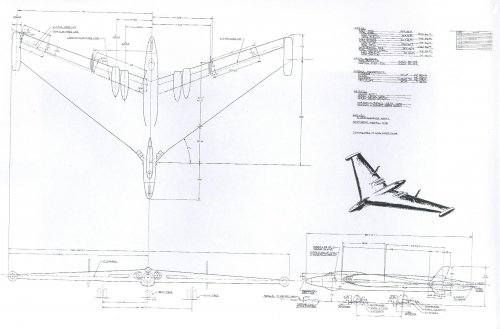
As I mentioned in the post about the EB-35B, Northrop had conceived a transport version of the XB-35 under the N-10 designation, but that project never came to fruition. However, by 1949, thanks to the Berlin airlift having highlighted the importance of strategic heavy airlift, Northrop returned to adapting the N-9 series for used as strategic airlifters, this time proposing a spree of flying wing airlifter designs powered by turboprop engines. One Northrop flying wing airlifter design dated April 27, 1949 had the same wingspan and outer wing panels as the B-35 and B-49 but was powered by two Allison T40 turboprops and had a raised center section housing a 75-foot long cargo pod that could accommodate either 84 combat troops or a bombardment crew and nuclear weapons (drawings in Chong, p. 69, and Cox & Kaston, p. 174). An alternative airlifter design, powered by two Northrop XT37 turboprops, retained the flat wing profile and wingspan of the N-9 development lineage and was to carry two cargo pods outboard of the T37 turboprops. Northrop's designs for cargo flying wings for the commercial market were basically based on the N-31 medium bomber design in terms of a forward fuselage section protruding from the wing and came in two iterations, one powered by four Allison T40s and another with two T37s. The Northrop commercial flying wing freighters dispensed with the external pods for cargo carriage and instead relied on hauling transit vans and they both had a cruising speed of 380-400 mph (612-644 km/h) as well as a higher aspect ratio wing to deliver greater fuel economy and range (Cox and Kaston, pp. 175-176). The T40-powered flying wing freighter was 102 feet 9 inches (31.32 meters) long with a wingspan of 184 feet 2 inches (56.11 meters), a wing area of 5,018 square feet (466.68 sq. meters), and a payload of 70,000 pounds (31,751.5 kg). The Turbodyne-powered proposal would have had the same wingspan as the B-35 and B-49 but with a slightly longer fuselage measuring 80 feet 2 inches (24.43 meters) in length, and it was to carry a payload of 66,000 pounds (29,940 kg).

Despite a marketing blitz by the Northrop Corporation trumpeting the advantages of its commercial and military cargo flying wing designs, unsurprisingly, neither the US Air Force nor the civil aviation industry had any genuine interest in these flying wing projects. And if minimal customer interest weren't enough, the Allison T40 turboprop that would have powered the four-engine Northrop flying wing transport proposals was beset by teething troubles and proved to be a complete engineering failure when it came to usage on several aircraft it powered, including the Convair P5Y and R3Y Tradewind flying boats, Douglas A2D Skyshark attack aircraft, Republic XF-84H Thunderscreech, and North American XA2J Super Savage prototype carrier-based strategic bomber. Nevertheless, the design philosophy embodied by Northrop commercial flying wing freighter designs of 1949-1950 lives on in the many designs for flying wing and blended wing body designs that have been worked on (and continue to be investigated) since the late 1970s by Boeing, Lockheed Martin, McDonnell Douglas, and Northrop Grumman.

References:

Chong, T., 2016. Flying Wings & Radical Things: Northrop's Secret Aerospace Projects & Concepts 1939-1994. Forest Lake, MN: Specialty Press. 

Cox, G., and Kaston, C., 2019. American Secret Projects 2: U.S. Airlifters 1941 to 1961. Manchester, UK: Crécy Publishing.

Little-known Northrop flying wings of 1940s-early 1950s, part 2: N-31 medium bomber

In the first part of a trio of posts discussing little-known Northrop designs for large flying wing aircraft, I discussed in detail Northrop's scheme to convert a YB-35 airframe under construction into a testbed for the Northrop XT37-NA-3 turboprop engine under the designation EB-35B, considering how Northrop touted the EB-35B as potentially leading to a fuel-efficient gas turbine-powered B-35 derivative with greater range than the jet-powered B-49. However, even though the United States Air Force cancelled the B-49 program in 1949, the Northrop Corporation continued to look into designs for advanced flying wing bombers in hopes of remedying the shortcomings of the jet-powered YB-49.

The first advanced Northrop combat flying wing from the 1940s-early 1950s interval that is worthy of discussion is the N-31 medium bomber. Even before the second YB-49 crashed over Muroc Dry Lake in June 1948, Northrop was starting to realize that it would have to start anew with novel flying wing bomber designs that could theoretically correct problems inherent in earlier Northrop flying wings like the B-35 and B-49 if it hoped to convince the US Air Force of the viability of flying wing bombers. With the Soviet Union having detonated its first nuclear weapon in present-day Kazakhstan in August 1949, Northrop was eager to develop a flying wing bomber with a bomb bay big enough to carry America's available nuclear weapons and ultimately the in-development hydrogen bomb. Multiple flying wing bomber and reconnaissance designs with either turbojet or turboprop engines were investigated under the N-31 company designation with two, four, or six engines.

Image result for northrop n-31 flying wing"
3-view drawing of the Westinghouse J40-powered N-31, with accompanying specification at the top right corner

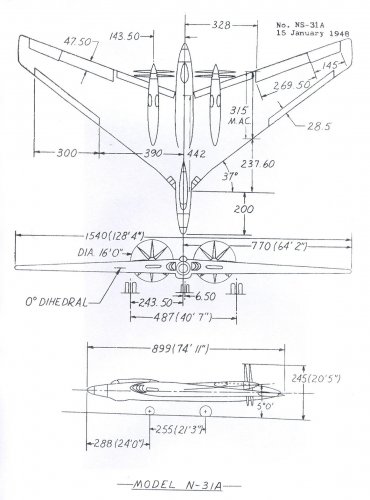
The first flying wing bomber design studied under the N-31 label was a strategic bomber powered by six Westinghouse J40-WE-6 turbojets (each with 7,500 pounds of thrust), conceived in February 1947. It was similar to the YB-49, YRB-49A, RB-49, and EB-35B in featuring vertical stabilizers on the trailing edge of the wing, but differed in having a blended wing body layout with a forward fuselage section reminiscent of the delta-wing Avro Vulcan bomber. The arrangement of the turbojets in the turbojet-powered N-31 design iteration was quite unorthodox; four of the J40s were buried between the center section of the aircraft and the vertical stabilizers, but the other two were placed on the wingtips. The jet N-31 design had a wingspan of 128 feet 4 inches (39.11 meters) and a length of 74 feet 11 inches (22.83 meters), with a crew of five and provisions for twin 20 mm cannons (0.50 caliber) in nose and tail barrel turrets. It was intended to have a combat radius of 2,022 miles (3,254 km) with a 10,000-pound bomb load, a cruising speed of 502 mph (808 km/h), and a top speed of 608 mph (978 km/h).

Image result for northrop n-31"
3-view drawing from Northrop company documents of N-31A design with two Allison T40 turboprop engines. Note the absence of upright vertical stabilizers.

The N-31A design (envisaged January 1948) had the same wingspan, length, armament, gross weight, and wing sweep and baseline N-31, but returned to some aspects of the design layout of the XB-35, especially the lack of vertical stabilizers, and it was powered by two 7,500 hp Allison T40 turboprops, possessing an operational range of 2,600 miles (4,441 km) with a 10,000-pound bomb load. The N-31B, would have been similar to the baseline N-31 but with an all-wing configuration and just the four wing-mounted turbojets, while the N-31C proposed in late April 1948 would have had two Turbodyne T37s, and the N-31F was to be a a photo-reconnaissance derivative of the N-31B (see Buttler 2010, pp. 19-20, for more details). In May 1950, two additional N-31A proposals were conceived, one with two 10,000 hp Turbodyne T37 turboprops each driving six-bladed counter-rotating propellers, a cruising speed of 500 mph (804 km/h), a top speed of 518 mph (833 km/h), a range of 2,760 miles (4,441 km) when unrefueled or 5,580 miles (8,980 km) when refueled, an empty weight of 161,540 pounds (73,227 kg), a gross weight of 222,710 pounds (101,019 kg), and a maximum altitude of 43,000 feet (13,106 meters), and another with four T40s each driving six-bladed counter-rotating propellers, an empty weight of 175,400 pounds (79,560 kg), a gross weight of 212,000 pounds (96,206 kg), a cruising speed of 506 mph (814 km/h), and an altitude of 37,000 feet (11,277 meters) (Rose 2010, p. 84). The combat radius of the T40-powered design when unrefueled was similar to that of the T37-powered proposal but had lower range with in-flight refueling were lower (4,027 miles for Allison-powered version vs. 5,580 miles for T37-powered design). 

But the N-31 was all for naught, despite offering potential remedies to the stability and range problems that made the YB-49 unsuitable as a bombing platform and ineligible to carry large nuclear and thermonuclear weapons. Continued concerns about longitudinal instability of flying wings combined with evolving air defense priorities meant that the N-31 was never green-lighted for full-scale development by the US Air Force, so it remained a paper project only.
   
References:

Buttler, T., 2010. American Secret Projects: Bombers, Attack, and Anti-Submarine Aircraft 1945-1974. Hersham, UK: Ian Allan Publishing.

Chong, T., 2016. Flying Wings & Radical Things: Northrop's Secret Aerospace Projects & Concepts 1939-1994. Forest Lake, MN: Specialty Press.

Rose, B., 2010. Secret Projects: Flying Wings and Tailless AircraftHersham, UK: Ian Allan Publishing.
   

Wednesday, January 1, 2020

Little-known Northrop flying wings of 1940s-early 1950s, part 1: Northrop EB-35B turboprop testbed flying wing

What a better way to start the new year with a blog post about the development of the original flying wing bombers designed by Jack Northrop in the 1940s and early 1950s?  

The story of the original flying bombers designed and built by the Northrop company in the 1940s is well-documented in literature on flying wings and US military aviation in World War 2 and the Cold War, as highlighted by the Northrop XP-79 prototype flying wing fighter and the Northrop B-35 and B-49 flying wing bombers. However, lost in talk regarding the development of the B-35/B-49 flying wing bomber development lineage and large Northrop flying wings in general is the fact that Jack Northrop considered modifying one B-35 airframe for testing his company's homegrown design for a turboprop engine (designation EB-35B) but also flying wing bombers more advanced than B-35 and B-49 as well as passenger/cargo flying wing projects. Tony Chong's recently published book Flying Wings & Radical Things: Northrop's Secret Aerospace Projects & Concepts 1939-1994 (Specialty Press, 2016) has helped to illuminate these little-noticed Northrop flying wings by providing a wealth of previously published and unpublished This post will be the first part of a three-part blog post series about unbuilt Northrop flying wing projects, and intends to touch upon the Northrop B-35 testbed for the Turbodyne XT37 turboprop, the EB-35B.

Beginning in 1939, the newly formed Northrop Corporation in Hawthorne, California, began a private venture aimed at developing a turboprop engine, and in 1941 the company was awarded a joint US Army/US Navy contract for design, analysis, and fabrication of a prototype turboprop engine, the Turbodyne I (company designation: N-10). (The contract was eventually amended to cover the construction of two turboprop prototypes.) The Turbodyne I Given its lack of experience in making aircraft engines with its nascent financial resources, Northrop formed a joint venture with the Joshua Hendy Iron Works of Sunnyvale, California, the Northrop-Hendy Corporation, to manufacture the Turbodyne I prototypes. The Turbodyne I prototype turboprops were completed on schedule and the engine began test runs in 1944. However, both prototypes failed during test runs and the Navy withdrew from the Turbodyne program in early 1945. Meanwhile, the US Army Air Force awarded Northrop a contract to build a more advanced version of the Turbodyne I under Wright Field Air Material Command designation MX 562, which was to have an output of 4,000 hp at 500 miles per hour. This turboprop engine design, given the company designation N-19 by Northrop, became known by its official designation XT37. The XT37-NA-3 was intended to deliver 10,000 shp.*

*Since this post is only intended to be a systematic treatment of the Northrop EB-35B, I have opted to only give some brief details on the powerplant intended for the Northrop (Turbodyne) XT37 turboprop.

The Northrop (Turbodyne) XT37 turboprop, which was intended to power the EB-35B.

In the late 1940s, with the XB-35 flying wing bomber design already made obsolete by the Jet Age thanks to its use of piston engines, and the jet-powered YB-49 having a lower operating range with a decent bombload than the B-35, Northrop investigated proposals for equipping the B-35 airframe with turboprop propulsion in hopes of combining the range of the B-35 with the speed of the B-49. Given that test runs of the latest version of the XT37 found the engine to approach the expected 10,000 shp output, the United States Air Force saw the XT37-NA-3 as a potentially fuel-efficient alternative to the turbojet, so on November 1, 1948, a contract was issued authorizing conversion of the first XB-35 prototype to a testbed for the XT37 under the designation ERB-35B (company designation: N-45) (note: the letter "E" stood for "Exempt", not "Electronic"). The proposed conversion of the first XB-35 to ERB-35B configuration entailed replacing four of the eight buried Allison J35s with two XT37s and placing two of the eight J35s in pods under the wings; the propellers for the XT37s would be mounted in pusher configuration, and the engine inlets were to protrude from the leading edge of the center section of the aircraft. After the Air Force cancelled its production contract for the RB-49 photo-reconnaissance version of the YB-49 on January 14, 1949, the November 1948 contract was emended whereby the XB-35 was to be salvaged, the ERB-35B was redesignated EB-35B, and the last YB-35 airframe (serial number 42-102378) was earmarked for conversion to the EB-35B. Northrop planned to have the EB-35B conduct the first 30 hours of its flight testing with one XT37 installed, with a later scheme to have the EB-35B fitted with both XT37s during the next 30 flight testing hours (Chong, p. 60).

The EB-35B was not the only iteration of the B-35/B-49 development lineage that was contemplated by Northrop to be fitted with Turbodyne turboprops. One design iteration of the planned RB-49, the RB-49C (company designation: N-37B), was to have two XT-37-NA-3 turboprops alongside two General Electric J47 turbojets, and Northrop envisaged additional variants of the RB-49 using the XT37-NA-3 turboprop under the company designations N-46 and N-47. However, none of these studies progressed beyond the design phase.

Top: 3-view drawing of the Northrop EB-35B testbed for the Northrop XT37 turboprop engine.
 Bottom left: Northrop EB-35B under construction at Northrop plant in Hawthorne, California, October 27, 1949.
Bottom right: Desktop model of the Northrop EB-35B at the Planes of Fame Museum, Chino, California.

Unfortunately, the EB-35B, despite potentially offering the promise of a gas turbine powered derivative of the B-35 with greater range than the B-49, was not to be. On March 30, 1950, the EB-35B was nearing completion at the Northrop plant in Hawthorne when the USAF ordered the EB-35B to be scrapped, presumably concerned that the EB-35B might be plagued by the same vibration troubles with the long propeller shafts that had bedeviled the XB-35 during flights. Despite offers from Northrop employees to have the EB-35B completed just for the sake of testing the XT37 in flight, Jack Northrop declined that suggestion because he knew the Air Force would not be happy if the EB-35B were not broken for scrap. Consequently, the EB-35B was destroyed by the breaker's torch without ever having had the chance to fly. As the EB-35B was consigned to California aviation history's dustbin, so was the Turbodyne, for in September 1950 Northrop sold the designs and patents for the Turbodyne engine to General Electric.

In an interesting footnote to this post, Chong (2016, pp. 27-28) notes that the N-10 designation allocated to the Turbodyne I turboprop was also used for a Northrop design for a cargo flying wing looking like a scaled down XB-35 with a wingspan of 114 feet and a crew of four (pilot, co-pilot, navigator, loadmaster). The N-10 flying wing project had flaps running the full length of the wing from the outboard of the propeller shaft nacelles to the wingtips, and cargo bay doors might have slid or dropped open to allow for cargo to be loaded into or unloaded from the cargo bay of the aircraft. It is unclear why the N-10 designation was re-used for Northrop's cargo flying wing proposal; Chong (p. 28) suggests that Northrop conceived this design for the 1941 USAAC/USAAF transport competition but never submitted it as a bid and instead supplanted it with the Navy Turbodyne contract.

References:

Chong, T., 2016. Flying Wings & Radical Things: Northrop's Secret Aerospace Projects & Concepts 1939-1994. Forest Lake, MN: Specialty Press.

Saturday, December 7, 2019

Takeaways from visit to Yanks Air Museum in July 2016, part 2: Starfighter Hangar

In the first part of my discussion of my July 2016 visit to the Yanks Air Museum, I talked about the planes on display in the Legends Hangar of the museum that were built in Southern California before and during World War II, with huge emphasis on displayed aircraft built by North American Aviation. Considering that Douglas, North American Aviation, and Convair led the way in warplane production in Southern California after World War Two, I found it plausible that the Starfighter Hangar of the Museum might contain jet aircraft from the Cold War era, including the A-4 Skyhawk and F-86 Sabre. As luck would have it, this section of the museum contained a number of familiar Cold War planes built in Southern California, including the F-86 Sabre and F-5 Tiger II.

Left: North American FJ-1 Fury BuAer No. 120349; Right: North American F-86E Sabre (built by Canadair as CL-13) RCAF 23682 (painted in USAF livery)

One of the most familiar sights inside the Starfighter Hangar was the presence of two virtually similar jet fighters built by North American Aviation of Inglewood, California, the straight-wing FJ-1 Fury and backswept wing F-86 Sabre. Just as the Mustang was North American's most famous product of World War II, the F-86 Sabre itself was destined to make its mark on the Korean War, striking fear into the hearts of MiG-15 pilots. When noting similarities in the fuselage and tail empennage of the FJ-1 Fury and F-86 Sabre, it is noteworthy that the F-86 design was originally a straight-wing combat jet design like the US Navy's FJ-1 (33 built), itself one of the earliest US Navy jet fighters. However, when learning of captured wartime German aeronautical research indicating that swept wings were crucial for supersonic flight in order to delay the buildup of air in front of a plane's wings in near-supersonic conditions, North American had the original Sabre design revised to incorporate backswept wings, and the F-86 flew on October 1, 1947. During the Korean War, F-86 Sabres were credited with shooting down 792 MiGs for a victory ratio of 10:1. In the meantime, the Navy procured Sabre jets under the designations FJ-2, FJ-3, and FJ-4, even though these aircraft differed from the original Fury in the sweptback wing. Odd as it may seem, the F-86 I saw in the Starfighter Hangar was never actually built for the US Air Force, despite being painted in Air Force livery. Instead, it was license-built in Canada by Canadair and delivered to the Royal Canadian Air Force in the 1950s bearing the RCAF serial 23682, before being later given to the South African Air Force, with which it served until 1979.


Left: Republic of China Air Force (RoCAF) Northrop F-5 Tiger II at Yanks Air Museum Starfighter Hangar
Right: RoCAF F-5 Tiger II on takeoff.

Another interesting sight at the Starfighter Hangar that I glanced upon was a Northrop F-5 Tiger II in the markings of the Republic of China Air Force (RoCAF). The Northrop F-5 was designed and built by Northrop in the late 1950s because the United States was concerned about the ability of its Cold War allies in Europe and Asia to defend itself from communist aggression with existing combat jets. The first flight of the F-5 occurred on July 30, 1959, and more than 2,100 aircraft were built for the US and its allies in Europe, Asia, Africa, and the Middle East. The F-5 at the Yanks Air Museum is of the F-5E Tiger II variant, and was delivered to Taiwan in January 1974, serving with the RoCAF for 24 years until July 1998, when it was retired. The F-5E/Fs in use with Taiwan were locally manufactured by the Aerospace Industrial Development Corporation (AIDC), and 308 Tiger IIs were built in Taiwan. The F-5 is still in use with a small number of countries like Brazil and Iran, even though it no longer serves many longstanding US allies.

Convair F-106B Delta Dart serial number 57-2513 at Yanks Air Museum

One last important exhibit at the Starfighter Hangar that is worth discussing is the Convair F-106 Delta Dart. An improved version of the F-102 Delta Dagger, the first delta-wing jet aircraft built for the US Air Force, the F-106 Delta Dart differed from the Delta Dagger in having a Pratt & Whitney J75 turbojet, a vertical stabilizer with a squared-off upper edge, a slightly bigger wing, and more powerful interception radar. It first flew on December 26, 1956 and it gradually supplanted the F-102 Delta Dart as the primary American long-range interceptor, and like the F-102, was tasked with protecting US skies from armadas of Soviet strategic bombers like the Tupolev Tu-95 'Bear', Tupolev Tu-16 'Badger', and Myasishchev M-4 'Bison'. Unlike the Delta Dagger, however, the F-106 was not as mass produced, with only 342 built. The F-106 on display at the Yanks Air Museum is of the two-seat B variant, which was slightly less heavy and had a better area ruled fuselage. F-106 Delta Darts would serve with the USAF until 1988, when they were replaced by F-15 Eagles. Several F-106s were converted to drones under the designation QF-106, and NASA used six in its Eclipse Project of 1997-1998, which aimed to test the feasibility of an Aerotow-launch vehicle.

Friday, November 29, 2019

Takeaways from visit to Yanks Air Museum in July 2016, part 1: Legends Hangar

One day in July 2016, me and my dad made plans to go to the Planes of Fame Museum in Chino, California. One interesting aspect of the museum that made me want to go there was that it preserves the earliest American jet engine ever designed and built, the Lockheed L-1000 turbojet. When we left Newport Coast bound for Chino, we were excited to go inside the museum. However, things turned haywire when we accidentally went to a different aviation museum in Chino, the Yanks Air Museum. As we went inside the museum, we were kind of stunned to see a wide variety of planes built in the United States. Therefore, I wanted to give an account of the planes built in Southern California on display at the Yanks Air Museum. This post focuses on the first part of my tour at the Yanks Air Museum, in the Legends Hangar.

During the first leg of my first trip to the Yanks Air Museum, I took a tour of all American aircraft designed and built in the 1900-1920 period and the Golden Age of Aviation. It's common knowledge that most US aircraft manufacturing during the first two decades of powered flight took place on the east coast but also in Ohio, but the Loughead brothers Alan and Malcolm set up the first aviation company along the West Coas tin San Francisco, in 1912, paving the way for men like William Boeing and Donald Douglas to establish an aircraft manufacturing base on the Pacific Coast. Off all the planes from the hangar covering the early aviation period and Golden Age of Aviation, there was only one plane from this era built in southern California, the Ryan B-1 Brougham. 


Ryan B-1 Brougham NC1159 (top); Ryan B-1 Brougham NC6956 at the Yanks Air Museum (bottom) 

The B-1 Brougham was a high-wing monoplane airliner similar in most respects to the Ryan Aeronautical Company's M-1 mailplane, but it differed from the M-1 in that it had a fully enclosed cabin for both the pilot and the passengers. Early Broughams, including the B-1 variant I saw on display at the Yanks Air Museum, used a Wright J-5 Whirlwind, but the later B-5 and B-7 used a Wright J-6 and Pratt & Whitney Wasp engine respectively. A total of 212 Broughams were built, and they served small US airlines as well as foreign countries like China, Guatemala, Mexico, and El Salvador. One Brougham was used by John Moncrieff and George Hood in their ill-fated January 1928 attempt to cross the Tasman Straits between southern Australia and Tasmania.  


Side front view (left) and oblique rear view (right) of North American B-25J Mitchell serial number 44-86791


The Legends Hangar containing WW2 aircraft was, in my view, quite ubiquitous for containing military planes built in Southern California during the war. One interesting aspect of the WW2 planes that I saw on display in this hangar is that three of them that were made in Southern California were built by Inglewood-based North American Aviation: the P-51 Mustang fighter and B-25 Mitchell medium bomber. The B-25 Mitchell was made famous by the April 1942 Doolittle Raid on Tokyo, and it bore the name of General William "Billy" Mitchell (1879-1936), an early advocate of American airpower. The B-25 Mitchell medium bomber I saw on display was built three years after the Doolittle Raid and given the serial number 44-86791. It was purchased by Ace Smelting of Phoenix, Arizona, in May 1959, and later was used by civil operators in Fairbanks, Alaska.

Front side view (left) and front view (right) of P-51D Mustang Miss Judy (serial number 44-74910)
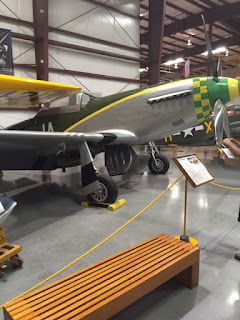
The P-51 Mustang, on the other hand, was the best-ever USAAF fighter plane of World War 2, with over 15,000 produced and 287 fighter aces having flown the Mustang. Early P-51s had an Allison V-1710 piston engine, but the V-1710 itself proved woefully inadequate at high altitudes, so all subsequent P-51 production versions were fitted with a Packard-built version of the Rolls-Royce Merlin (designated V-1650). The P-51 Mustang I saw during my July 2016 tour of the Legends Hangar was of the P-51D variant, which, like the B and C versions had the Merlin engine but sported a new cockpit canopy. The P-51D was the most mass-produced P-51 version, with 8,200 built (6,600 at Inglewood, 1,600 in Dallas, Texas).

North American SNJ-5 Texan BuAer No.43771 at Legends Hangar

The third airplane built by North American Aviation that caught my eye at the Legends Hangar was the North American AT-6/SNJ/T-6 Texan. Known to the British as the Harvard (in accordance with the Royal Air Force tendency to name trainers after academic institutions [Note: American trainers were named for American academic institutions by the RAF]), the Texan was the most mass-produced and widely used Allied trainer aircraft of World War 2, with a total of 15,495 aircraft built for the US Army Air Force, US Navy, and the armed forces of the British Commonwealth. Given that the Army Air Force and Navy had different designation systems for their aircraft, the Texan was designated BC-1, BC-2, AT-6, and AT-16 by the USAAF, and the SNJ and TJ by the Navy. The Texan trainer I saw at the Legends Hangar was of the SNJ-5 version, of which 1,357 were built. 

A P-38L Lightning (serial number 44-27183), later converted to F-5G configuration, photographed by me in the Legends Hangar of the Yanks Air Museum on July 10, 2016.

The Lockheed P-38 Lightning on display in the Legends Hangar has a superfluous operational history. Bearing the serial number 44-27183 and christened 23 Skidoo, it was built as a P-38L, the most mass-produced P-38 variant, of which 3,923 aircraft were built (113 made by Vultee). Photo-reconnaissance versions of the P-38 Lightning (designated F-4 and F-5 by the US Army Air Force) were used for reconnaissance flights in the European and Pacific theaters of World War II, and the P-38L with serial number 44-27183 was one of an unknown number of P-38Ls converted to the F-5G variant, which differed from the F-5F (also a reconnaissance conversion of the P-38L) in having revised nose contours to provide extra space for photographic equipment and a wider selection of cameras. After World War II, it was used for aerial survey of the North Pole by Kargl Aerial Surveys, Mark Hurd Aerial Surveys, Pacific Aerial Surveys, and the Aero Exploration Company, operating in this capacity until the 1970s. In the late 1980s, this aircraft was donated to the Yanks Air Museum, where it remains on static display to this day. 

Thursday, May 23, 2019

Reflections from visit to San Diego Aerospace Museum, September 2017

I have long known that San Diego was the home of Consolidated Aircraft, later Convair, which built some of America's strategic bombers, flying boats, jet interceptors, and space rockets and missiles during World War II and the Cold War. However, even though San Diego has its own aerospace museum, the San Diego Aerospace Museum, I did not visit the museum until the summer of 2011. I've gone to the museum again since a number of times, most recently in September 2017. Therefore, I wanted to discuss highlights from my last visit to the SDAM as they relate to aviation development in Southern California, including San Diego.


Top: Convair YF2Y-1 Sea Dart (BuNo 135763) flanking entrance to San Diego Aerospace Museum
Bottom: Convair XF2Y-1 Sea Dart during flight testing in San Diego Bay 

The most noticeable sight that I've noticed as I walk into the San Diego Aerospace Museum is a pair of planes mounted on pedestals -- a Convair F2Y Sea Dart seaplane fighter and a Lockheed A-12 spy plane. While the A-12 is better known as the precursor of the famous SR-71 Blackbird, the F2Y Sea Dart is quite notable as one of a few designs in the world for a seaplane jet fighter. The F2Y was conceived in the early years of the Cold War in response to a US Navy requirement for a supersonic seaplane fighter, largely in response to whether supersonic aircraft could be made to operate from carriers. Convair specialized in the design of delta-wing aircraft, namely the XF-92, F-102 Delta Dagger, F-106 Delta Dart, and B-58 Hustler, and the design philosophy for these aircraft was carried over to the new seaplane fighter, designated F2Y (FY was allocated to Convair's tail-sitting VTOL fighter). The Sea Dart first flew on January 14, 1953, and flight tests were conducted involving various ski configurations, including a single-ski configuration. The F2Y became the first (and only) seaplane fighter to go supersonic, with the first YF2Y (BuNo 135762) breaking the sound barrier on August 3, 1954 in a shallow dive. However, this aircraft was tragically lost in an accident on November 4 while carrying out flight demonstrations over San Diego Bay, killing test pilot Charles Richbourg. Although an interesting design, the F2Y was cancelled without entering production as the Navy solved problems dealing with operating supersonic jet fighters from large carriers. Nonetheless, the Sea Dart remains a valuable piece of aviation heritage from San Diego because it was the only US jet fighter built to operate from water.


Northrop Grumman MQ-8B Fire Scout unmanned rotorcraft and RQ-4 Global Hawk long-range, high-altitude UAV on display inside San Diego Aerospace Museum. A Ryan B-5 Brougham and BQM-74F Chukar III drone are in the foreground.

San Diego is also home to General Atomics, which has manufactured the Predator and Reaper drones that have been used since 9/11 to take out terrorists in Yemen, Afghanistan, and other hotspots in the fight against Islamic extremism, and the museum has a Predator drone on display, but it also features unmanned aircraft built by the Northrop Grumman Corporation, whose aerospace division is located in southern California. The RQ-4 Global Hawk long-endurance UAV (first developed by Teledyne Ryan before that company was acquired by Northrop Grumman in 1999) is the most prolific high-altitude surveillance drone in service with the Air Force,  relying on synthetic aperture radar and sensors to spy on enemy territory over an area of 40,000 square miles at an altitude of 60,000 feet. It first flew on February 28, 1998, and during service tests flew surveillance missions over Afghanistan in the early stages of Operation Enduring Freedom; Global Hawks have since overflown not only Afghanistan but also the Middle East. The Navy has adapted the Global Hawk for use as an ocean reconnaissance platform, the MQ-4C Triton, which complements P-8 Poseidon patrol aircraft over high seas. Another Northrop Grumman drone at the museum that struck me was the MQ-8 Fire Scout unmanned rotorcraft. The MQ-8 is one of a growing fleet of unmanned air vehicles designed to take off and land like a helicopter, and it is widely used for reconnaissance, situational awareness, and aerial fire & support and precision targeting support for air, sea, and land forces. Based on the Schweizer 330 helicopter, it first flew in 2000 and has become the premier US Navy unmanned rotorcraft; the MQ-8C version is based on the Bell 407 and has enhanced range, endurance, and payload capacity.

Although the Ryan NYP (Spirit of St. Louis) is best known for being flown by Charles Lindbergh in 1927 to accomplish the first solo transatlantic flight from New York to Paris, it is noteworthy to point out that the NYP shares its design heritage with another plane built by the Ryan Aeronautical Corporation based in San Diego, the B-5 Brougham. The B-5, like the NYP, was a high-wing, strut-braced monoplane of all-metal design, but was used as an airliner. The Ryan company would later go on to build a number of airplanes, including the Navion light aircraft, ST sports aircraft, PT-22 Recruit trainer, and FR Fireball and F2R Dark Shark mixed power fighters, but the most well-known flying machine built by the Ryan company after 1945 was the Firebee, of which over 7,000 were built. Firebee drones were used for reconnaissance over Vietnam (AQM-34/Model 147 variant), being launched from DC-130 drone control aircraft. The Firebee drone on display at the SDAM is the supersonic BQM-34F, which could fly at Mach 1.5 and flew in 1972. The supersonic Firebees were retired in 1990, but some subsonic BQM-34 drones continued to serve in the early 2000s, seeing combat in the Iraq War, although they have since been replaced by the newer BQM-167 Skeeter drone. Teledyne Ryan was absorbed by Northrop Grumman in 1999.


North American P-51D Mustang "Bunnie" s/n 44-73683 in WW2 gallery (left) and Douglas A-4B Skyhawk BuNo 142905 in Modern Age gallery (right). 

Although much of the display halls in the annular section of the SDAM feature aircraft from the dawn of flight, WW1, and the Golden Age, my tour of the WW2 gallery and Modern Age gallery offered me sights of a handful of planes built in southern California in the World War II and Cold War periods. The P-51 Mustang that I saw is one of the most recognizable exhibits in the WW2 gallery because it was the quintessential American fighter plane of World War II, with over 10,000 aircraft produced. Designed by Edgar Schmued (1899-1985) and flown in 1940, the P-51 was second to the Grumman F6F Hellcat in the number of Axis aircraft destroyed by the Allies (4.950 planes destroyed by the P-51 vs. 5,223 destroyed by the Hellcat). Early versions of the Mustang (including the A-36 Apache ground attack variant) more powerful Rolls-Royce Merlin piston engine as the Royal Air Force judged the V-1710 to handicap the Mustang's performance in high-altitude combat operations. The Douglas A-4 Skyhawk (originally A4D) was quite interesting because it was the most prolific attack aircraft design of American aircraft designer Ed Heinemann (1908-1991) after the SBD Dauntless and AD/A-1 Skyraider. Nicknamed the "Hot Rod", the Skyhawk flew in 1954 and served as the Navy's lightweight attack aircraft until the arrival of the A-7 Corsair II in the late 1960s, with 2,960 built. The Skyhawk no longer serves with its country of origin, but still flies with the Argentine Air Force and the Brazilian Navy.


Gallery of Convair aircraft and desktop models of an Atlas ICBM (left), F-106 Delta Dart (middle), and B-24 Liberator (right)

One of the interesting sights I encountered in the museum hall was a display of the history of Convair, including models of Convair products and photos highlighting Convair's heyday as an aerospace company and some little-known Convair products. The B-24 Liberator stands out as the best-known Convair product of WW2 because it was more mass-produced than the B-17, while the F-102 and F-106 epitomized the Air Defense Command's efforts to defend the US mainland from Soviet bombers. The Atlas ICBM (originally designated SM-65, later CGM/HGM-16) was the first American ICBM ever built, but its career as a missile was brief compared to the Titan and Minuteman, so it ended up as a space launch vehicle for most of its career, launching the first American into orbit (John Glenn) and ferrying a plethora of spacecraft into space including reconnaissance satellites, interplanetary probes, and weather and navigation satellites. I happened to notice a photo in the display of the Convair YB-60, a jet-powered derivative of the giant B-36 Peacemaker intercontinental bomber that served as Convair's rival to the B-52 Stratofortress. The YB-60 was judged inferior to the B-52 in speed and the Boeing ship was chosen for production, freeing Convair to develop the first American supersonic bomber, the B-58 Hustler.


Consolidated PBY-5A Catalina on display at Edwin D. McKellar Pavilion of Flight (left); Catalina flying boat on patrol over North Atlantic, early 1940s (right).

While taking a tour of the Edwin D. McKellar Pavilion of Flight, I came upon a Consolidated PBY Catalina flying boat mounted on a pedestal. The flying boat impressed me, especially with the nature of the landing mechanism and the wing arrangement. The PBY Catalina was the most widely used American flying boat of World War II, with over 3,300 built, and Catalinas played a vital role in the fight against "wolfpacks" of German U-boats in the North Atlantic and patrolled the Atlantic and Pacific Oceans in the war. The PBY-5 I saw was the most mass-produced Catalina version (1,486 built), and the PBY was named in honor of Catalina Island. A number of Catalina flying boats are still in use as waterbomber aircraft designed for firefighting operations.

Supersonic Firebees

The Firebee drone family is unquestionably the most versatile jet-powered unmanned air vehicle family developed and built during the Cold Wa...