Saturday, June 17, 2023

T-28 Trojan: the tricycle propeller-engined flying classroom from Inglewood

The North American Texan that I discussed in a March 2016 post is arguably the most prolific trainer aircraft ever manufactured by North American Aviation, having trained thousands of crewmen to fly technologically complex front-line combat aircraft that served with the militaries of the US and British Commonwealth in World War II. However, North American's production of piston-engine trainers for the US military did not stop with the end of Texan production despite the fact that the Jet Age had come into full swing. During my visits to the Palm Springs Air Museum, I happened to see for the first time in person another piston-powered trainer aircraft built by North America, the T-28 Trojan, and while North American surely made its mark on US combat aviation during the 1950s by manufacturing jet fighters while undertaking development of the XB-70 Valkyrie prototype supersonic bomber, what is sometimes overlooked is the fact that the T-28 not just replaced North American's own Texan as the mainstay of the US Air Force and US Navy's primary training squadrons in the 1950s but also had a secondary role as a light attack aircraft for use in the Vietnam War and by some US allies around the world.

Left: The first XT-28 prototype (serial number 48-1371)
Right: A trio of US Air Force T-28As in flight, 1960

The T-28 Trojan traces its roots back to the North American XSN2J prototype primary trainer (company designation NA-142) design, which was designed in response to a 1945 US Navy requirement for a new trainer to replace the N3N and N2S biplane primary as well as the SNJ Texans and SNV Valiant. The XSN2J first flew on February 10, 1947 and exhibited good performance, but did not enter production due to a tight Navy. Nevertheless, in response to a US Air Force requirement issued in late 1947 for a training aircraft to replace the Texan, a new trainer utilizing some design attributes of the XSN2J was conceived by North American under the company designation NA-159 along with a competing design by Douglas, which were designated XT-28 and XT-30 respectively. Like the XSN2J, the XT-28 had a squared-off vertical stabilizer with a spine at its base but utilized a tricycle landing gear and one Wright R-1300 Cyclone 7 radial engine. After inspection of mockups of the XT-28 and XT-30, in early 1948 the XT-28 was declared the winner of the USAF competition for a Texan replacement, and two XT-28 prototypes (serial numbers 48-1371/1372) were ordered. The first XT-28 prototype flew on September 24, 1949, and the Air Force ordered 266 production examples (serial numbers 49-1491/1756) of the baseline T-28 variant, the T-28A (company designations NA-171, NA-174, and NA-189), which was officially named Trojan in the early 1950s. The T-28A was 32 feet (9.75 meters) long with a wingspan of 40 feet 1 in (12.22 meters), a wing area of 268 square meters (24.90 m2), an empty weight of 5,111 lb (2,318 kg), and a gross weight of 6,759 lb (3,065 kg). Following suitability tests of the T-28A for the advanced training role at the Air Proving Ground at Eglin Air Force Base in Florida by the 3200th Fighter Test Squadron in June 1950 were deemed satisfactory by the US Air Force, production contracts were awarded for an additional 928 T-28As (serial numbers 50-195/319, 51-3463/3796, 51-7482/7891, 52-1186/1242, and 52-3497/3498) in 1950-1952. Deliveries of the T-28A to the Air Training Command began in 1950 and continued until 1953, by which time 1,194 T-28As had been built. The T-28A served a number of USAF training squadrons with the ATC in the mid- to late 1950s, replacing T-6Gs in service, but in 1957 the Air Force began phasing out the T-28A as the Cessna T-37 Tweet jet trainer began entering operational deployment, with retirement of the T-28A completed in the early 1960s, after which some T-28As were transferred to the Air National Guard to assist in proficiency training for squadrons transitioning to jet aircraft, many others were placed in storage or transferred to the air forces of Argentina, Cuba, Dominican Republic, Ecuador, Ethiopia, Mexico, Philippines, Saudi Arabia, South Korea, and Taiwan. In addition, 94 ex-USAF T-28As were given to the US Navy in the early 1960s and reserialled with BuNos 150356/150405, 150692/150716, and 153643/153659.

An early-production T-28B in flight, 1954

Despite having not ordered the XSN2J into production due to a tight fiscal climate in the late 1940s, the US Navy continued shopping for a successor to the SNJ Texan. In 1952, two T-28As (serial numbers 51-7527/7528) were acquired by the Navy for evaluation testing, receiving the BuNos 137636/137637 while being given the company designation NA-199 by North American. Evaluation tests of the T-28A showed that the Trojan required substantial modifications in order to meet Navy training requirements, including airframe strengthening to withstand the “drop-in” landing technique, a more powerful piston engine with a three-bladed propeller for better approach and wave-off characteristics, a hydraulically-operated speed brake in the belly, a fully-castering nosewheel, and a lower profile canopy. In response, North American developed a carrier-based version of the Trojan with a belly-mounted speed brake and one Wright R-1820-9 radial engine driving a three-bladed propeller, the T-28B (company designations NA-200 and NA-219). On September 2, 1952, a Navy contract was signed for 489 T-28Bs (BuNos 137638/137810, 138103/138367, and 140002/140052), and deliveries of the T-28B to the Naval Air Training Command began in 1953, continuing until 1955. The T-28C (company designations NA-226, NA-252, and NA-307) was a T-28B with arrestor hooks, strengthened landing gear, and shorter propellers with wider blades, designed to meet a new US Navy requirement for a carrier-qualification trainer, and in June 1954 production contracts for 372 T-28Cs (BuNos 140053/140077, 140449/140666, 146238/146293, and 154658/154729) were signed. The first flight of the T-28C occurred on September 19, 1955, and deliveries were made to US Navy units from 1956 to 1957; the T-28C batch with BuNos 154658/154729 was canceled before any could be built. The T-28B and T-28C were used for training student aviators at NAS Whiting Field and NAS Saufley Field in Florida as well as NAS Corpus Christi in Texas, and they served NATS units until the early 1980s, when they were retired from service as Beechcraft T-34Cs began reaching Navy training squadrons; before long, in late 1959, T-28Cs used for carrier-qualification training were supplanted in that role by the Lockheed T2V/T-1 SeaStar jet trainer. The Japanese Air Self-Defense Force was the only foreign operator of the T-28B, with one T-28B delivered to the JASDF in 1955 and given the serial number 63-0581; the company designation NA-218 was assigned by North American Aviation to the T-28B for the JASDF.

Top: Two T-28D Nomads (serial numbers 53-8367 and 53-8368, originally BuNos 138112 and 138127 respectively) in South Vietnamese markings during Operation Farm Gate, early 1960s.
Bottom left: Ex-USAF T-28A (serial number 51-3663), one of 148 T-28As converted to T-28S Fennec standard by France, photographed by me at the Palm Springs Air Museum on March 11, 2023.
Bottom right: A T-28S Fennec (ex-USAF T-28A serial number 51-7799) of the French Air Force in flight, 1960

In the late 1950s, with the Algerian National Liberation Front engaging in guerrilla warfare against French colonial rule over Algeria, 148 retired T-28As were sold by Pacific Airmotive (PacAero) in 1959 to France to be modified by Sud-Aviation into the T-28S Fennec counter-insurgency (COIN) aircraft, which had four underwing hardpoints for unguided air-to-surface rockets or 0.50-caliber machine gun pods, and one Wright R-1820-97 supercharged radial engine (thus the letter S in T-28S standing for "supercharged"). The T-28S Fennec was used by the French Air Force for airstrikes  against against Algerian independence fighters from 1959 to 1962, and after Algeria won its independence in 1962, the French Air Force sold most of the Fennec aircraft to other countries, with 65 sold to the Argentine Navy to be converted to the T-28P carrier-based attack aircraft with shortened propeller blades and arrester gear, and 25 given to the Royal Moroccan Air Force; several the Fennecs in service with the Argentine Navy and Royal Moroccan Air Force were transferred to Honduras, Tunisia, and Uruguay. For its part, in the early 1960s, PacAero modified 313 retired T-28s for the counter-insurgency, reconnaissance, search and rescue, and forward air control roles, and when these aircraft were delivered to the US Air Force, they were designated T-28D and christened Nomad. The T-28D had two underwing hardpoints for unguided air-to-surface rockets and other armament; the T-28D-5 sub-variant had ammo pans inside the wings that could be hooked up to hardpoint-mounted gun pods for greater center of gravity and aerodynamics. Three sub-variants of the Nomad differed in the variants of the R-1820 Cyclone engine, the Nomad Mark I with a supercharged R-1820-56S, the Nomad Mark II with one R-1820-76A, and the Nomad Mark III with one R-1820-80. Fairchild Hiller, in the meantime converted 72 T-28Ds to light attack aircraft under the designation AT-28D, fitting them with six underwing hardpoints and the rocket-powered Stanley Yankee ejection seat. The USAF began using its Nomads in combat in Vietnam in the Air Commando role in December 1961 as part of Operation Farm Gate, with the 4400th Combat Crew Training Squadron carrying out airstrikes against Viet Cong targets using trained South Vietnamese pilots. The USAF operated the Nomad until 1964-1965, when it was withdrawn from service and replaced by the A-1E Skyraider due to losses from ground fire and structural failures, and several ex-USAF Nomads were given to the Republic of Vietnam Air Force; various T-28Ds became inducted into the Vietnamese People's Air Force after the fall of Saigon in April 1975 and Vietnam's reunification under Hanoi's control in July 1976. The USAF and the Royal Lao Air Force, Royal Thai Air Force, and Khmer Air Force, in the meantime, used the Nomad for clandestine airstrikes against the Khmer Rouge and Pathet Lao over Cambodia and Laos, and Royal Laotian Air Force T-28Ds fitted with a camera pack behind the wing below the fuselage when used for photo-reconnaissance were called RT-28D. The CIA used the T-28D in secret operations against the Marxist Simba rebellion in the eastern provinces of the Democratic Republic of Congo in the early 1960s, and T-28D and AT-28D also served the air forces of Bolivia, Ethiopia, and Nicaragua in the late 1960s and 1970s, with several Nomads from USAF stocks delivered to those countries. The Hamilton Aircraft Company of Tucson, Arizona, undertook development of a civilian version of the Mark III subvariant of the Nomad, the T-28R Nomair, which had the R-1820-80 engine of the Mark III but had the wingspan increased by 7 feet (2.13 meters) to reduce stalling speed. The T-28R prototype, converted from an ex-USAF T-28A (serial number 50-201), first flew in September 1960 and received an FAA Type Certificate on February 15, 1962; six T-28As (serial numbers 49-1605, 49-1665, 49-1720, 50-202, 50-270, and 50-299) were modified by Hamilton Aircraft as the T-28R-1 Nomair I military trainer for use by Brazil and ten more T-28As were converted to the T-28R-2 Nomair II utility aircraft with provisions for one pilot and two rows of two passengers housed in a cramped cabin that opened from the port side (one T-28R-2 was later sold to a high-altitude photographic company).

The first YAT-28E prototype (serial number 0-21242) during a test flight in 1963. 

Not too long after the Nomad began operations in Vietnam, North American envisaged a derivative of the T-28D with one 2,445 shp (1,823 kW) Lycoming YT55-L-9 turboprop, the NA-284, which was armed with two 0.50 in machine guns and up to 6,000 lb (2,730 kg) of weapons on twelve underwing hardpoints. On September 17, 1962, the US Air Force awarded North American a contract to convert one ex-USAF T-28A (serial number 52-1242) to NA-284 configuration, and the YAT-28E designation was assigned to the NA-284. The first flight of the YAT-28E took place on February 15, 1963, and the first YAT-28E prototype made twelve successful flights before it was lost in accident on March 27 after it went into a flat spin during high G maneuvers, killing North American test pilot George Hoskins. Despite the crash of the first YAT-28E, the US Air Force was so impressed with performance of the aircraft that it authorized the conversion of two more T-28As (serial numbers 51-3786 and 51-3788) to YAT-28Es. The second and third YAT-28E prototypes differed from the first aircraft in having an LW-2 ejection seat, a taller vertical stabilizer, and a reinforced fuselage. The second YAT-28E prototype had a 9 inch (22.86 cm) tall vertical stabilizer, and the third YAT-28E was representative of the design of the proposed production YAT-28E, featuring a redesigned flat-topped cockpit canopy that allowed clearance for the ejection seats and improved rudder control and a slightly taller stabilizer measuring 12 inches (30 cm) high. The second YAT-28E prototype flew on November 15, 1963, and the third aircraft took to the skies in July 1964, but after a joint evaluation with North American of these two aircraft over a timespan of nine months, the US Air Force concluded that further development of the YAT-28E required extensive and costly redesign, and with the advent of the North American OV-10 Bronco and Cessna A-37 Dragonfly, it chose not to order the YAT-28E into production. The second and third YAT-28Es were returned to North American in January 1965 and placed in long-term storage, but when the US Navy began shopping for a new trainer to replace the T-28B and T-28C, North American proposed a navalized version of the YAT-28E, and the third YAT-28E prototype was loaned to the Navy for evaluation tests under a joint Air Force-Navy contract. Evaluation testing of the third YAT-28E by the US Navy began on January 24, 1966 and 27 flights were conducted, but the US Navy in May 1966 pronounced the YAT-28E unsuitable for the training role due to both technical and operational drawbacks, and the proposed navalized YAT-28E never materialized. The second and third YAT-28Es were again put in long-term storage, and they were initially donated to private owners before being given to C&J Aviation in 1999 a dismantled state in Camarillo, southern California; the third YAT-28E currently awaits restoration in Camarillo, while the fuselage and tail empennage of the second YAT-28E have been in storage in a private collection in Port Hueneme since 2014.

As a side note, the T-28 design formed the basis of the AIDC T-CH-1 Chung-Hsing, the first indigenous Chinese trainer to serve with the post-World War II Republic of China Air Force (which relocated to Taiwan after the communist takeover of mainland China in late 1949), which was powered by one Lycoming T53 turboprop and had tricycle landing gear like the Trojan. Fifty-two T-CH-1 trainers were built, and the first prototype flew on November 23, 1973 followed by series production starting in 1976 and continuing until 1981.     

References:

Adcock, A., 1989. T-28 Trojan in Action. Carrollton, TX:: Squadron/Signal Publications Inc. 

Avery, N., 1998. North American Aircraft: 1934–1998, Volume 1. Santa Ana, CA: Narkiewicz-Thompson.

Darke, S.M., 2013. "The North American T-28D". Air-Britain Aeromilitaria 39 (156): 147–155.. 

Hellström, L., 2014. "T-28s in the Congo – Part 1: Stemming The Rebellion". Air-Britain Aeromilitaria  (159): 117–128.

Hellström, L., 2014. "T-28s in the Congo – Part 2: Heyday of the Trojan". Air-Britain Aeromilitaria  40 (160): 147–157.

Hellström, L., 2015. "T-28s in the Congo – Part 3: The Twilight Years". Air-Britain Aeromilitaria 41 (161): 4–17.

Johnson, E.R., 2015. American Military Training Aircraft: Fixed and Rotary-Wing Trainers Since 1916. Jefferson, NC: McFarland & Company.

Thompson, K., 1999. North American Aircraft: 1934–1998 Volume 2. Santa Ana, CA: Narkiewicz-Thompson.

Thursday, April 27, 2023

A-26 Invaders in service with Lynch Air Tankers

When I first went to the Lyon Air Museum, it marked the first time that I saw the Douglas A-26 Invader close air support aircraft in person, and while the A-26 entered service soon enough to see action within the last year of World War II, it saw immensely widespread usage as both a close air support aircraft and counter-insurgency aircraft in the Korean War, Vietnam War, and Bay of Pigs Invasion, not to mention its use in conflicts in Angola, Biafra, Congo, and Indonesia, and it even served with the US Navy as a general utility aircraft and drone launch platform under the designation JD-1. However, most people interested in US combat aircraft from World War II don't think too much about the fact that a few decades after the end of World War II, several examples of the Invader were converted into aerial firefighting aircraft for use by the civilian firefighting company Lynch Air Tankers. Since I've already written about Privateers modified for aerial firefighting, I will devote this post to discussing the use of the A-26 Invader by Lynch Air Tankers during the 1960s to 1990s.   

A Douglas A-26C Invader (serial number 44-35721, civil registration N9425Z) at the Palm Springs Air Museum in Palm Springs, California, photographed by me on March 11, 2023, and painted in the US Navy color scheme seen on many examples of the JD-1 utility variant of the Invader. This aircraft was the first A-26 delivered to Lynch Air Tankers for aerial firefighting.

The founder of Lynch Air Tankers Incorporated, John Dennis "Denny" Lynch, was born in Shelby, Montana, on November 21, 1935. In 1940, his father and uncle founded Lynch Flying Service, and years after earning a private pilot license in 1952, he began working for the air service in the late 1950s. By 1964, Lynch himself created an offshoot of the Lynch Flying Service dedicated to aerial firefighting, Lynch Air Tankers, which was based in Billings, Montana. An A-26C/B-26C previously flown by the US Army Air Force with serial number 44-35721 and allocated the civil registration N9425Z after being sold to the Oregon-based firm Central Oregon Aerial Company was acquired by Lynch Air Tankers in 1966 to be fitted with internal 1,200-gallon fire retardant tanks and assigned the serial number A24 (later changed to 57), beginning aerial firefighting activities that year. Another ex-USAAF Invader, built as an A-26C with serial number 44-35371 and later converted to a TB-26C unarmed trainer before being acquired by the Rock Island Oil & Refining Company in Wichita, Kansas, in 1960, with civil registration N4818E, was sold to Lynch Air Tankers in 1967 and received the company serial A28 (later changed to 58). One ex-USAAF A-26B with serial number 44-34102, which later received the civil registration N4060A, was delivered to Lynch Air Tankers in 1972 with company serial 01, and an ex-French Air Force A-26C (USAAF serial number 44-35425) used in Indochina during the early 1950s followed suit in 1973 with company serial B27 (later changed to 59), while one ex-USAAF Invader with serial number 44-34121 and one retired B-26K Counter-Invader (built as an A-26B with serial number 44-34198, reserialled 64-17679 after conversion to B-26K configuration) were converted to firefighting aircraft by Lynch Air Tankers in 1975 and 1978 respectively. In an interesting footnote, the first two A-26 Invaders to be acquired by Lynch Air Tankers were flown by John Dennis Lynch himself in his role as a stunt pilot during filming of the 1989 movie Always by Steven Spielberg (best known as the director of the Jurassic Park film series and Schindler's List).

An in-flight view of an A-26B Invader aerial firefighting aircraft (ex-USAAF serial number 44-34121, civil registration N4805E) in service with Lynch Air Tankers. Note the Lynch Air Tankers serial number 58 on the vertical stabilizer. 

Although the Invader bombers operating for Lynch Air Tankers played a special role in putting out forest fires in Montana but also other US states with extensive woodlands in their first decade of service with Lynch Air Tankers, they encountered some aerodynamic issues during take-off and landing as well as in flight. To solve these problems, Lynch himself conceived a modified wing section which was also designed for efficient high-speed flight as well as take-off and landing at "hot and high" airfields that were used each summer, since greater angles of attack were achievable during these phases of the flight. The two A-26s that had been acquired by Lynch Air Tankers in the late 1960s and the A-26 with civil registration N4060A were modified in 1975 with leading edge cuff running from the fuselage out to the wingtip and four wing fences across the wing and main body of the aircraft, and these Invaders became known as the Lynch STOL 26. Two other A-26s in use by Lynch Air Tankers which originally bore the USAAF serial numbers 44-35497 and 44-34121 were also modified with this new wing section and converted to STOL 26 standard. One of the first two A-26s converted to STOL 26 configuration, serial number 44-35371, sustained some damage when its nose landing gear while landing at the Lynch Air Tankers headquarters in Billings, Montana, on June 28, 1975, but was eventually repaired and resumed aerial firefighting services with Lynch Air Tankers. The A-26 fleet conducting aerial firefighting while operating with Lynch Air Tankers was kept flying using spare parts from ex-USAAF aircraft and retired Portuguese Air Force Invaders, so two A-26 aircraft were given to Lynch Air Tankers in the late 1970s for use as spare parts airframes to support the company's Invader fleet, an ex-USAAF A-26B with serial number 41-39303 and an ex-French Air Force A-26C (USAAF serial number 44-35439) used by the French in Indochina in the early 1950s. On August 8, 1976, A-26 serial number 59 (originally B27) crashed into a hill during a low-level turn after suppressing a forest fire in the Rocky Mountains near Grand Junction, Colorado, killing its pilot. Consequently, Lynch Air Tankers in 1977 acquired an A-26C firefighting aircraft from Evergreen Air (USAAF serial number 44-35497, civil registration N3426G) as a replacement aircraft, assigning it the company serial number 56; this Invader had been allocated the serial number A17 when it served firefighting duties with Johnson Air Service before that company was acquired by Evergreen Air in 1975, which led to the serial A17 for N3426G being changed to 17. One of A-26s of Lynch Air Tankers that had been modified to Lynch STOL 26 standard, serial number 01 (USAAF serial number 44-34102, civil registration N4060A), crashed into a forest in Hubbard Fork, Kentucky, on March 5, 1983 while fighting forest fires while making an additional turn after having made two runs over the forest fire area, killing the pilot. 

The last firefighting mission involving an A-26 of Lynch Air Tankers took place in 1990, the last-ever operational use of the A-26/B-26 as a firefighting aircraft in US service, and by 1992 Lynch Air Tankers retired its A-26 fleet, including the two aircraft given to the company as spare parts airframe. The A-26 with civil registration N74833 was made airworthy again in 1989 and given to the Evergreen Aviation Museum in McMinnville, Oregon, in March 1990, while the A-26B with serial number 41-39303 was donated to the Pacific Coast Air Museum in Santa Rosa, California, in 1992. The first A-26 Invader to be delivered to Lynch Air Tankers is now on display at the Palm Springs Air Museum in Palm Springs, while the A-26 with civil registration N4818E is currently displayed at the Marine Aviation Museum in Houston, Texas. The only B-26K to be operated by Lynch Air Tankers was sold to the Vintage Flying Museum in Houston in the early 2010s, where it has been restored to airworthy condition (this Invader was involved in minor incident on September 9, 2022 when its landing gear collapsed and a tire blew as the aircraft was landing at Forth Worth Meacham International Airport). Lastly, the A-26 Invaders with serial numbers 44-34121 and 44-35497 were sold to the Canadian aerial firefighting firm Air Spray Limited in the 1990s and early 2000s, receiving the new civil registrations C-GHZM and C-FOVC respectively, although they still retain the Lynch Air Tankers serial numbers on their vertical fins.

As a side note, the ex-Lynch Air Tankers A-26 that I've seen at the Palm Springs Air Museum is painted in one of the US Navy color schemes applied to the JD-1 (redesignated DB/UB-26J after 1962) utility and drone control variant of the A-26 Invader for the US Navy. Although this is paradoxical because no JD-1s are known to survive today, the Palm Springs Air Museum probably found it convenient to apply US Navy markings to the aircraft because the A-26 that was allocated the serial number 57 by Lynch Air Tankers was no longer in service as an aerial firefighting aircraft. As a matter of fact, an A-26B Invader on display at the National Naval Aviation Museum in Pensacola, Florida is also painted in JD-1 guise and marked with the number "446928" on its vertical stabilizer, but was actually allocated the serial number 41-39215 when it was ordered by the US Army Air Force (the serial number 44-46928 in actuality was never allocated to an A-26 but instead belonged to a canceled production contract for the General Motors P-75 Eagle fighter plane). 

References:

Ogden, B., 2007. Aviation Museums and Collections of North America. Tonbridge, UK: Air-Britain.

Thompson, S., 2002. Douglas A-26 and B-26 Invader – Crowood Aviation Series. Marlborough, UK: Crowood Press.

"Lynch flying service." Douglas A/B-26 Invader. https://napoleon130.tripod.com/id368.html. Accessed 27 April 2023.

Monday, February 27, 2023

Rocket-powered target drones from Van Nuys

In my previous post about unmanned air vehicles that I saw at the Western Museum of Flight during my visit there in January 2020, I offered brief details on three Radioplane/Northrop-built UAVs preserved at this museum, the MQM-57 Falconer and MQM-36 Shelduck derivatives of the prolific MQM-33 Quail target drone family, and the NV-144 prototype jet-powered reconnaissance UAV. However, one Radioplane-built UAV on display at the Western Museum of Flight that I virtually overlooked happened to be one of just a handful of rocket-powered UAVs to be designed and built in southern California, the Radioplane AQM-38. Having recently gotten a copy of the book 50 Years of Target Drone Aircraft (published in 1985 by the very company that built many of southern California's most notable 20th century drones besides the Firebee) and done some brief yet painstaking research into the genesis and early development of the AQM-38, I now have the opportunity to dedicate this post to telling the story of rocket-powered unmanned aerial vehicles developed by the Radioplane Division of Northrop in the 1950s.

A trio of XKD4R-1s on their towing platforms at the Naval Air Missile Test Center (NAMTC) in Point Mugu, southern California, January 1957.

In March 1955, Radioplane proposed an air-launched rocket-powered target drone under the company designation RP-70, which used molded plastic in its construction and had a sharply pointed nose, with longitudinal stability provided by three forward control fins (one on top of and two on the sides of the forward fuselage) and a horizontal stabilizer mounted below the ventral vertical stabilizer. Power was provided by a single 37 lb (0.16 kN) thrust Aerojet 530NS35 solid-fuel rocket motor with a burn time of 530 seconds, and the RP-70 had a length of 9 feet 6 in (2.90 meters), a wingspan of 5 feet (1.52 meters), a diameter of 12 inches (30 cm), a weight of 305 lb (138 kg), a top speed of Mach 0.95 and a service ceiling of 60,000 feet (18,300 meters). After launch, the drone would rely on autopilot to remain on a constant heading and altitude for a flight endurance of 9 minutes, with a bright flashing light in the tail utilized to facilitate visual tracking. For recovery, the RP-70 was equipped with a parachute system. The Navy assigned the designation XKD4R-1 to the RP-70, and the first XKD4R-1 drones were built and first flown in late 1956, with deliveries to the Naval Air Missile Test Center (NAMTC) at NAS Point Mugu in January 1957. The main launch platforms for the XKD4R-1 wer the Douglas F3D Skyknight all-weather jet fighter and McDonnell F3H Demon jet fighter, both of which could fly at the subsonic speeds that the XKD4R-1 attained. A handful of XKD4R-1s were manufactured but the drone was not approved for series production despite exhibiting satisfactory performance.

Left: An AQM-38A (RP-76) on display at the Western Museum of Flight, photographed by me on April 17, 2021.
Right: An AQM-38A under the wing pylon of an F-89 Scorpion.

Months before the XKD4R-1 began flight testing, in early 1956 Radioplane proposed a variant of the RP-70 to be used by the US Army for surface-to-air missile training, the RP-76. Despite having the tail empennage, rocket motor, and flight duration of the RP-70, the RP-76 differed in having a blunt nose section to house the Luneberg lens, straight wing/rocket exhaust fairings, and the dorsally mounted forward control fin moved to the underside of the forward fuselage. The Luneberg lens was designed for radar reflectivity augmentation, and the RP-76 also utilized a Northrop RPTA-1 tracking aid system, necessitating elimination of the bright flashing light in the tail developed for the XKD4R. After being launched from an aircraft, the RP-76 was be controlled in flight by autopilot with an optional override by radio command, and recovery of it was done by a two-stage parachute system.  The Army awarded Radioplane a contract for full-scale development of the RP-76 in June 1957, and test flights of RP-76 began in early 1958, with deliveries of service test drones to US Army units commencing later that year, and the first successful hit against an RP-76 by a Nike Ajax surface-to-air missile taking place on September 18, 1958 at the Red Canyon Guided Missile Range near Carrizozo, New Mexico. Series production of the RP-76 began in late 1959, by which time the drone had been cleared for operational service, and launches were conducted from the Northrop F-89 Scorpion all-weather fighter but also the RP-77DL mothership variant of the RP-77D turboprop-powered target drone. 

Left: An AQM-38B (RP-78) under a wing pylon of an F-89 Scorpion, late 1962
Right: An RP-76-4 target drone under a wing pylon of an F-89 Scorpion, circa 1961

In parallel with design of the RP-76, in April 1956 Radioplane envisaged a supersonic variant of the RP-76 for the Air Defense Command of the US Air Force, the RP-78, which had the same airframe and guidance system as the RP-76 but was designed for a top speed of Mach 1.25. The RP-78 had a service ceiling of 78,700 feet (24,000 meters) and a range of 44 miles (70 km), and the top speed and altitude for which for the RP-78 was designed meant that this drone utilized a slightly more powerful solid-fuel rocket motor generating 100 lb (0.44 kN) of thrustThe RP-78 began flight tests in 1960, but by then the US Air Force had lost interest in the RP-78 in favor of the Ryan Firebee, so the US Navy took over the RP-78 program, and the operational deployment of the RP-78 with Navy units commenced in October 1962, with the F-89 being used as the launch platform. Radioplane in April 1960 proposed another supersonic derivative of the RP-76 to be used by the US armed forces and NATO member states in Europe, the RP-76-4, which began test flights in December 1961. The RP-76-4 was 11 feet (3.35 meters) long with a wingspan of 4 feet 4 in (1.32 meters), a top speed of Mach 2.25, a service ceiling of 80,000 feet (24,384 meters), and a 200 lb (0.89 kN) thrust solid-fuel rocket motor. It differed from the RP-76 and RP-78 in having delta wings and a conventional dorsal vertical stabilizer as well as anhedral horizontal stabilizers, and it had an endurance of four minutes over a range of 62 miles (100 km) under rocket power and 30 minutes in controlled glide mode. Over 20 test flights of the RP-76-4 were made by 1964, and despite its stellar flight performance, no production orders for this advanced drone followed. When the US Defense Department introduced a new designation system for missiles, unguided rockets, and drones on June 27, 1963, the RP-76 and RP-78 were designated AQM-38A and AQM-38B respectively (ironically, the RP-78 had not been assigned a Navy designation prior to 1963). Production of the AQM-38 ended in 1968 with more than 2,400 targets built, and the AQM-38 itself remained in operational service until the mid-1970s.

References:

Botzum, R.A., 1985. 50 Years of Target Drone Aircraft. Newbury Park, CA: Northrop Corporation (Ventura Division) Publishing Group.

Taylor, J.W.R., 1963. Jane's All the World's Aircraft 1963-1964. New York, NY: McGraw-Hill.

Taylor, J.W.R., 1965. Jane's All the World's Aircraft 1965-1966. New York, NY: McGraw-Hill.

Tuesday, February 21, 2023

From land-based patrol bomber to firefighter: PB4Y-2s for Hawkins and Powers Aviation

I have long been familiar with the post-World War II use of the Martin JRM Mars giant flying boat as a firefighting aircraft, while reading about how aerial firefighting has come to be one of the many niches of the C-130 Hercules tactical transport in its peacetime non-military capacity, having remembered watching the local news back in June 2002 of the crash of one C-130A firefighting aircraft in Mono County, eastern California. During my visits to the Yanks Air Museum in Chino in the past, I saw a Consolidated PB4Y-2 Privateer languishing in the boneyard section of the museum, the first time I encountered this aircraft in person after seeing photos of this aircraft in several aviation books. While helping Joe Baugher update several webpages about US military aircraft, it transpired to me that a handful of Privateer aircraft were repurposed for use as firefighting aircraft by Hawkins and Powers Aviation not too long after being retired from service with the US Navy. Even though the Hawkins and Powers firefighting company was based in Wyoming, the history of PB4Y-2 operations with this company is worth discussing because the PB4Y-2 was built in San Diego, California, like the B-24 Liberator and PB4Y-1 navalized version of the B-24.

A PB4Y-2 aerial firefighting aircraft (ex-BuNo 59701, civil registration N6884C) in flight over Reno, western Nevada, in 1976. Note the Hawkins & Powers serial number 127 on the nose of the aircraft. 

Several books have been written about the operational career of the PB4Y-2 Privateer in the early 1950s (by which time PB4Y-2s in active service were redesignated P4Y-2 despite the P4Y designation having been applied to the Consolidated Model 31 Corregidor flying boat), but the story of the conversion of a handful of PB4Y-2s to aerial firefighting planes began in 1959, when several PB4Y-2s were declared surplus and earmarked for scrapping in the summer of 1958. The US Navy had retired its PB4Y-2/P4Y-2 fleet from service in 1954, but the US Coast Guard continued to operate several ex-USN Privateers in the search-and-rescue role (designated P4Y-2G) until 1958. In the second half of 1959, eight PB4Y-2 aircraft (BuNos 59701, 59882, 66260, 66261, 66300, 66302, 66304, and 66306) were acquired by aerial firefighting firm Christler & Avery Aviation of Greybull, Wyoming and seven were converted to aerial firefighters, necessitating modification of the bomb bays to carry 18,000 lb (8,164 kg) of fire-retardant chemicals, while the R-1830 Twin Wasp radial piston engines were replaced by Wright R-2600 Twin Cyclones. These aircraft, which were called Super Privateers, had short-stack exhausts which protruded around the circumference of the engine nacelles. The PB4Y-2 with BuNo 66261, while allocated the civil registration N7682C and the serial number 13 by Christler & Avery Aviation, was never converted to aerial firefighting configuration and instead used as a spare parts airframe to support the the PB4Y-2 firefighter fleet, which began firefighting operations in the western US in 1960. Meanwhile, Christler & Avery Aviation changed its name to Avery Aviation in 1961, and it was eventually bought out by Hawkins and Powers Aviation in 1969. The PB4Y-2s with BuNos 59701, 59882, 66260, 66300, 66302,  and 66304 were allocated the new serial numbers 127, 126, 123, 124, 121, and 122 by Hawkins and Powers, which also received one PB4Y-2 with civil registration N6813D (ex-BuNo 59876) that had been previously operated by Cisco Aircraft and another PB4Y-2 with civil registration N6816D (ex-BuNo 59792). Even before the purchase of Avery Aviation by Hawkins and Powers, one PB4Y-2 in use by Avery Aviation with civil registration N7974A (ex-BuNo 66306) was lost in an accident on July 22, 1968, when it hit a mountain near McGrath, Alaska, while en route to a forest fire, killing all four people aboard. 

The PB4Y-2 aerial firefighting aircraft serial number 124 (ex-BuNo 66300, civil registration N2872G) on display in the outdoor storage area of the Yanks Air Museum in Chino, California, photographed by me on May 19, 2018.

The PB4Y-2 aerial firefighter that I've seen at the outdoor storage area of the Yanks Air Museum, BuNo 66300, was one of 710 production PB4Y-2 aircraft (BuNos 66245/66394, 66795/67054, 76839/77138) ordered in late 1944, of which only 80 had been delivered by October 1945, the remainder on order canceled after V-J Day. The PB4Y-2 with BuNo 66300 was delivered to the Navy on August 31, 1945 and later assigned to storage at NAF Litchfield Park in Arizona from November 16, 1945 until August 1949. By the early 1950s, it was transferred to the US Coast Guard for search-and-rescue duties and converted to P4Y-2G configuration, serving in that capacity until 1958, when it was retired from active service with the USCG and transferred to CGAS Elizabeth City in Elizabeth City, North Carolina, for eventual disposal. BuNo 66300 was assigned the civil registration N2872G when sold to Ace Smelting in 1959, but was eventually spared from the breaker's torch along with a few other PB4Y-2s and sent to  Christler & Avery Aviation for conversion to Super Privateer configuration, receiving the serial number B24 and beginning firefighting operations in July 1960. After Hawkins and Powers Aviation acquired Avery Aviation, the aircraft was given the new serial number 124 in 1970, and it was used by the US Forest Service for extinguishing forest fires in and around Fairbanks, Alaska.

PB4Y-2 serial number 123 (ex-BuNo 66260, civil registration N7620C) crashing near Estes Park, Colorado, on July 18, 2002

Although the PB4Y-2s operated by Hawkins and Powers Aviation had success in putting out forest fires in western North America during their three decades of service with Hawkins and Powers Aviation, their operational career was marred by a few accidents. On July 27, 1972, N6816D was destroyed in flight while on approach to Wenatchee-Pangborn Field in Washington after fighting a local forest fire. On July 18, 2002, PB4Y-2 serial number 123 (BuNo 66260, civil registration N7620C) broke up in flight and crashed near Estes Park, Colorado, while fighting a forest fire in Rocky Mountain Regional Park, killing both crewmembers. The other PB4Y-2s operated by Hawkins and Powers Aviation and US Forest Service were withdrawn from operational service due to old age, and by 2005 Hawkins and Powers Aviation ceased operations. Three years later, the PB4Y-2 that had been given the serial number 124 by Hawkins and Powers Aviation was delivered to the Yanks Air Museum on November 23, 2008. It should be noted that PB4Y-2 serial number 122 (BuNo 66304) was damaged beyond repair after veering off the runway during a takeoff roll at Ramona Airport in Ramona, California, on August 27, 1980. The damaged aircraft was mated with remnants of BuNo 66261 and retained BuNo 66304 due to the fact that BuNo 66261 had been in derelict condition for over 20 years, but Hawkins and Powers had no need for any additional operational use of this aircraft, and the rebuilt PB4Y-2 was eventually given to the National Museum of Naval Aviation in Pensacola, Florida, where it resides today.

References:

Carey, A.C., 2005. Consolidated-Vultee PB4Y-2 Privateer: The Operational History of the U.S. Navy's World War II Patrol/Bomber Aircraft. Atglen, PA: Schiffer Publishing.   

Veronico, N.A, and Ginter, S., 2012. Convair PB4Y-2/P4Y-2 Privateer (Naval Fighters Number 93). Simi Valley, CA: Ginter Books.

Friday, January 27, 2023

Gliders from San Diego: the story of the Bowlus Sailplanes Company

The aircraft manufacturers Convair (originally Consolidated, later Consolidated Vultee) and Ryan come to the average aviation historian's mind when it comes to discussing and recording the history of aircraft development in San Diego in the 20th century, no surprise because the Rosie the Riveter mascot originated at the main Convair plant in San Diego and the aircraft used by Charles Lindbergh for his history-making solo transatlantic flight in 1927 was built by Ryan. During a recent visit to the San Diego Air and Space Museum, I happened to learn that San Diego also boasted a glider manufacturer, the Bowlus Sailplanes Company, after learning that one of the aircraft on display there, the Bowlus SP-1 Paperwing (represented at the museum by a replica), was manufactured in San Diego. Since Bowlus Sailplanes deserves the honor of being the first glider manufacturer from California yet is seldom discussed in most published accounts of the San Diego aircraft industry, I am dedicating this post to the history of Bowlus Sailplanes and its aircraft products.

William Hawley Bowlus (1896-1967), founder of the Bowlus Sailplanes Company

The founder of the Bowlus Sailplanes Company, William Hawley Bowlus, was born on May 8, 1896, in the Ohio Township in Bureau County, Illinois. As a teenager, he began his foray into aviation by building homemade gliders, flying them from the hillsides of San Fernando Valley. In 1917, Bowlus joined the US Army Air Service and learned to fly powered aircraft along with T. Claude Ryan (the founder of the Ryan Aeronautical Corporation) after enrolling in the American School of Aviation in Venice, California. When Ryan went to Oregon State College to study engineering after the end of World War I, Bowlus himself quit the USAAS, eventually re-associating with Ryan but also B.F. Mahoney at the new Ryan Aeronautical Company in 1924. As a member of the Ryan company in the 1920s, he was instrumental in design and construction of the Ryan M-1 and M-2 mailplanes for Ryan Airlines, while helping with construction of the NYP (Spirit of St. Louis) used by Charles Lindbergh to fly across the Atlantic Ocean solo in 1927. 

Left: The Bowlus SP-1 sailplane being towed for launch, January 1930.
Right: A replica of the Bowlus SP-1 on display at the San Diego Air and Space Museum.

Buoyed by the success of the Spirit of St. Louis, in 1928 Bowlus undertook design of his sixteenth glider, the SP-1, which had a shoulder-mounted wing and an open cockpit. Construction of the SP-1 was completed in January 1929, and when the aircraft flew for the first time that month, it became the first indigenous American sailplane to fly. The SP-1 had a wingspan of 44 feet (13 meters), an aspect ratio of 11:1, and a wing area of 179 square feet (16.6 m2), and it had an empty weight of 180 lb (81 kg), a gross weight of 305 lb (138 kg), a cruise speed of 22 miles per hour (35 km/h), and a glide ratio of 20:1. Although the SP-1 was largely made from wood and doped fabric, the ring webs of the wings, elevator, and rudder had to be fabricated from craft paper to make the SP-1 as light as possible, hence the aircraft's nickname "Paperwing". William Bowlus piloted the SP-1 in several regional glider meets in southern California, including two at Pacific Beach and one at Redondo Beach, and on October 5, 1929, the SP-1 set a new soaring endurance record when it flew over the cliffs at Point Loma, for 14 minutes and ten seconds. Fourteen days later, on October 19, it became the first American sailplane to attain an endurance of more than one hour when it flew for 1 hour and 21 minutes. Bowlus established the Bowlus Glider School in San Diego to train glider pilots to fly the SP-1, and in 1930, the Bowlus Sailplanes Company  was established. Although just one SP-1 was built, it served as a technology demonstrator for a series of Bowlus glider designs built in the 1930s, including the SP-D, Model A, and S-1000, which differed from the SP-1 in completely utilizing wood and fabric in their construction. The SP-D, Model A, and S-1000 gliders had a wingspan of 60 feet (18.3 meters) and were used by Charles Lindbergh himself and his wife Anne Morrow when obtaining glider licenses in 1930. Of interesting note is the fact that the design philosophy of the SP-1, SP-D, Model A, and S-1000 influenced that of some gliders, particularly the Silver King designed by Harland Ross and the Nighthawk sailplane used by William A. Cocke to set an air endurance record of 21 hours 34 minutes in 1931. The original SP-1 no longer exists, but a replica of this sailplane was built from scratch in the late 1980s and is now on display at the San Diego Air and Space Museum. The S-1000 derived from the SP-1 is displayed at the Wings of History Museum in San Martin, California, and the Nighthawk sailplane was originally placed on display at the Santa Monica Museum of Flying before being moved to the Los Angeles County Museum of Natural History.

A Bowlus BA-100 Baby Albatross in flight, late 1930s.

Elated by the success of its initial glider designs, the Bowlus company built the first American high-performance sailplane, the 1-S-2100 Senior Albatross, which was based on the Super Sailplane with a shoulder-mounted gull wing that was designed by William Bowlus and German glider engineer Martin Schempp and built and flown in Glendale by the Curtiss-Wright Technical Institute in 1932. The wings of the Bowlus 1-S-2100 spanned 61 feet 9 inches (18.82 meters) and had a wing area of 204.75 square feet (19 m2) and aspect ratio of 18.72:1, and the 1-S-2100 itself had an empty weight of 340 lb (154 kg) and a gross weight of 520 lb (236 kg). The Senior Albatross was first flown in 1933, with six 1-S-2100 Senior Albatross sailplanes built, and during the 1930s the Senior Albatross set a number of records for altitude. In the meantime, the Bowlus Sailplanes Company started development of a cheap strut-braced glider design, the Baby Albatross, which had a shoulder-mounted wing like that of the SP-1 and an open cockpit. The wings and horizontal stabilizers of the Baby Albatross were made from wood and covered with fabric, while the tail boom was of all-metal construction and the open cockpit was made of plywood. The baseline version, the single-seat BA-100, first flew in 1937 and a total of 156 Baby Albatross kits were manufactured, with certification occurring in 1938. A two-seat variant of the Baby Albatross, the BA-102, had a slightly longer rear fuselage with two small portal-type windows and with accommodations for a passengers, and three aircraft were built, the first being completed and first flown in 1938. The aerodynamic liability of the Baby Albatross lay in its poor pitch handling characteristics,  the rotation axis of the horizontal tail being located at 35% chord, the horizontal tail rotation hinge having high friction, and the relatively soft pitch axis cable control system storing elastic energy reacting the friction in the tail hinge. With input from aeronautical engineer Irv Culver, the Baby Albatross designed was modified to have the hinge axis moved forward and the pitch control fitted with a downspring. The BS-100 Super Albatross was a mid-wing single-seat glider that combined the fuselage pod and tail boom of the Baby Albatross with the outer wing panels of the Senior Albatross, and like the BA-100, it was of mixed construction, the wings and horizontal stabilizers being made of wood and covered with fabric, and the tail boom being made from metal. The Super Albatros first flew in 1938 but only two examples were manufactured, the first with a mobile horizontal stabilizer and second aircraft with a fixed horizontal stabilizer and flaps.

Left: The XCG-7 prototype (serial number 41-29621) being towed in flight, October 1942.
Right: The sole XCG-8 prototype (serial number 41-29622) at Rogers Dry Lake in the Mojave Desert, 1943. 

Months before the Japanese attack on Pearl Harbor, on April 29, 1941, Bowlus Sailplanes submitted designs for 8- and 15-seat transport gliders in response to a requirement issued in March by the US Army Air Corps (renamed US Army Air Force on June 20) for large gliders capable for carrying troops and war material to the battlefield in anticipation of the moment when the US would enter World War II to help push back against Axis aggression in Europe. The eight-seat design, designated XCG-7, was 53  feet 4 inches (16.26 meters) long with a wingspan of 65 feet (19.81 meters), a wing area of 700 square feet (65 m2), an empty weight of 2,870 lb (1,301 kg), and a gross weight of 4,800 lb (2,177 kg), and could cruise at 120 miles per hour (190 km/h) when towed by a transport plane. The 15-seat design, the XCG-8, was a scaled-up XCG-7 measuring 61 feet (18.6 meters) long with a wingspan of 85 feet 8 inches (26.04 meters), a wing area of 996 square feet (92.5 m2), an empty weight of 3,895 lb (1,767 kg), a gross weight of 6.800 lb (3,084 kg), and a speed of 120 miles per hour (190 km/h) when towed. Both designs featured a podded cabin with a boom aft fuselage and a cruciform tail empennage, and they were primarily made from spruce and birch, while the cantilever wing surfaces had plywood ahead of the spar and fabric behind it, and the fuselage and stabilizers were wrapped in plywood, whereas the movable surfaces used fabric. In late July 1941, one XCG-7 prototype (serial number 41-29621) and one XCG-8 prototype (serial number 41-29622) were ordered along with static test airframes for both designs and a wind tunnel model of the XCG-7. Due to its existing factory being too small for both the XCG-7 and XCG-8 to be manufactured, Bowlus Sailplanes outsourced construction of these gliders to Douglas, which completed the XCG-7 and XCG-8 prototypes at its facility in El Segundo in early 1942. The static test XCG-7 airframe was delivered to Wright Field on February 11, 1942, for loading tests, but it suffered structural failures and repairs to the airframe meant that static tests did not resume until June 16, yet the static test article failed at 40 percent of simulated loadings. Meanwhile, the sole XCG-7 prototype began flight tests on July 15-16, 1942, displaying good handling characteristics and staying aloft in a thermal, and after completing flight tests at Muroc Army Air Base (now Edwards Air Force Base) in early 1943, it was delivered to Wright Field. The XCG-8 static test article was completed in December 1942, and like the XCG-7 static test article failed loading tests as low as 35 percent of the design limit load. The XCG-8 prototype began test flights at El Segundo on March 29-April 1, 1943, and it was subsequently tested at Muroc, after which it was delivered to Wright Field and eventually Clinton County Army Air Field in Wilmington, Ohio. The USAAF decided not to place the XCG-7 or XCG-8 into production due to its commitments to the Waco CG-4, terminating both programs in August 1943. The XCG-7 was eventually tested to destruction on August 25, and the XCG-8 was destroyed in a windstorm at CCAAF on July 17, 1944.

The first and only completed Bowlus XTG-12 training glider (serial number 42-96830) during testing at Twenty-Nine Palms in the late summer of 1942. This aircraft also carried the civil registration NX28386 (visible on the vertical stabilizer).

As full-scale development of the XCG-7 and XCG-8 began, Bowlus Sailplanes envisaged a two-seat trainer derivative of the BA-100 Baby Albatross with a larger cockpit to accommodate men wearing parachutes, known internally as the BM-5. A mockup of the BM-5 was completed in about November 1941, and on April 28, 1942, a contract was awarded for three BM-5 prototypes (serial numbers 42-96830/96832) plus a static test airframe, and the designation XTG-12 was assigned to the BM-5. The first XTG-12 prototype (which also bore the civil registration NX28386) was completed in late spring and began flight tests in San Bernardino County in the summer of 1942, before being delivered to the US Army Air Force later that year. (One Bowlus-DuPont Utility M1PU3 glider previously owned by Orvil Leigh Smith [civil registration NR15314] was impressed into USAAF service with serial number 42-57200 in July 1942 and designated TG-12A, but the Utility glider was unrelated to the XTG-12 and the Bowlus-DuPont company that manufactured it was based in Delaware, not southern California.) Even though the first XTG-12 prototype probably exhibited satisfactory handling characteristics during flight testing, the XTG-12 program was dogged by government demands for design changes given that the BM-5 was based a prewar glider and did not constitute a new design, and after months of effort by Bowlus, the XTG-12 program was terminated on August 5, 1943, with only the first XTG-12 built and the other two cancelled without being completed. The end of the XTG-12 program eventually prompted the Bowlus Sailplanes Company to go out of business in early 1944, by which time William Hawley Bowlus was involved in development of the General Airborne Transport XCG-16 lifting body transport glider and would later join forces with sailplane pilot Ted Nelson to design the Bumblebee, Dragonfly, and Hummingbird motor gliders.

References:

Byard, J., 2015. On the Wings of an Albatross: Hawley Bowlus and his BA-100 Baby Albatross. Scotts Valley, CA: CreateSpace Independent Publishing Platform.

Fogel, G., 2000. Wind and Wings: The History of Soaring in San Diego. San Diego, CA: Rock Reef Publishing House.

Norton, W. J., 2012. American Military Gliders of World War II: Development, Training, Experimentation, and Tactics of All Aircraft Types. Atglen, PA: Schiffer Publishing.   

Thursday, January 19, 2023

Aerial meteors from San Diego: the Ryan FR and F2R Fireball

The Ryan Aeronautical Corporation of San Diego, California, is best known in the annals of early 20th century American aviation history for building the NYP (Spirit of St. Louis) parasol monoplane that Charles Lindbergh famously used to carry out the first non-stop solo flight across the Atlantic Ocean on May 20-21, 1927 as well as the M-1 mail plane and Brougham airliner, but also the ST sports aircraft and military trainer derivatives of the ST for the US armed forces (PT-16, PT-20, PT-21, PT-22, PT-25, NR), not to mention that it also developed the S-C three-seat utility monoplane and YO-51 Dragonfly prototype liaison aircraft. With the US entry into World War II, Ryan did not miss an opportunity to get involved in combat aircraft design, beginning with design studies in 1942 for the US Army Air Force and Navy for the Model 26 dive bomber and Model 27 interceptor, neither of which moved past the design phase. Not too long after the Americans defeated Japanese forces at the Battle of Tarawa in November 1943, Ryan had a stroke of luck when it built one of the world's first mixed jet/piston power combat planes, the FR Fireball, putting Ryan in the same league with Convair in producing a combat aircraft type in quantity in San Diego in World War II.

In late 1942, the US Navy's Bureau of Aeronautics announced a requirement for a fighter plane to utilize a composite piston/turbojet powerplant, an idea first suggested by US Navy Admiral John S. McCain Sr. (the grandfather of the late US Senator John McCain, himself a Vietnam War veteran and the unsuccessful Republican nominee for president in the 2008 presidential election), who noted that early jet engines had sluggish acceleration that would render a fighter aircraft with pure jet power unsafe and unsuitable for carrier operations. In response to this requirement, Ryan proposed the Model 28 fighter with one Wright R-1820 Cyclone radial piston engine and one General Electric J31 turbojet in the rear fuselage, the latter fed by ducts in each wing root, and this proposal was submitted to the Navy in December 1942. The Navy assigned the designation XFR-1 to the Model 28, and on February 11, 1943, a contract was signed for three prototypes (BuNos 48232/48234) plus a static test airframe, with the first two prototypes scheduled for delivery in 14 months. The FR-1 was officially christened Fireball, and on December 2, an order was placed for 100 production FR-1s (BuNos 39647/39746); the Fireball prototypes were known internally as Model 28-1 while the production FR-1 bore the company designation Model 28-2.

FR-1 Fireball (BuNo 39657) on display at the Planes of Fame Museum in Chino, California, photographed by me on April 13, 2019.

The FR-1 Fireball was 32 feet 4 in (9.86 meters) long with a wingspan of 40 feet (12.19 meters), a wing area of 275 square feet (25.5 m²), and a height of 13 feet 11 in (4.24 meters) (the XFR-1 prototypes measured 12 feet 3 in [3.75 meters] high). The Fireball was similar to the F2A Buffalo, F4F Wildcat, F6F Hellcat, and F8F Hellcat in the design of the inner wing section relative to the wing root, and the cockpit design bore uncanny resemblance to that of the F8F Bearcat. However, the most novel design feature of the FR-1 compared to the Buffalo, Wildcat, Hellcat, and Bearcat was the tricycle landing gear, which had been previously developed for the Douglas SB2D/BTD Destroyer and was also utilized for the Curtiss XF15C and Douglas TB2D Skypirate. Armament consisted of four .50 in (12.7 mm) Browning machine guns in the wing center section outboard of the air ducts for the turbojet, four 5 in (127 mm) HVAR unguided rockets under the outer wing panel, and two 1,000 lb (454 kg) bombs carried under hardpoints beneath the center wing section. The composite piston/turbojet powerplant demanded a piston engine whose output could be perfectly balanced with the maximum thrust of the auxiliary turbojet, and the R-1820 was chosen as the piston engine for the Fireball because its output was comparable to that of the R-1830 and significantly less than that of the R-2600, R-2800, R-3350, and R-4360, in which case the output of both the piston engine and turbojet combined would rival the amount of horsepower yielded by the piston engines used to power the Navy's most advanced carrier-based combat aircraft. Due to the location of the auxiliary turbojet in the rear fuselage, the cross-section of the rear fuselage was circular in contrast to the slab-shaped rear fuselage of the F4F Wildcat.


Left: On of the three XFR-1 prototypes in flight, late 1944
Right: Two FR-1s during trials aboard the USS Ranger in May 1945 

The first prototype of the FR Fireball made its first flight on June 25, 1944, running solely on piston power because the auxiliary turbojet had not yet delivered. When General Electric delivered the J31 to Ryan, the first XFR-1 prototype had the auxiliary turbojet installed and began test flights with both the piston engine and turbojet in July. The second prototype took to the skies on September 20, and the third prototype followed suit on October. Despite offering advantages over the Navy's piston-engine fighters in speed, test flights of the Fireball revealed that the circular cross-section of the rear fuselage suffered longitudinal instability compared to the slab-like fuselage of the F4F Wildcat and that the Douglas double-slotted flaps were unsatisfactory. To improve longitudinal stability, the three Fireball prototypes were fitted with larger vertical and horizontal stabilizers, and the three XFR-1s and the first 14 production Fireballs were also modified with single-slotted flaps, which now were being applied during construction of all FR-1s beginning with the 15th production aircraft. The FR-1 began carrier tests in early January 1945, and despite a few problems with the engine's heating system and nosewheel oleo shock strut, trials aboard the escort carrier USS Charger were successful when using both engines. Deliveries of the FR-1 to the newly established squadron VF-66 began that month, and in March the Fireball entered service with VF-66 aboard the USS Ranger. The Navy increased the number of FRs on order on January 31, 1945, when it ordered 600 more FR-1s (BuNos 92702/93301) and also signed a contract for 600 examples (BuNos 104576/105175) of the FR-2 (Model 28-3), a proposed FR-1 variant powered by the 1,450 hp (1,063 kW) R-1820-74W, which was slightly more powerful than the R-1820-72W used on the FR-1. Despite an incident on May 1, 1945, where two of three FR-1s of VF-66 were damaged while landing on the USS Ranger while qualifying a number of pilots to fly combat missions with the FR-1, the pilots assigned to those Fireballs were qualified in June and entered pre-embarkation leave. In the meantime, all three XFR-1s were destroyed during flight tests, with the first and second prototypes lost on October 13, 1944 and March 25, 1945 respectively due to compressibility effects, and the third prototype crashing on April 5, 1945 when the cockpit canopy blew off during a high-speed pass over Lindbergh Field in San Diego. 

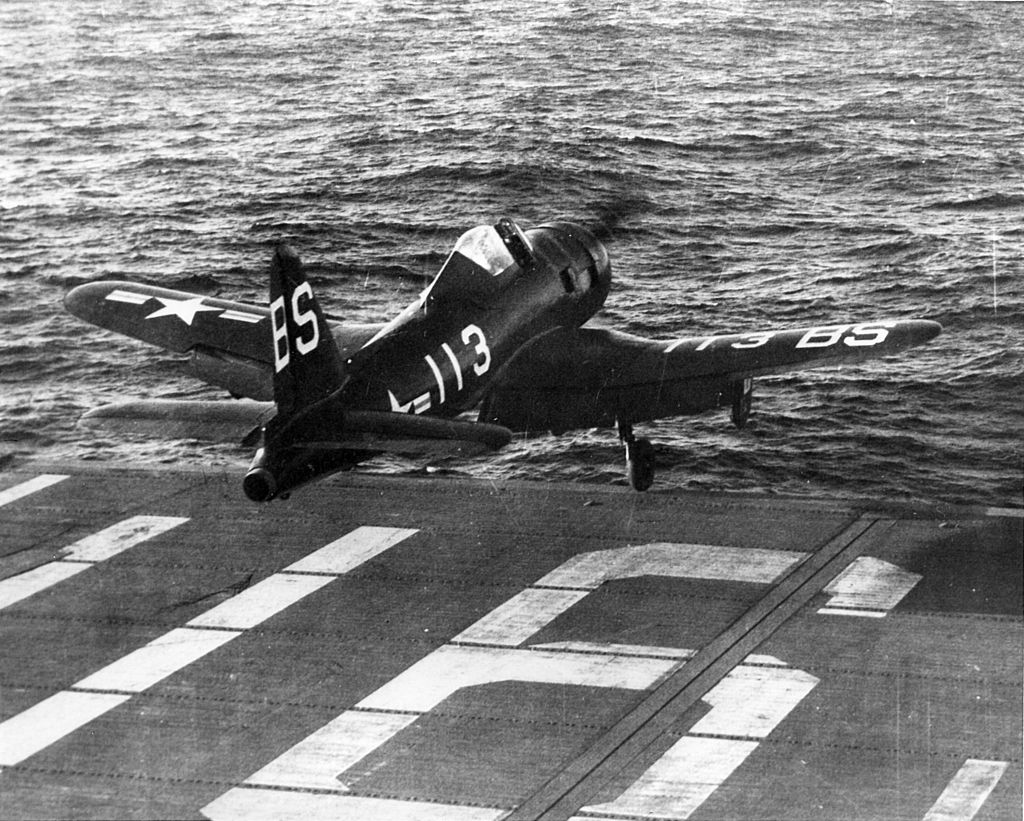
An FR-1 taking off from the deck of the escort carrier USS Badoeng Strait in early 1947

If VF-66 was looking forward to using the FR-1 on its first combat missions in the Pacific theater of World War II, such plans were not to be. On August 14, Japan formally surrendered to the Allies, and after V-J Day, production orders for the FR-1 were reduced to 66 aircraft (BuNos 39647/39712), and thus the FR-1 and FR-2 production contracts signed in January were canceled. On October 18, VF-66 was disbanded and all FR-1s in service and the pilots who flew them transferred to the squadron VF-41. True carrier trials involving the Fireball began on November 5, 1945, aboard the escort carrier USS Wake Island, and on November 6 one FR Fireball unintentionally became the first airplane in history to land on a carrier under jet power when its pilot ignited the J31 for final approach to the Wake Island  after the R-1820 radial engine lost substantial power, eventually catching the arrestor wire before hitting the ship's crash barrier. VF-41 was attempting to qualify its pilots to operate the FR Fireball aboard the Wake Island, but only 14 out of 22 pilots made the six required takeoffs and landings, and accidents occurred when the nose gear failed on landing, although the pilots were partly to blame because they slammed the nose landing wheel onto the deck after landing on the main wheels. By March 1946, the FR-1s of VF-41 began serving aboard the USS Bairoko, but nose gear problems persisted and cut short cruises, and despite Ryan modifying the nosewheels of the Fireball fleet with a steel fork, inspections of the aircraft also revealed evidence of partial wing failures, so the Navy required all Fireball to conduct maneuvers that were not to exceed 5 Gs. After three fatal crashes, one involving a collision between two Fireballs that killed both pilots, VF-41 was renamed VF-1E on November 15, 1946, and in March 1947 the rechristened squadron conducted carrier qualification aboard the USS Badoeng Strait but only eight pilots successfully qualified, largely because the Fireballs lacked the structural strength to endure repeated carrier landings. During one brief deployment in June aboard the USS Rendova, one FR-1 broke in two after a hard landing, and when the US Navy recognized that the entire FR-1 fleet had many signs of structural failure, the Fireball was withdrawn from service on August 1, 1947.  

Top: The XFR-4 (BuNo 39665) in flight
Bottom left: The sole XF2R-1 (BuNo 39661) in flight, early 1947
Bottom right: A full-scale mockup of the XF2R-2 at the Ryan factory in San Diego, mid-1946

Even as the FR-1 began to be deployed, Ryan worked out two variants of the FR-1 with more powerful auxiliary turbojets, and when the US Navy announced the SD399 requirement in mid-1945 for a fighter plane to be powered by a turboprop in the nose and an auxiliary turbojet in the tail empennage, two derivatives of the Fireball with one General Electric T31 turboprop substituted for the R-1820 were conceived, the Model 29 with one General Electric J31 auxiliary turbojet and the Model 30 with one Westinghouse J34 auxiliary turbojet. The XFR-3 (Model 28-4) would have used the R-1820-74W of the FR-2 and replaced the J31 with a 1,985 lb (8.8 kN) thrust General Electric J39 (I-20), and the XFR-4 (Model 28-5) was similar to the XFR-3 but was powered by one Westinghouse J34 turbojet in the rear fuselage, necessitating an extension of the rear fuselage by 8 inches (20 cm),  the wing intake ducts, and installation of NACA-type flush fuselage intakes. The XFR-3 did not leave the design phase before the end of World War II, but the XFR-4 design reached the hardware phase when one FR-1 (BuNo 39665) was converted to XFR-4 configuration, making its first flight in about late 1945 or early 1946*. The XFR-4 exhibited stellar performance during flight testing, being 100 miles per hour (160 km/h) than the FR-1 variant, and since it was intended to test the J34 planned for the Model 30, the Navy was duly so impressed by flights of the XFR-4 that it approved the Models 29 and 30 for full-scale development by late 1945, designating the Model 29 as XF2R-1 and Model 30 as XF2R-2. The XF2R-1 was 36 feet (10.97 meters) long with a wingspan of 42 feet (12.80 meters), a wing area of 305 square feet (28.3 m²), and 14 feet (4.27 meters) in height, and it had a gross weight of 11,000 lb (4,990 kg), a top speed of 497 miles per hour (800 km/h), and provisions for four 0.50 in (12.7 mm) Browning machine guns outboard of the air intakes for the J31 on the leading edges of the wing center section. The XF2R-2 had the same wingspan and wing area as the XF2R-1 but differed in having a slightly longer fuselage measuring 37 feet 4.5 in (11.39 meters) in length to fully accommodate the J34 turbojet in the rear fuselage as well as air intakes for the J34 on the forward fuselage, and it was to have a gross weight of 15,763 lb (7,150 kg), a top speed of 533 miles per hour (858 km/h) with both engines running (386 miles per hour [621 km/h] with the turboprop only), and a service ceiling of 52,200 feet (15,911 meters), while armament would comprise four 20 mm cannons in the wing roots and eight 5 inch (127 mm) HVAR unguided rockets below the inner wing panels. One FR-1 (BuNo 39661) was converted into the sole prototype of the XF2R-1, and two prototypes of the XF2R-2 (BuNos 39713/39714) were ordered in late 1945, with a full-scale mockup of the XF2R-2 being completed for inspection in mid-1946. The first flight of the XF2R-1 took place on November 1, 1946, flown by Ryan test pilot Al Conover, and test flights of the aircraft revealed good performance and maneuverability. On May 2, 1947, the XF2R-1 set an altitude record for a turboprop-powered aircraft when Conover took the aircraft to 39,160 feet (11,936 meters). Although "Dark Shark" is often cited in many publications for the F2R, Ryan company documents indicate that the XF2R-1 and XF2R-2 were actually called Dark Shark Fireball, in which case "Dark Shark" was an unofficial moniker for the F2R by Ryan to point out the shark-like nose of the F2R. Despite being impressed by the performance of the XF2R-1, the Navy did not order the XF2R-1 into production because of the deployment of its first generation of pure jet fighters, and for that reason the XF2R-2 project was canceled before construction of the two prototypes could begin. Before long, Ryan had envisaged a backswept wing derivative of the F2R in April 1946, the Model 34, which would have had a length of 39 feet 4 in (12 meters), a wingspan of 36 feet 8 in (11.18 meters), and a gross weight of 13,390 lb (6,074 kg), while using the same powerplant as the XF2R-2, but this project found no favor with the Navy. 

* Although Norton (2008) notes that the exact date of the XFR-4's first flight is uncertain, he points out that a November 1944 timeframe given by some published sources for the first flight of the XFR-4 is erroneous given the timing of the development of this variant.

After retirement from service, all FR-1s were scrapped except for a few that continued to fly for testing purposes until April 1948, when the last airworthy FR-1 made its last flight en route to the Naval Air Technical Training Center at NAS Memphis in Memphis, Tennessee. This aircraft along with another FR-1 that had been retired to NAS Memphis were later given to the Mississippi State University, two Fireballs were lent to Lewis Institute of Technology in Romeoville, Illinois, as instructional airframes; the current whereabouts of these aircraft are unknown. One FR-1 (BuNo 39657) is now on display at the Planes of Fame Museum in Chino, California, and another Fireball (BuNo 39707) was initially given to the US Navy's airplane collection at the Smithsonian Institution before being placed on display at the San Diego Air and Space Museum, where it remained until it was destroyed by a fire in 1978.

The TR-1 half-scale mockup of the FR-1 (nicknamed "Winged Victory") at the San Diego Tournament of Roses Parade on January 1, 1946 (courtesy of Secret Projects forum).

As a side note, Ryan built a half-scale wooden model of the FR-1 Fireball, called TR-1 (Tournament of Roses, Model 1) by the company, that was used as a float for the Tournament of Roses Parade in San Diego on New Year's Day 1946. The float, which was nicknamed "Winged Victory" (a virtual pun on the Winged Victory of Samothrace, a Hellenistic sculpture of the Greek victory goddess Nike standing on a warship's bow found on the Greek island of Samothrace in the 1860s), received sponsorship from the San Diego city and county governments and as well as the San Diego-California Club and Junior Chamber of Commerce.  

References:

Friedman, N., 2016. Fighters over the Fleet: Naval Air Defence from Biplanes to the Cold War. Barnsley, UK: Seaforth Publishing.

Ginter, S., 1995. Ryan FR-1 Fireball and XF2R-1 Darkshark (Naval Fighters Number 28). Simi Valley, CA: Ginter Books.

McDowell, E., 1995. FR-1 Fireball (Mini in action number 5). Carrollton, TX: Squadron/Signal Publications.

Wagner, R., 2004. American Combat Planes of the 20th Century: A Comprehensive Reference. Reno, Nevada: Jack Bacon & Co. ISBN 0-930083-17-2.

Friday, November 18, 2022

Northrop BQM-74 Chukar: the naval partridge from Ventura County

As I pointed out in a post written back in February 2020, Northrop entered the world of unmanned air vehicle development when it acquired the Radioplane Company of Van Nuys in 1952, capitalizing upon Radioplane's drone manufacturing business by developing the KD2R-5/MQM-36 Shelduck and XQ-10 piston-engine target drones, the supersonic jet-powered Q-4/AQM-35, and rocket-powered KD4R and AQM-38 drones, plus a number of advanced target drone projects. By 1962, however, the Radioplane Division of Northrop decided to move its headquarters from Van Nuys to the town of Newbury Park in Ventura County, and it changed its name to Northrop-Ventura after the relocation, opening up a new chapter in the history of drone development in the Los Angeles Basin. Northrop's drone-related business activities in Ventura County are largely overlooked in most published histories of the Southern California aerospace industry, but the Northrop-Ventura Division's most successful unmanned aerial vehicle ever produced was the BQM-74 Chukar. It is no wonder that I first saw this drone while visiting the San Diego Air and Space Museum in the 2010s, I had no idea that it was one of a few target drones built outside the Los Angeles metropolitan area, making it the most successful mass-produced Northrop drone design to be developed in the late Cold War. Given its distinction of being the only mass-produced target drone to built in a locality of southern California outside the Los Angeles and San Diego counties, I've opted to provide a comprehensive synopsis of the development, testing, production, and operational service of the Chukar. 

A Northrop MQM-74A Chukar I on its ground-based launch platform

In the early 1960s, the US Navy issued requirement for a small jet-powered aerial target to be used for anti-aircraft gunnery and missile training and system evaluation. Northrop-Ventura proposed a delta-winged target drone to meet this requirement, designated NV-105 by the company, and power was provided by one Williams J400 turbojet with an air intake slung under the fuselage. Four NV-105 prototypes were constructed, and flight tests began in 1964, but it was clear that the delta wing wasn't aerodynamically satisfactory, so a straight-wing NV-105 variant with a cigar-shaped fuselage was developed as the NV-105A, which made its first flight in 1965. After a few years of flight testing, the NV-105A was cleared for production and operational deployment with the US Navy in 1968 and designated MQM-74A. The Navy christened the MQM-74A the Chukar in reference to a species of partridge because just as a chukar can be hunted for sport, the MQM-74A could be deemed suitable to be shot at during gunnery training. Besides the cigar-shaped fuselage and straight wings, the MQM-74A had the horizontal stabilizers arranged in an inverted V-shape, and it was designed to be launched from land- or ship-based zero-length launch systems aided by two solid-fuel JATO rocket boosters. The MQM-74A featured a command guidance system, and the operator could track it either visually or through radar. When the command link was damaged, a parachute was deployed by remote command or automatically to allow for the drone to be recovered. Mission equipment of the MQM-74 included passive and active radar augmentation devices, wingtip-mounted infrared flares, a smoke system for visual augmentation, and tow targets; if a Chukar landed in the water, a floatation gear kit was provided for recovery. More than 2,000 MQM-74As were built, with the US Navy acquiring 1,800 of them, and hundreds more serving with the Royal Navy, Italian Navy, and a NATO test range on the island of Crete. Northrop proposed an improved version of the MQM-74A in the early 1970s with variable speed, designated MQM-74B, but this was never built. The MQM-74A Chukar I also formed the basis of the XBQM-108 unmanned tail-sitter VTOL research vehicle developed by the US Navy's Naval Surface Weapons Center (NSWC), which began tethered flight tests in late September 1976 but never made a free flight before the Navy canceled the XBQM-108 program. 

Left: An MQM-74C on its launch platform, mid-1970s.
Right: An MQM-74C being retrieved by crewmen aboard the drone recovery craft USS Retriever after a test launching in October 1984.

The Navy was very impressed with the MQM-74A, but in the early 1970s it felt that it needed a slightly faster variant of the Chukar capable of attaining 576 miles per hour (926 km/h). Northrop responded with an slightly larger version of the MQM-74A powered by a higher-rated Williams J400-WR-401 (Model WR24-7) turbojet, which was designated MQM-74C by the Navy. The MQM-74C Chukar II began flight tests in 1973 and production of Chukar II started the following year, with deployment beginning shortly afterwards. A total of at least 1,400 MQM-74Cs built, mostly for the US Navy but also the armed forces of the United Kingdom, West Germany, Greece, Iran, Italy, Japan, Saudi Arabia, the Netherlands, and Spain. In 1975, the MQM-74C was selected by the US Air Force for the Tactical Expendable Drone System (TEDS) competition, and Northrop had four Chukar II drones modified for the TEDS requirement as the NV-130, which eliminated the parachute recovery equipment and carried more fuel space as well as electronic countermeasures systems. Tests of the NV-130 began in 1976 and continued until 1977, and even though performance results were seemingly satisfactory, the NV-130 did not enter production because the TEDS program was canceled due to a lack of funds. The US Army also took an interest in the MQM-74C and ordered a surveillance variant of the Chukar II, designated BQM-74D, which was fitted with a precision navigation system and sensors for target acquisition and battlefield surveillance. Although little is known about the developmental history of the BQM-74D, test flights of this variant took place in the mid-1970s but no production orders were placed.

Top: An air-to-air view of a BQM-74C Chukar III in flight
Bottom: A BQM-74E Chukar III on display at the San Diego Air and Space Museum, photographed by me on August 24, 2019

Even as production of the MQM-74C began, in the mid-1970s Northrop envisaged a significantly improved version of the Chukar II, which became the BQM-74C Chukar III. Differences from the MQM-74C included a new cylindrical forward fuselage measuring 12 feet 11.5 inches (3.95 meters) in length, addition of the provision for air-launch capability, and a new microprocessor-based A/A37G-13 flight control system to enable much more complex pre-programmed flight profiles. The BQM-74C made its first flight in 1978 and following completion of flight testing the following year, production and deliveries of the Chukar III commenced in 1980, with the BQM-74C supplanting the MQM-74C in squadron service. Initial production BQM-74Cs used a Williams J400-WR-402 turbojet, which had slightly greater thrust than the J400-WR-401 that powered the MQM-74C, but beginning in 1986 all production BQM-74Cs were fitted with the J400-WR-403. For ground-based launches, the BQM-74C was fitted with a pair of MK 117 MOD 0 solid-fuel rocket boosters, which were jettisoned shortly after take-off once the target drone reached sufficient altitude. The main launch aircraft for the Chukar III was the DC-130 drone control version of the C-130 Hercules tactical airlifter, although the BQM-74C was also carried aboard the F-15 and F-16. Northrop developed a reconnaissance version of the Chukar III, the BQM-74C/Recce, which housed a TV camera in the nose and a video data link transmitter, and ten BQM-74Cs were converted to BQM-74C/Recce and tested in the mid-1980s, but this version was not procured by the Navy. During the aerial phase of Operation Desert Storm in January 1991, several BQM-74Cs were acquired by the US Air Force and modified as decoys by the fitting of pair of corner reflectors to enhance the radar signature to imitate a manned aircraft, and these were used as decoys in the midst of US-led coalition airstrikes against Iraq under Project Scathe Mean of the USAF's Big Safari program, ensuring that the air forces of the US and its allies suffered minimal losses in the opening hours of Operation Desert Storm. Even before Operation Desert Storm began, an improved version of the BQM-74C with greater endurance, increased range as well as new-generation software, the BQM-74E, began flight tests in 1989/1990. Despite having the same length and wingspan as the BQM-74C, the BQM-74E uses an Williams J400-WR-404 turbojet delivering 240 lb (1.07 kN) and can fly at a top speed of 621 miles per hour (1,000 km/h), and it incorporates the latest target augmentation devices, namely the AN/DPN-90(V) radar tracking beacon, the AN/DPN-88 IFF transponder, the AN/DRQ-4 and AN/DSQ-50 scoring systems, the AN/DKW-3 and -4(V) target control transponders, and the AN/DPT-2 radar threat simulator. The BQM-74E, which retains the Chukar III moniker to emphasize it derivation from the BQM-74E, is air-launched from the DC-130 and simulates anti-ship cruise missiles as well as maneuvering attack aircraft. The BQM-74E entered service in 1992 and replaced the BQM-74C on existing production lines, and by the time that Chukar III production ended in the early 2000s, more than 2,000 BQM-74C/E target drones had been built and delivered. Before long, Northrop shut down its Ventura Division after the conclusion of the flight test program of the Tacit Blue stealth technology demonstrator in 1985, leading to the relocation of production facilities for the BQM-74E to Hawthorne in the early 1990s and thence to Palmdale in 2002.

The BQM-74F, the last Chukar variant to be built

Although Northrop Grumman's drone manufacturing business in Ventura County was consigned to the dustbin of history, one more BQM-74 variant was developed in the late 1990s, initially marketed by the company as Target 2000 and later designated BQM-74F in March 2002 when a development contract was awarded. The BQM-74F differs from the BQM-74E with having backswept wings spanning 7 feet (2.1 meters), a length of 15 feet (4.5 meters), a top speed of Mach 0.9, a range of more than 1,037 miles (1,670 km), greater maneuverability, an endurance of two hours, and a drastically uprated William J400 turbojet delivering 300 lb (1.32 kN) of thrust. Novel electronic systems fitted to the BQM-74F include a IMU/GPS-based waypoint navigation system as well as new mission planning software (allowing in-flight modification of all parameters). The BQM-74F first flew on August 29, 2005, entering service with the US Navy in 2010, and more than 100 BQM-74Fs have been built. Although the BQM-74E still serves with Navy units despite having been phased out of production in the early 2000s, is it currently being replaced in frontline service by the Kratos BQM-177, which has greater range, maneuverability, and speed than the Chukar and features a new fuselage with area ruling.

References:

Munson, K., 1988. Jane's World Unmanned Aircraft. Coulsdon, UK: Jane's Information Group.

Munson, K., 2000. Jane's Unmanned Aerial Vehicles and Targets, Issue 15. Coulsdon, UK: Jane's Information Group.

Yenne, B., 2012. US Guided Missiles: The Definitive Reference Guide. Manchester, UK: Crecy Publishing. 

Supersonic Firebees

The Firebee drone family is unquestionably the most versatile jet-powered unmanned air vehicle family developed and built during the Cold Wa...