Wednesday, May 20, 2020

Convair's last propeller-engine flying boats: the P5Y/R3Y Tradewind and P6Y

The Convair company in San Diego, California is best known for building some of the finest American flying boats of World War II, namely the PBY Catalina and PB2Y Coronado. While visiting the Planes of Fame Museum in January 2018, I happened to notice a model of the Convair R3Y Tradewind, a turboprop-powered flying boat that most people don't think about too much, with the exception of the most talented US naval aviation historians. The R3Y, nevertheless, seemed quite interesting because it offers a window into a time when turboprop-powered flying boats promised to give the US Navy an advantage in new-generation anti-submarine and maritime patrol technologies, including minelaying, sonobuoys, and dipping sonar, only to be overtaken by ballistic missile submarines and the submarine-launched ballistic missile.

On December 20, 1944, the US Navy's Bureau of Aeronautics initiated a requirement for a maritime patrol flying boat powered by four Pratt & Whitney R-2800 Double Wasp radial piston engines and carrying 4,000 lb (1,814 kg) of bombs, which would be used for anti-submarine warfare, anti-shipping missions, and search-and-rescue. Convair, Hughes, and Martin submitted bids in early 1945, and the Convair design proposed in January 1945 had four 2,100 hp (1,544 kW) Pratt & Whitney R-2800C-14 radial piston engines, a gross weight of 105,000 lb (47,628 kg), and a crew of seven (pilot, co-pilot, navigator/bombardier, radar operator, radio operator, flight engineer, and countermeasures operator). An alternate design was proposed with four 5,000 shp (3,677 kW) Wright turboprop engines and a gross weight of 140,000 lb (63,502 kg). Both designs had a wing area of 2,625 ft2 (243.87 m2) and armament for these designs comprised eight .50 caliber machine guns in four turrets (one nose turret, two waist turrets, and one tail turret) and either four 1,000 lb (453 kg) bombs, two 2,000 lb (907 kg) bombs, four 400 lb (181 kg) bombs, twelve 325 lb (147 kg) depth charges, or six 657 lb (298 kg) depth charges in internal weapons bays in the wings.

Top: A desktop model of the R3Y-1 Tradewind at the Planes of Fame Museum, photographed by me in January 2018.
Bottom left: The first XP5Y-1 prototype (BuNo 121455) taking off for its first flight on April 15, 1950.
Bottom right: An 
R3Y-1 Tradewind flying low over San Francisco Bay near Alameda NAS

As 1945 progressed, the BuAer decided that the performance parameters jotted out in the December 1944 specification for a new four-engine patrol flying boat only offered marginal improvement over that of the Consolidated PB2Y and Martin PB2M/JRM Mars, so the idea of a brand new flying boat with R-2800s was instantly abandoned and Convair's design solicitations were not proceeded with. and However, the Navy still wanted a new flying boat able to perform the operational roles specified in the December 1944 requirement, and on December 27, 1945, the Navy's Bureau of Aeronautics (BuAer) issued a specification for a new-generation maritime patrol flying boat designed to use gas turbine engines. Convair, Hughes, and Martin submitted bids for turboprop flying boat designs, and the Navy selected Convair's Model 117 design, assigning it the designation XP5Y-1. Technical details of the P5Y and its transport derivative, the R3Y Tradewind, have been covered in Bradley (2010, pp. 65-68, pp. 82-85), so will not be wastefully replicated here, except to say that the  P5Y/R3Y series used four Allison T40 turboprops driving counter-rotating propellers. Two XP5Y-1 prototypes were ordered on May 27, 1946, and the first prototype flew on April 18, 1950 (the second prototype never flew). However, by the time of the P5Y's first flight the Navy gave up on turboprop-powered patrol flying boats and ordered Convair to rework the P5Y design as a transport aircraft to replace the Martin JRM Mars, leading to the R3Y Tradewind (designated Model 3 by Convair), the first flight of which occurred on February 22, 1954. Eleven R3Ys were built, with the baseline R3Y-1 version retaining the nose of the XP5Y-1 and the the R3Y-2 version with a lifting nose similar to that of the Lockheed C-5 Galaxy. Unfortunately, the T40 used on the Tradewind suffered teething troubles, and when one R3Y-1 was lost en route to Alameda, California on January 24, 1958, the Navy ordered all R3Ys removed from active service and sold for scrap.  


Left: 3-view drawing of the Convair P6Y dunking sonar ASW flying boat from the Convair project documents
Right: A company scale model of the Convair P6Y 

The last Convair flying boat design to receive a US Navy designation was the Convair Model 24, designated P6Y. Aware of the pitfalls of its traditional anti-submarine warfare capabilities, Convair beginning in October 1953 explored the notion of an ASW flying boat with the capability to use dunking sonar, even constructing a large free-flight model nicknamed the "Dunker", tested in late 1955 and early 1956 (Bradley 2010, p. 99). On May 21, 1956 the US Navy issued a Request for Proposals for an ASW flying boat able to use dunking sonar to track enemy submarines. Convair responded with the Model 24, a high-wing seaplane with three Wright R-3350 Duplex Cyclones (two outboard, one above the fuselage), a boundary layer control system powered by two General Electric J85 turbojets situated behind the outboard piston engines, a wingspan of 127 feet 6 inches, a gross weight of 107,648 pounds, and a crew of 10 (Buttler 2010, pp. 152-153). (Grumman and Martin's submissions for the Class VP requirement were the G-132 and Martin Model 313/P7M respectively.) Despite falling short of the performance parameters in the requirement, the Model 24 was judged by the Navy to be superior to the Grumman and Martin designs, and in November 1956 the Navy selected the Convair design and allocated it the designation XP6Y-1. Two prototypes were ordered in February 1957, but members of the US Navy top brass who had experience with flying seaplanes were not too enthusiastic about the P6Y, viewing the operational environment of  the dunking sonar seaplane concept fairly dangerous and highly uncomfortable. As a result of this criticism, the P6Y program was canceled before any of the prototypes were built (Bradley 2010, p. 102).

References:

Bradley, R., 2010. Convair Advanced Designs: Secret Projects from San Diego 1923-1962. North Branch, MN: Specialty Press.

Buttler, T., 2010. American Secret Projects: Bombers, Attack, and Anti-Submarine Aircraft 1945-1974. Hersham, UK: Ian Allan Publishing.

Douglas transport gliders

The Douglas Aircraft Company based in Santa Monica, California (later Long Beach) is famous in the annals of US aviation history for producing a plethora of civil and military transports, including the DC-1, DC-2 (military designations: C-32, C-33, C-34, C-38, C-39, C-41, C-42, R2D), DC-3 (military designations: C-41A, C-47 Skytrain, C-48, C-49, C-50, C-51, C-52, C-53 Skytrooper, C-68, C-84, C-117, C-129, R4D, CC-129), DC-4 (military designations: C-54 Skymaster, C-114, C-116, C-117, R5D), DC-5 (military designations: C-110, R3D), DC-6 (military designations: C-112, C-118 Lifmaster, R6D), DC-7, DC-8, DC-9, C-74 Globemaster I, C-124 Globemaster II, and C-133 Cargomaster. However, one aspect of the Douglas company's design and development of transport planes that is largely overlooked by most military aviation historians is the fact that in the 1940s, Douglas itself tinkered with cargo gliders for the US Army Air Force (later US Air Force). During a visit to the Planes of Fame Museum in Chino, California in April 2019, I happened to notice a subscale plastic model of the Douglas XCG-17 prototype transport glider in the Foreign Hangar building of the museum, and it may quite surprise some historians that Douglas developed transport glider designs of its own because the vast majority of American transport gliders built in World War II were made by the Waco Aircraft Company. Therefore, I thought it would prudent to discuss the Douglas company's design and development of transport gliders.

Left: Desktop model of the Douglas XCG-17 transport glider at the Planes of Fame Museum.
Right: Douglas XCG-17 transport glider being towed during flight testing, 1944.

Following the introduction of the Douglas C-54 Skymaster military transport version of the DC-4 airliner, the US Army Air Force, facing the challenge of hauling troops and war material over the Himalayas from India to China, realized that its existing transport gliders would be unsuitable for towing over the "Hump" because of altitude, turbulence and additional payload. Therefore, it felt that a larger transport glider based on an existing powered transport plane was better suited to be towed by a C-54 over the Himalayas at higher speeds because it had much higher wing loading, and therefore withstand mountain turbulence. At the behest of Lieutenant Colonel Chet Decker, the USAAF suggested converting a C-47 Skytrain to glider configuration (Norton 2012, p. 176). One C-47 (serial number 41-18496; originally built as a Northwest Airlines DC-3 with the civil registration N69030) was earmarked by Douglas for modification to a transport glider in April 1944 and given the designation XCG-17. Conversion of the aircraft, completed on June 12, involved removing the engines and covering the engine nacelles with hemispherical domes, but also removing the radio operator and navigator spaces as well as bulkheads and wiring. The XCG-17 had a towing speed of 290 mph, a glide speed of 190 mph, with a capacity of 42 troops or 15,000 pounds (three jeeps and a 4x4 truck), carrying 3.75 times the payload capacity of the Waco CG-4. The first flight of the XCG-17 took place on June 14, 1944, and flight testing continued through the remainder of 1944. Despite satisfactory results of the flight test program, the XCG-17 was not ordered into production because the aircraft did not meet the USAAF requirement that it prove its ability to land on unimproved airfields. In any case, the war situation in Asia reached the point that the need for a large transport glider like the XCG-17 was obviated. The sole XCG-17 was sent to the boneyard at Davis-Monthan Air Force Base in August 1946, and it was eventually modified back to DC-3 configuration and sold to Mexico, where it remained in service until 1980.

Douglas C-47 "Nez Perce" (serial number 43-16229) after being converted to a transport glider, January 1946

The XCG-17 was not the only conversion of a C-47 airframe to transport glider configuration, however. In January 1946, a C-47 with the serial number 43-16229 was ferried to Nichols Field in Manila, the Philippines, for conversion to a glider transport; as with the XCG-17, the engines were removed and fairings mounted on the nacelles, but the nacelle fairings were octagonally shaped rather than hemispherical. An auxiliary power unit was taken from a B-24 Liberator to enable the operation of a radio and other electrical equipment. The converted C-47, christened "Nez Perce", flew on June 17, 1946, towed by a C-54 transport. Flight tests of the "Nez Perce" proved stellar, and later in June, the aircraft was towed by C-54 from Luzon to Tachikawa Airfield, Tokyo, with an overflight stay in Okinawa Airfield. The flight, which covered a distance of 1,800 miles, suggested that the "aerial freight train" concept of using large gliders for regular transport might be viable, but that concept never really caught on. In August, the "Nez Perce" had its piston engines reinstalled and converted back to C-47 configuration.   
USAAF 1946 Informal Design Competition, Glider, Assault, Light ...
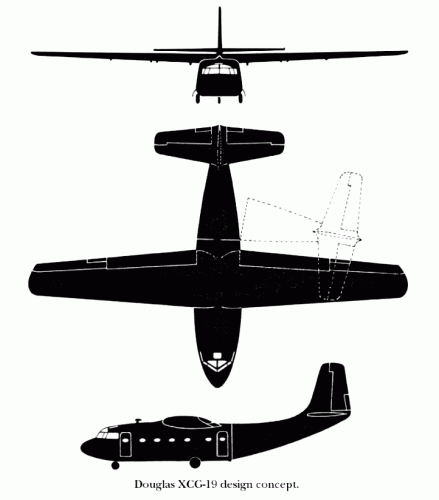
Three-view drawing of the Douglas XCG-19 transport glider (after Mrazek 1977)

Douglas Aircraft's next foray into transport glider design when the USAAF's Air Service Technical Command on January 31, 1946 announced a requirement for two new assault gliders, a light glider able to carry an 8,000 pound payload and a heavy glider with a payload capacity of 16,000 pounds. The proposed gliders were to be of steel tube and monocoque construction, with provisions for loading men and military equipment into the aircraft via a ramp at the rear of the fuselage, as well as cargo space 35 feet long, 8 feet 8 inches wide, and 7 feet 11 inches high (10.67x2.64x2.41 meters) (Cox and Kaston 2019, p. 67). Douglas responded to this requirement with two designs, the Model 1028 light glider and Model 1029 heavy glider. Both proposals were similar in having a shoulder-mounted wing and an upswept rear fuselage rectangular in cross-section. The Model 1028's rear fuselage was hinged to swing sideways, while the Model 1029 had clamshell doors, each with triangular folding panels for ground clearance together with an integral ramp. Besides being intended to carry an 8,000 pound payload, the Model 1028 would be 61 feet long, with an 85 foot wingspan and gross weight of 14,200 pounds; the Model 1029, on the other hand, not only would carry a 16,000 pound payload but also have a length of 76 feet and five inches, a wingspan of 107 feet 3 inches, and a gross weight of 28,500 pounds (Cox and Kaston 2019, p. 69). The Douglas Model 1029 lost the heavy glider contract to Chase's MS-3 (designated XCG-20, later XG-20), but the Model 1028 and Chase's MS-7 won the light glider competition, receiving the designations XCG-19 and XCG-18 respectively. A mockup of the XCG-19 was inspected by USAAF officials in March 1947, but budget restrictions imposed later that year forced the USAAF to cancel the XCG-19 in favor of Chase's XCG-18, since the Chase XCG-18 prototypes were nearing completion (Mrazek 1977, p. 143).*    

Although somewhat outside the scope of this post, it should be noted that two other aircraft manufacturers in southern California issued their own proposals in response to the ASTC requirement. Hughes submitted its Model 31 and Model 32 designs, the former with an upward-swinging rear fuselage and the latter having a full-width loading ramp that formed the lower surface of the rear fuselage. North American, for its part, proposed the RD-1413 heavy glider which was unusual for having a detachable fuselage 'egg' for accommodating troops and cargo hanging from a rack under the glider (Cox and Kaston 2019, pp. 72-73). Of course, like the Douglas designs, the Hughes and North American glider proposals remained paper projects only. 

The Douglas transport glider designs represent a seldom-noticed footnote in the history of the Douglas Aircraft Company, but they also were a reminder that in the post-World War II era, the notion of large gliders designed to haul men and war materials to the battlefield was becoming a thing of the past due to the advent of helicopters and powered tactical transports.

*Although the XCG-19 and Model 1029 never reached the hardware stage and large transport gliders were rendered obsolete by powered tactical airlifters and helicopters, Douglas proposed powered derivatives of the XCG-19 and Model 1029 as the Model 1044 and Model 1072 respectively, both of them powered by Ranger XV-770 inline piston engines (Cox and Kaston 2019, p. 74). Like the XCG-19 and Model 1029, however, the Model 1044 and Model 1072 never left the drawing board.

References:

Cox, G., and Kaston, C., 2019. American Secret Projects 2: U.S. Airlifters 1941 to 1961. Manchester, UK: Crécy Publishing.

Mrazek, J., 1977. Fighting Gliders of World War II. London, UK: St. Martin's Press.

Norton, W. J., 2012. American Military Gliders of World War II: Development, Training, Experimentation, and Tactics of All Aircraft Types. Atglen, PA: Schiffer Publishing.   

Tuesday, May 19, 2020

Northrop YA-9 and little-known design studies for the A-X program from the Southern California aviation industry

Much has been written about the late 1960s-early 1970s A-X program by the US Air Force for a dedicated ground attack aircraft, with emphasis on the two competing aircraft involved in the A-X competition, the Fairchild-Republic A-10 Thunderbolt II and the Northrop YA-9, of which the former was declared the winner of the A-X contest. For the most part, the fly-off between the YA-9 and A-10 as part of the A-X competition was one aspect of the 'fly-before-buy' method concocted by the USAF at times whereby two or more designs for an aircraft competition were selected for prototyping, and the Pentagon could evaluate those designs to decide on which aircraft should be selected for production. During my first visit to the March Field Air Museum in Riverside, California, I got the chance to see the YA-9 for the first time in person back in December 2018, marveling at the placement of the YA-9's engines and the sleek fuselage. Thanks to project documents in the archives of southern California aircraft manufacturers contained in the books American Secret Projects: Bombers, Attack, and Anti-Submarine Aircraft 1945 to 1974 (Midland Publishing, 2010) and Convair Advanced Designs II: Secret Fighters, Attack Aircraft, and Unique Concepts 1929-1973 (Crecy Publishing, 2013), it is apparent that Northrop wasn't the only aircraft manufacturer in southern California to submit a design bid for the A-X program.

In the first two decades of the Cold War, the US Air Force viewed long-range combat aviation, strategic mobile airlift, and air defense as paramount priorities for US military aviation, putting ground attack aviation on the back burner. However, combat experience the Vietnam War involving the Douglas A-1 Skyraider highlighted pitfalls in the USAF's ground attack capabilities, so beginning in mid-1966, the Air Force launched the A-X program to begin shopping for an aircraft exclusively designed for close air support missions, including taking out Warsaw Pact armored vehicles stationed in Eastern Europe. The initial A-X requirements, which called for long loiter time, extreme survivability, and massive cannon firepower, requested that any design submission rely on use of turboprop engines. However, by May 1969, the Air Force tweaked the A-X design parameters to require that ground attack aircraft design bids be powered by turbofans (Jesse and Engbrecht 1994, p. 58).

                                                           
Unrealized A-X designs by the southern California aerospace industry: Northrop N-308 V-tailed pusher turboprop design study (top); three-view drawing of the General Dynamics (Convair) Model 70 high-wing attack aircraft (bottom left); three-view drawing of the Lockheed CL-1400-1 attack aircraft with underwing nacelles.  

No fewer than half a dozen aircraft companies submitted design bids as part of the A-X competition (see Buttler 2010, pp. 175-181). Of these companies, four of them (Convair-San Diego division of General Dynamics, Lockheed, North American, Northrop) were based on southern California. Northrop's first design studies for the A-X competition, under the N-308 designation, ranged from tractor turboprop attack aircraft designs to a V-tail attack aircraft with a Lycoming T55 turboprop in pusher configuration (Chong 2016, pp. 177-179). The Northrop YA-9 (company designation N-320) has been described extensively by Wagner (2004) and Chong (2016), but it can be readily summarized as a design with Lycoming F102 turbofan engines buried in the wing roots (similar to Russia's Sukhoi Su-25 ground attack aircraft), a single vertical stabilizer, and underwing pylons for anti-tank weapons, and prior to design of the N-320, Northrop proposed two jet-powered A-X designs, one with rear fuselage mounted turbofans and another with F102s buried in the wing roots, the latter closely resembling the YA-9 (Chong 2016, p. 185). Convair's A-X study, the Model 70, was a high-wing design powered by two General Electric TF34 turbofans slung under the wings, and it had six underwing weapons pylons with provisions for carrying bombs under the wings on the fuselage corners (Bradley 2013, pp. 261-266). Lockheed's A-X design study, the CL-1400, was quite similar to Lockheed U-2 spy plane in having engines buried in the wing roots and a pair of wing nacelles, and it had ten underwing pylons for air-to-surface weapons, two situated between the air intakes and wing nacelles, and eight outside the undercarriage (Buttler 2010, p. 180; see drawing on p. 182). Lastly, the North American NA-339 design (for which only an artist's conception exists) was apparently similar to the N-312 in having turbofans on the upper sides of the rear fuselage, and armament comprised a guns under the nose, bombs mounted under the inner wing sections and fuselage, and (unusually) wingtip-mounted rocket pods (Buttler 2010, p. 177).

Selected photos of the Northrop YA-9, losing competitor to the A-10 Thunderbolt II: second YA-9 prototype (serial number 71-1368) at the March Field Air Museum in Riverside, California; first YA-9 prototype (serial number 71-1367) in flight.

By December 18, 1970, the Northrop N-320 and Farchild Republic proposals were selected by the USAF for prototyping and a subsequent fly-off. The Northrop and Fairchild Republic designs were designated A-9 and A-10 respectively, and the first flight of the YA-9 took place on May 30, 1972 with Northrop test pilot Lew Nelson at the controls. From October 10 to December 9, the A-9 and A-10 prototypes entered a fly-off competition, and on January 10, 1973, the A-10 was declared the winner of the A-X competition. The engine arrangement probably played a role in the USAF's decision to chose the Fairchild Republic design over the Northrop design, because the Air Force top brass was concerned about the wing root-mounted engines of the A-9 being vulnerable to anti-aircraft artillery during combat missions, whereas the location of the A-10's TF34 engines on the rear fuselages were very likely to give the A-10 greater survivability in wartime conditions. Also, the F102 powerplant for the A-9 was still in the testing phase, while the TF34 used to power the A-10 had recently passed test runs, being cleared for production (Jesse and Engbrecht, 1994, p. 59).

The story of the Northrop YA-9 can be seen as one of rigorous and painstaking evaluation of various designs for jet-powered attack aircraft from southern California aircraft companies by the USAF, considering the diversity of engine layouts for the different A-X proposals conceiving by Northrop, Lockheed, North American, and General Dynamics. However, the engine layout of the YA-9 ensured that the Pentagon would deny Northrop the chance to build America's first production attack aircraft since World War II.

References:

Bradley, R., 2013. Convair Advanced Designs II: Secret Fighters, Attack Aircraft, and Unique Concepts 1929-1973.. Manchester, UK: Crécy Publishing.

Buttler, T., 2010. American Secret Projects: Bombers, Attack, and Anti-Submarine Aircraft 1945 to 1974. Hinckley, UK: Midland Publishing.

Chong, T., 2016. Flying Wings & Radical Things: Northrop's Secret Aerospace Projects & Concepts 1939-1994. Forest Lake, MN: Specialty Press.

Jesse, W., and Engbrecht, B., 1994. Not Quite Ten: Northrop's A-9, A-X runner-up. Air Enthusiast
64 (July–August): 57–59.

Genesis of the Lockheed C-141 Starlifter: designs for the SOR-182 competition from California

The Lockheed C-141 Starlifter earned its place in military aviation history as the first US jet-powered strategic airlifter, representing a quantum leap in US transport technology in the post-World War II era in terms of combining jet power with the strategic range and payload capacity of the propeller-driven Douglas C-124 Globemaster II and C-133 Cargomaster. I finally had the chance to see the C-141 Starlifter in person when I saw one C-141 at the March Field Air Museum in Riverside, California, especially when bearing in mind that the C-141 would serve half of the USAF's strategic airlift needs from the 1960s until 2006, when it was supplanted by the C-17 Globemaster III. However, very little emphasis has been paid to unbuilt competitors to the C-141 in most publications on strategic military aviation, including designed in southern California. Thanks to a copy of the book American Secret Projects 2: US Airlifters 1941-1961 that I received last year, I am now able to discuss strategic airlifter designs by aircraft manufacturers in southern California for the Air Force's SOR-182 requirement of 1960.
The Lockheed C-141 Starlifter (serial number 65-0257 Spirit of the Inland Empire, photographed by me in the outdoor section of the March Field Air Museum in Riverside, California), winner of the SOR-182 competition.

By the end of the late 1950s, the Military Air Transport Service (MATS) of the US Air Force saw the need for a new-generation airlifter powered by jet engines to supplant its fleet of C-124 Globemaster II piston-engine airlifters. The Boeing C-135 Stratolifter transport version of the KC-135 Stratotanker provided the USAF with an interim solution to some airlift requirements outlined by MATS, with 48 aircraft built, but it wasn't enough to truly satisfy the logistical demands issued by the Air Force in its search for a dedicated jet-powered airlifter. Therefore, two companies based in southern California with experience in building commercial and military transports, Convair and Douglas, decided to tinker with designs for dedicated strategic airlifter designs in the late 1950s. The San Diego division of Convair unveiled the 'Model 105' airlifter design with two podded pairs of Pratt & Whitney JT3D turbofans, and Douglas conceived the jet-powered Model 1467-79 and Model 2204 derivatives of the Douglas DC-8 jet airliner as well as the turboprop powered Model 1467-55. None of these proposals moved beyond the design phase, but they at least gave America's leading builders of large transport planes, especially Douglas, a starting point from which to plan for the USAF's transition to a wholly jet-powered airlifter force.

Left: A display model of the Convair (San Diego) Model 63
Right: A desktop model of the Douglas (Santa Monica) Model 2085

In May 4, 1960, the US Air Force issued its formal requirement for a jet-powered strategic airlifter able to carry the load of the C-124 Globemaster II, the SOR-182 specification. This specification stipulated that the aircraft conduct airlift missions over a distance of 4,600 miles (6,440 km) with a maximum payload of 70,000 pounds (31,780 kg), and that the new airlifter accommodate troops and battlefield vehicles within 6,000 cubic feet (170 cubic meters) of usable space within a rectangular fuselage measuring 70 feet long, 10 feet wide, and 9 feet high (21.35 m x 3.03 m x 2.75 m). Convair, Douglas, and Lockheed responded with the Model 63, Model 2085, and the GL-207-45 Super Hercules designs respectively. The Convair Model 63, like the earlier 'Model 105', had jet engines mounted in podded pairs under the wings, but differed in having the main undercarriage retracting into large fairings extending beyond the trailing edges of the wings. The Douglas Model 2085, on the other hand, departed from earlier Douglas jet strategic airlifter studies in its double-lobe, double-deck fuselage, whose flight deck was positioned above the cargo compartment in a manner similar to that of the cancelled XC-132 heavy turboprop-powered airlifter. Lockheed submitted a new design for the GL-207-45 Super Hercules with four Pratt & Whitney JT3D turbofans and a T-tail configuration*, the latter feature contrasting with the placement of the horizontal stabilizers below the base of the vertical stabilizer in the Douglas and Convair proposals. Convair built a mock-up of the Model 63 for the purpose of carrying out loading tests for military payloads, including Army vehicles.

After evaluating all proposals for the SOR-182 specification, the US Air Force picked Lockheed's design to be the successor to the C-124 Globemaster II, and five development aircraft were ordered under the designation C-141A. Production orders were placed for 132 aircraft (later increased to 248 units), and the first flight of the C-141 Starlifter occurred on December 17, 1963, the 60th anniversary of the Wright brothers' historic flight at Kitty Hawk, North Carolina. Deliveries of the Starlifter commenced in October 1964, with entry into service in April 1965. Over the course its service life, the C-141 Starlifter would eventually be deployed abroad to war zones in Southeast Asia, the Middle East, and the Hindu Kush during the Vietnam War, Operation Nickel Glass, Operation Desert Shield/Desert Storm, Operation Enduring Freedom, and Operational Iraqi Freedom. In one interesting chapter of its late operation career, in September 2005 it was used by the US Air Force to evacuate thousands of people seeking refuge from Hurricane Katrina. With the deployment of the McDonnell Douglas/Boeing C-17 Globemaster III picking up the pace, the C-141 itself was phased out of Air Force service in May 2006.

*The T-tail design trait seen in the C-141 Starlifter has become the tail empennage design philosophy for all American jet-powered strategic airlifters, while the tail empennage configuration of the Douglas Model 2085 and Convair Model 63 is similar to that of the Antonov An-124 Ruslan.

[EDIT: Since I wrote this post, project documents pertaining to the Convair Model 63 and photos of the Model 63 mockup came to my attention via the Secret Projects Forum and Flickr websites. My many thanks to the San Diego Air and Space Museum for alerting me to this.]

References:

Cox, G., and Kaston, C., 2019. American Secret Projects 2: U.S. Airlifters 1941 to 1961. Manchester, UK: Crécy Publishing.
Wednesday, April 22, 2020

From Inglewood to San Diego: the story of the Navion light utility aircraft

In the annals of 20th century aviation history there have been several aircraft designs conceived by one aircraft manufacturer which have been acquired by other companies whenever the manufacturer initially in charge of designing a new aircraft is preoccupied with other aircraft products. One aircraft design built in Southern California, the Navion light utility aircraft, was initially manufactured in quantity in the Los Angeles Basin before production rights for it were transferred to the Ryan company in San Diego. Given the relocation of production of the Navion to San Diego, I am dedicating this post to telling the story of development and series production of this interesting utility aircraft.

Left: The first North American Navion prototype (civil registration NX18928)
Right: A North American Navion (civil registration N91161) at the Planes of Fame Museum, photographed by me on April 13, 2019. 

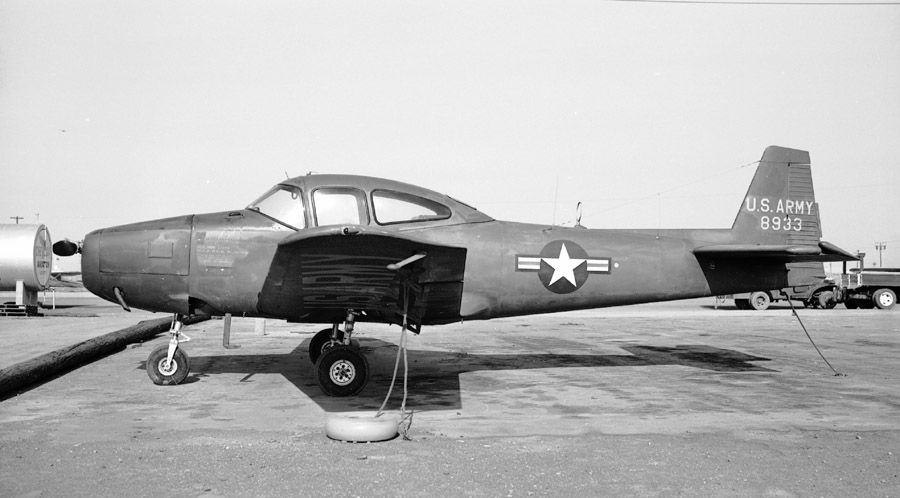
In late August 1945, North American Aviation proposed the NA-143 light utility aircraft which featured a tricycle landing gear, simple aluminum construction, and seating accommodations for the pilot and three passengers, with power provided by one 185 hp (138 kW) Continental E185 flat piston engine. This design was christened the Navion, and the commercial production version proposed in January 1946 was designated NA-145 by the company. The rugged design of the Navion was tailored to match the intended post-World War II boom in US general aviation, and the assumption was that wartime pilots would come home and continue flying with their families and friends under peacetime conditions. Two NA-143 prototypes were built (NX18928 and NX18929), with the first prototype taking to the skies in April 1946. North American eventually produced 1,027 commercial Navions from 1946-1947 for light utility purposes, although the post-World War II boom in general aviation anticipated by North American did not materialize. The US Army Air Force took a keen interest in the Navion and in 1946 it placed an order for 83 aircraft (serial numbers 47-1297/1379) under the designation L-17A (company designation NA-154) for use a liaison and staff transport aircraft, The L-17A first flew in 1947, and 36 L-17As were given to the US Army while 47 were lent to the Air National Guard.

An L-17B (serial number 48-933) at Crissy Field in San Francisco, 1955.

Even as the US military was taking deliveries of the Navion, North American Aviation handed over the Navion design to the Ryan Aeronautical Company in the summer of 1947 due to its growing focus on the AJ Savage and F-86 Sabre programs. Ryan launched production of the Navion in 1948, building 600 examples of the baseline Navion and eventually undertaking development of two improved Navion variants, the Navion A with one 205 hp (153 kW) Continental O-470-7 flat piston engine and the Navion B (also called the Super Navion 260) with by one 260 hp (194 kW) Lycoming GO-435-C2 geared flat piston engine. Ryan completed a total of 602 Navion A and 222 Navion B aircraft before ending production in 1951 to focus on unmanned air vehicle development, by which time it had built more than 1,400 Navions under license. The military designation L-17B was assigned to 163 Navion A airframes delivered to the US Army and ANG with serial numbers 48-921/1078 and 49-1961/1965, and 35 L-17As (47-1298/1301, 47-1303/1313, 47-1315/1319, 47-1321/1328 and 47-1335) were designated L-17C after being fitted by Ryan with improved brakes and fuel capacity; the L-17Bs with serials 49-1961/1965 were eventually delivered to the Royal Hellenic Air Force in Greece in the early 1950s). Three Navion Bs ordered by the US Army in 1950 with serial numbers 51-16425/16427 were originally designated XL-22 but were redesignated XL-17D before delivery. The L-17 augmented its liaison and staff transport duties with casualty evacuation and forward air control roles during the Korean War, aiding American and South Korean troops in preventing friendly fire incidents and evacuating US war casualties. The L-17s were retired from frontline service in 1957 and eventually handed over to the USAF's civil air patrols or used as hacks, by which time the Tulsa Manufacturing Corporation in Tulsa, Oklahoma, had converted many Navion airframes to Navion D, E, and F configuration with wingtip tanks and an inverted Continental IO-470H piston engine after acquiring development rights for the Navion. After US Defense Department established the Tri-Service aircraft designation system on September 18, 1962, the L-17s remaining in service were redesignated U-18, with L-17A, L-17B, and L-17C becoming U-18A, U-18B, and U-18C respectively.

The Navion airframe I saw at the Planes of Fame Museum back in 2019, despite sporting a military paint scheme, was actually not used by the US military. It was completed on October 31, 1946 and flew on December 7 (the fifth anniversary of the Pearl Harbor attack), bearing the civil registration N91161 and serving several civilian customers until it was donated to the Planes of Fame Museum in Chino, California, in 1996. The Planes of Fame Museum boss Steve Hinton found the aircraft to be in derelict shape and in 2003, two volunteers, Bill Fisher and Jury Vanderwoude, launched a project to restore N91161 to good condition. When Fisher died while the restoration was taking place, Vanderwoude emblazoned the aircraft's nose with the Li'l Bill nose art as a tribute to Fisher, and another volunteer joined the restoration project, painting the aircraft in the US Army color scheme applied to the L-17 variant of the Navion. After 20,000 hours of volunteer labor, the restoration of N91161 was completed in 2018, and the aircraft made its first post-restoration flight of N91161 on April 25, 2019, a little over a week after I saw the aircraft in person.

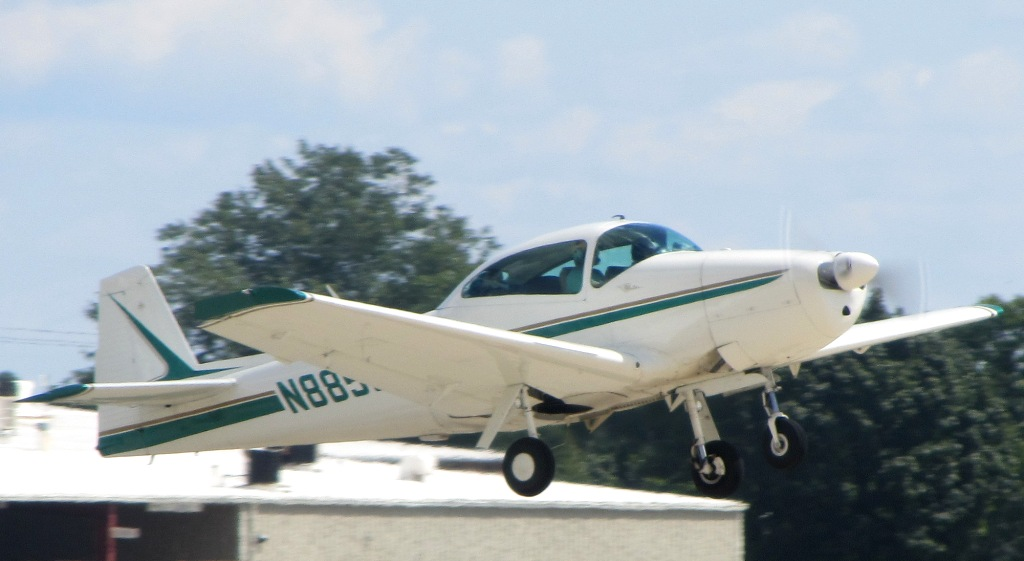
A Navion A at the 2013 Oshkosh Air Show in Wisconsin.

Nearly 70 years after its inception, the Navion is still in active use by private individuals, largely thanks to the purchase of the type certificat, design data, molds and tooling for the Navion by Sierra Hotel Aero Inc. of South St. Paul, Minnesota on March 18, 2003, and an active community of Navion owners. Although outside the scope of this blogpost, it must be mentioned that in January 2013 Sierra Hotel Aero announced plans to bring the Navion back into production, but it is unclear if this scheme has materialized. 

Saturday, February 15, 2020

Faster than Superman: Lockheed multisonic UAVs

The Lockheed Skunk Works has earned its place in 20th-century US aerospace history for building America's most reliable reconnaissance aircraft, most notably the U-2 Dragon Lady (which was shot down over the USSR in May 1960 and also set the stage for the 1962 missile crisis by photographing Soviet SS-4 "Sandal" missiles in Cuba) and the SR-71 Blackbird, the fastest-ever US military aircraft. However, one aspect of Lockheed's aerospace history that some aerospace historians tend to overlook is the fact that generations before NASA and the US Air Force undertook development and flight testing of hypersonic air-breathing technology, the Lockheed Skunk Works undertook development, testing, and deployment of unmanned air vehicles able to travel at high supersonic speeds (Mach 3 to 4), most notably the D-21 Tagboard. Recently, in late 2018, I finally got to see the D-21 in person at the March Field Air Museum. Therefore, I thought it would be appropriate to give an overview of multi-sonic UAVs developed by the Lockheed Skunk Works.

Top: Lockheed X-7 ramjet-powered test vehicle
Bottom: Lockheed Q-5/AQM-60 high-speed target drone

Lockheed's foray into aerospace vehicles able to travel faster than Superman (at speeds exceeding Mach 2.5) started in December 1946 when the US Army Air Force (US Air Force after September 18, 1947) issued a requirement for an unmanned experimental vehicle to investigate air-breathing flight at speeds of the Mach 3. Lockheed immediately responded with a proposal for an unmanned Mach 3 technology demonstrator, the L-171, which was 15 feet long and was to be powered by a Marquardt RJ37 ramjet, which would sustain itself at speeds of Mach 2.3-3.0 for 3 minutes. The performance estimates for the X-7 were rather remarkable, because the L-171 itself was designed several months before Chuck Yeager broke the sound barrier in the Bell X-1 on October 14, 1947. The Air Material Command favorably responded to Lockheed L-171 proposal and assigned it the MX-883 designator in January 1947. The original L-171 design was judged too small to achieve its desired performance targets, so Lockheed refined its MX-883 design to produce a larger test vehicle with better performance. The MX-883 was initially designated PTV-A-1 by the USAF (the prefix "PTV" stood for "Propulsion Test Vehicle"), but later redesignated X-7 in 1951. The first flight of the X-7 took place on April 26, 1951, and a total of 130 test flights were conducted until July 20, 1960. All X-7 test vehicles were launched from B-29 and B-50 motherships, relying on solid-fuel rockets for the boost to Mach 4, and a ramjet for sustained Mach 4 cruise; one X-7 test flight reached an altitude of 106,000 feet, while another reached Mach 4.31 (2,881 miles per hour; 4,636 km/h). The X-7 later evolved into a dedicated high-speed target drone, the Q-5 Kingfisher (redesignated AQM-60 in 1963), which had one Marquardt RJ43 ramjet and two Thiokol XM45 solid-fuel rockets. The Kingfisher was intended to simulate America's anti-aircraft missiles, including the Nike Ajax, Nike Hercules, and Bomarc, and it . Despite being the first air-breathing supersonic drone built in the US, the Kingfisher proved faster than the missiles it simulated, embarrassing the Air Force establishment and some sectors of the US aerospace industry, and by the mid-1960s, the Kingfisher program was axed.


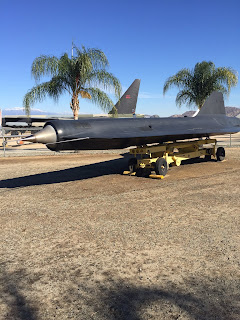
Upper left: D-21 on display at the March Field Air Museum in Riverside, California
Upper right: D-21B being boosted to high supersonic speed by a solid-fueled rocket booster, late 1960s.
Bottom: Lockheed M-21 (s/n 60-6940) carrying a D-21 drone.


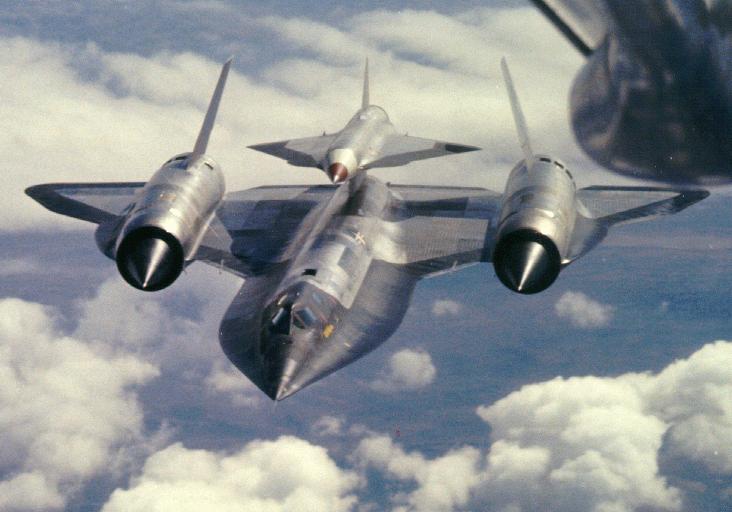
The Lockheed D-21, however, stands out as the best-known high-speed UAV ever developed by the Lockheed Skunk Works. In October 1962, the Lockheed Skunk Works proposed a Mach 3+ reconnaissance UAV under the company designation Q-12 for long-range reconnaissance missions or spy missions over enemy territory that were deemed too dangerous for the A-12 or SR-71. Like the Blackbird, the D-21 was made from titanium and radar-absorbent composites. For spy missions, the Q-12 was to be launched from the back of a modified A-12. The Q-12 was later designated D-21 in late 1963 to avoid confusion with the A-12 designator, and two A-12s on contract were modified as launch platforms for the D-21 and designated M-21 (M=Mother). The D-21, codenamed Tagboard by the CIA, utilized a Marquardt RJ43 ramjet for sustained high-supersonic flight, and the drone's fuselage is reminiscent of a stovepipe. The D-21 would be launched from the M-21 at high altitude, coast to Mach 3.8 with the ramjet and scour an enemy target with a Hycon high-resolution camera, eventually releasing a hatch with the onboard camera over a predetermined overwater area to be retrieved by a mid-air recovery system.

Captive carry flights of the D-21 began in December 1964 and continued into 1965; the first free flight of the D-21 occurred on March 5, 1966, and two additional launches followed. On the fourth launch, on July 30, 1966, a D-21 hit the tail of the M-21 mothership shortly after separation, causing both aircraft to crash and the death of one of the M-21 crewmembers. Due to the risks associated with the D-21/M-21 launch procedure, Lockheed opted for launching D-21 drones from the underwing pylon of a B-52H. Given the slower release speed from a B-52H, all D-21s under construction were equipped with a large solid-propellant rocket booster for acceleration to Mach 3+ speeds and designated D-21B. Two B-52Hs were modified as D-21 motherships, each carrying two D-21s. Twelve D-21B test launches were conducted from September 1967 to July 1969, and when the last two of those launches were deemed successes, the Air Force cleared the D-21 for operational missions over the Lop Nur nuclear weapons test site in Xinjiang, China, under codename SENIOR BOWL. Four D-21 overflights of the nuclear weapons test site were conducted from November 1969 to March 1971, but none were successful; the first mission ended in mishap when the D-21 veered off course and crashed in Siberia, the second and third missions completed their flights, but the hatches with the cameras weren't recovered, while the final D-21 mission ended crashed in Yunnan province. Because of the poor success of Operation Senior Bowl and Richard Nixon's finalization of his diplomatic opening to the People's Republic of China, the Tagboard program was cancelled in July 1971. Several D-21 drones that were built but not used in the Tagboard and Senior Bowl programs are now on display at museums in the US, including the one I saw at the March Field Air Museum. (In an interesting footnote, the D-21 that crashed in Siberia after veering off course during its first operational mission was used by the Tupolev Design Bureau as a basis of a planned reverse-engineered drone, the Voron [Raven], which never left the drawing board. More info on the Voron drone can be found in Gordon and Rigmant [2005, pp. 325-327].)

References:

Gordon, Y., & Rigmant, V., 2005. OKB Tupolev: A History of the Design Bureau and its AircraftHinckley, UK: Midland Publishing.  

Miller, J., 2001. The X-Planes: X-1 to X-45. Hinckley, UK: Midland Publishing.

Peebles, C., 1999. Dark Eagles: A History of Top Secret U.S. Aircraft Programs (Revised ed.). Novato, CA: Presidio Press.

Saturday, February 8, 2020

Takeaways from visit to Western Museum of Flight, January 2020, part 2: Northrop and Teledyne Ryan drones

Northrop Grumman has emerged as a key player in the non-combat and combat unmanned air vehicle market since the late 1990s with the RQ-4 Global Hawk and "RQ-180" high-altitude reconnaissance UAVs and X-47B Pegasus UCAV technology demonstrator. However, Northrop actually entered the unmanned aircraft business in 1952 when it acquired the Van Nuys-based Radioplane Company which had produced large quantities of OQ-2/3/7/13/14/TDD target drones in World War II, continuing the manufacturing activities of Radioplane in Van Nuys before moving its UAV business to Newbury Park in Ventura County in 1962, after which Radioplane Division was renamed Northrop-Ventura. Another major player in American subsonic drone development during the Cold War was the Ryan Aeronautical division of Teledyne, which built the Firebee, Lightning Bug, and Firefly drones, and it undertook the design of the RQ-4 high-altitude unmanned reconnaissance drone and RQ-8 Fire Scout rotorcraft in the first decade after the Cold War's end. Since the Radioplane/Northrop Ventura and Teledyne Ryan were key players in US military subsonic UAV development during the Cold War, and the Ryan Aeronautical Division of Teledyne would later become part of Northrop Grumman (which mean that the RQ-4 and RQ-8 became Northrop Grumman products, I've decided to discuss in this post a number of Northrop- and Teledyne Ryan-built drones that I saw at the Western Museum of Flight when it visited the museum last month.


An RP-71/MQM-57 Falconer (aka SD-1) on display at the Western Museum of Flight, photographed by me in January 2020.

The first drone on display at the Western Museum of Flight that deserves discussion is the Northrop (Radioplane) RP-71 Falconer propeller-driven drone (redesignated MQM-57 after 1963). Developed in 1955 from Radioplane's prolific Quail drone (called OQ-19 by USAAF/US Air Force and KD2R-1/2/3/4 by US Navy; later redesignated MQM-33), it was designed for battlefield reconnaissance in support of ground troops and had a slightly bigger fuselage than the Shelduck. The MQM-57 was also called the SD-1 because the US Army allocated the designation AN/USD-1 to the surveillance UAV system that included the drone itself. The Falconer carried a KS-54 or KS-61 camera system (including a KA-39A or KA-30 still picture camera, respectively), flare ejectors, and an AN/DPN-32 (later AN/DPN-62(V)) radar beacon, and it was tracked on the ground using the AN/MPQ-29 radar system. The MQM-57 was launched from a ground-based zero-length launcher and boosted to altitude by a RATO booster, and it could release flares to illuminate the night sky on night reconnaissance missions. After a reconnaissance flight, a Falconer would be recovered by parachute. About 1,500 Falconers were built, and they served the US Army and other armies of main US allies until the 1970s.


Left: Northrop KD2R-5/MQM-36 Shelduck at Western Museum of Flight.
Right: A pair of MQM-36 Shelducks aboard the USS Kearsarge, 1966.

Another early Northrop/Radioplane drone displayed at the museum worthy of discussion, related to the above-discussed Falconer drone, is the KD2R-5 Shelduck (later redesignated MQM-36). It was similar to the naval version of the Quail drone (KD2R-1/2/3/4) in having a McCulloch O-100 piston engine and being launched from a mobile platform, but had an improved autopilot and altitude-hold unit. The Shelduck entered service with the US Navy in the mid-1950s, and it became a training target for anti-aircraft missiles including the Hawk, Sidewinder, Nike, Tigercat, Redeye, Blowpipe, and Sparrow. The last MQM-36 drones were retired in the late 1980s.

Left: Teledyne Ryan AQM-34K (Model 147SRE) at Western Museum of Flight
Right: AQM-34L (Model 147SC) on a reconnaissance flight over North Vietnam, 1969.

The Teledyne Ryan Model 147 Lightning Bug drone I saw at the museum was a photo-reconnaissance adaptation of the Ryan Firebee, one of the most successful jet-powered American drones of the Cold War era. Impressed by the success of the Firebee, the US Air Force in 1961 instructed Teledyne Ryan to develop a reconnaissance version of Firebee, the Model 147 Lightning Bug, under Project Firefly. Four BQM-34A Firebees were converted into the first Lightning Bugs and internally called Model 147A, and the first of these flew in this iteration in April 1962. The Model 147B which flew in 1964 was the first high-altitude version of the Lightning Bug, having a longer fuselage and a far greater wingspan than the Model 147A. The Lightning Bug began flying operational missions in a wartime capacity after the US began military involvement in Vietnam in August 1964, and they were launched from DC-130 drone carrier versions of the Hercules tactical airlifter on spy flights over North Vietnam during the Vietnam War, performing tasks such as photo-reconnaissance, signals intelligence, and electronic warfare. While a comprehensive overview of different variants of the Lightning Bug is outside the scope of this post, I should mention that the AQM-34 designation was assigned to some versions of the Model 147. The Lightning Bug on display at the Western Museum of Flight is of the AQM-34K (Model 147SRE) night reconnaissance version of the Model 147S low-altitude day reconnaissance variant of the Model 147. Although the AQM-34K had the short wings of the BQM-34A Firebee, it had the longer fuselage of the Model 147G and 147J, which were powered by a slightly more powerful version of the Continental J69 turbojet, and because the AQM-34K was designed for night operations, it used an infrared strobe barely noticeable from ground view and infrared film, while relying on an improved guidance system with Doppler navigation radar. Other low-altitude versions of the Lightning Bug versions with the AQM-34 designation were the AQM-34J (Model 147NC(M1)) derivative of the AQM-34G/H (Models 147NA and 147NC), the AQM-34L (Model 147SC), and AQM-34M (Model 147SD) with a real-time datalink. Twenty AQM-34Ks along with more than 400 AQM-34Ls and 87 AQM-34Ms were manufactured, and the AQM-34K flew operational missions over North Vietnam from November 1968 to October 1969, while the AQM-34L variant served in Vietnam from 1969 to 1973 and achieved a survivability rate of 87.2% with respect to overflights of North Vietnam. When the Vietnam War ended, all AQM-34K/L/M drones were retired and put in storage. The preserved AQM-34K was acquired by the Western Museum of Flight in 2001, after spending 15 years at the California Science Center.


Top: Northrop NV-144 prototype multirole drone
Bottom: Display panel for NV-144, including 3-view drawing

One last drone design I saw at the Western Museum of Flight during my visit there in January 2020 is the NV-144. In early 1980, after the US Navy initiated a requirement for a new high subsonic target drone (designated BQM-126) to replace the Firebee and Chukar drones Northrop initiated design of a subsonic reconnaissance drone derived from the Chukar, designated NV-144. Four NV-144 prototypes were constructed, and captive carry tests were conducted in early 1984, with the NV-144's first free flight occurring on February 24, a Grumman A-6 Intruder serving as a launch platform for the drone. However, the BQM-126 production contract was awarded to the Beechcraft Model 997, a derivative of the Beechcraft MQM-107 Streaker first flown in March 1984. Unfortunately, production plans for the BQM-126 (the Navy hoped to procure 700 drones) were axed, perhaps due to a lack of funds. Northrop later adapted the NV-144 design to a 1986 requirement by the Air Force, Navy, and Marine Corps for a medium range reconnaissance drone by conceiving a battlefield surveillance version of the NV-144, the NV-144R, which carried cameras, an infrared linescanner, and other reconnaissance equipment inside the nose. The NV-144R and a rival design by Beechcraft and Martin Marietta for a BQM-126 derivative were down-selected for prototyping in 1987, with a fly-off and contract award planned for late 1988, but the medium-range reconnaissance RPV program was shelved before the NV-144R could be built. Northrop also conceived the NV-151 derivative of the NV-144 with a slightly longer fuselage and wings as well as a 1,000 lb (4.45 kN) thrust turbojet for the US Air Force, sometime in 1982/1983 and little else is known about the NV-151's development, although it can be surmised that it does not seem to have advanced beyond the prototype stage. 

References:

Taylor, J.W.R., 1984. Jane's All the World's Aircraft 1984-1985. Coulsdon, UK: Jane's Information Group.

Taylor, J.W.R., 1986. Jane's All the World's Aircraft 1986-1987. Coulsdon, UK: Jane's Information Group.

Supersonic Firebees

The Firebee drone family is unquestionably the most versatile jet-powered unmanned air vehicle family developed and built during the Cold Wa...