Wednesday, April 22, 2020

From Inglewood to San Diego: the story of the Navion light utility aircraft

In the annals of 20th century aviation history there have been several aircraft designs conceived by one aircraft manufacturer which have been acquired by other companies whenever the manufacturer initially in charge of designing a new aircraft is preoccupied with other aircraft products. One aircraft design built in Southern California, the Navion light utility aircraft, was initially manufactured in quantity in the Los Angeles Basin before production rights for it were transferred to the Ryan company in San Diego. Given the relocation of production of the Navion to San Diego, I am dedicating this post to telling the story of development and series production of this interesting utility aircraft.

Left: The first North American Navion prototype (civil registration NX18928)
Right: A North American Navion (civil registration N91161) at the Planes of Fame Museum, photographed by me on April 13, 2019. 

In late August 1945, North American Aviation proposed the NA-143 light utility aircraft which featured a tricycle landing gear, simple aluminum construction, and seating accommodations for the pilot and three passengers, with power provided by one 185 hp (138 kW) Continental E185 flat piston engine. This design was christened the Navion, and the commercial production version proposed in January 1946 was designated NA-145 by the company. The rugged design of the Navion was tailored to match the intended post-World War II boom in US general aviation, and the assumption was that wartime pilots would come home and continue flying with their families and friends under peacetime conditions. Two NA-143 prototypes were built (NX18928 and NX18929), with the first prototype taking to the skies in April 1946. North American eventually produced 1,027 commercial Navions from 1946-1947 for light utility purposes, although the post-World War II boom in general aviation anticipated by North American did not materialize. The US Army Air Force took a keen interest in the Navion and in 1946 it placed an order for 83 aircraft (serial numbers 47-1297/1379) under the designation L-17A (company designation NA-154) for use a liaison and staff transport aircraft, The L-17A first flew in 1947, and 36 L-17As were given to the US Army while 47 were lent to the Air National Guard.
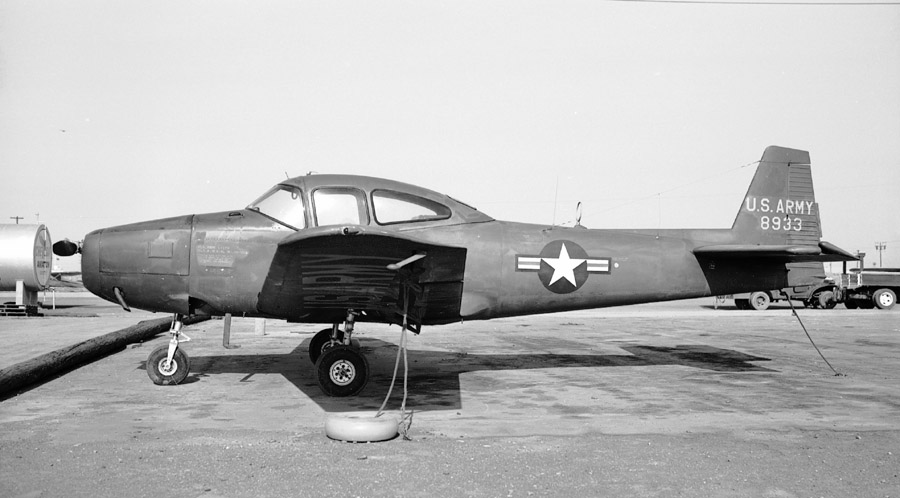
An L-17B (serial number 48-933) at Crissy Field in San Francisco, 1955.

Even as the US military was taking deliveries of the Navion, North American Aviation handed over the Navion design to the Ryan Aeronautical Company in the summer of 1947 due to its growing focus on the AJ Savage and F-86 Sabre programs. Ryan launched production of the Navion in 1948, building 600 examples of the baseline Navion and eventually undertaking development of two improved Navion variants, the Navion A with one 205 hp (153 kW) Continental O-470-7 flat piston engine and the Navion B (also called the Super Navion 260) with by one 260 hp (194 kW) Lycoming GO-435-C2 geared flat piston engine. Ryan completed a total of 602 Navion A and 222 Navion B aircraft before ending production in 1951 to focus on unmanned air vehicle development, by which time it had built more than 1,400 Navions under license. The military designation L-17B was assigned to 163 Navion A airframes delivered to the US Army and ANG with serial numbers 48-921/1078 and 49-1961/1965, and 35 L-17As (47-1298/1301, 47-1303/1313, 47-1315/1319, 47-1321/1328 and 47-1335) were designated L-17C after being fitted by Ryan with improved brakes and fuel capacity; the L-17Bs with serials 49-1961/1965 were eventually delivered to the Royal Hellenic Air Force in Greece in the early 1950s). Three Navion Bs ordered by the US Army in 1950 with serial numbers 51-16425/16427 were originally designated XL-22 but were redesignated XL-17D before delivery. The L-17 augmented its liaison and staff transport duties with casualty evacuation and forward air control roles during the Korean War, aiding American and South Korean troops in preventing friendly fire incidents and evacuating US war casualties. The L-17s were retired from frontline service in 1957 and eventually handed over to the USAF's civil air patrols or used as hacks, by which time the Tulsa Manufacturing Corporation in Tulsa, Oklahoma, had converted many Navion airframes to Navion D, E, and F configuration with wingtip tanks and an inverted Continental IO-470H piston engine after acquiring development rights for the Navion. After US Defense Department established the Tri-Service aircraft designation system on September 18, 1962, the L-17s remaining in service were redesignated U-18, with L-17A, L-17B, and L-17C becoming U-18A, U-18B, and U-18C respectively.

The Navion airframe I saw at the Planes of Fame Museum back in 2019, despite sporting a military paint scheme, was actually not used by the US military. It was completed on October 31, 1946 and flew on December 7 (the fifth anniversary of the Pearl Harbor attack), bearing the civil registration N91161 and serving several civilian customers until it was donated to the Planes of Fame Museum in Chino, California, in 1996. The Planes of Fame Museum boss Steve Hinton found the aircraft to be in derelict shape and in 2003, two volunteers, Bill Fisher and Jury Vanderwoude, launched a project to restore N91161 to good condition. When Fisher died while the restoration was taking place, Vanderwoude emblazoned the aircraft's nose with the Li'l Bill nose art as a tribute to Fisher, and another volunteer joined the restoration project, painting the aircraft in the US Army color scheme applied to the L-17 variant of the Navion. After 20,000 hours of volunteer labor, the restoration of N91161 was completed in 2018, and the aircraft made its first post-restoration flight of N91161 on April 25, 2019, a little over a week after I saw the aircraft in person.
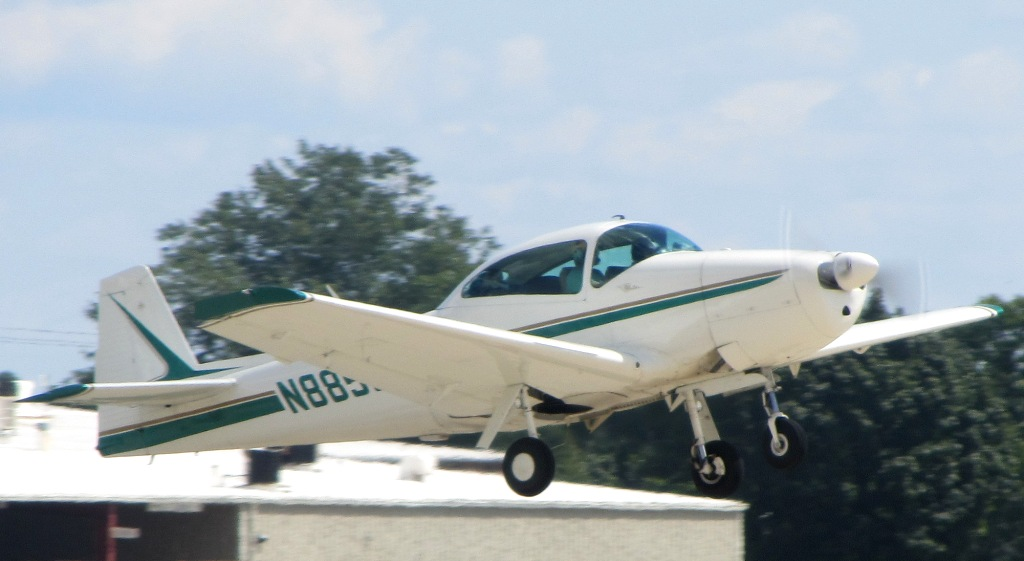
A Navion A at the 2013 Oshkosh Air Show in Wisconsin.

Nearly 70 years after its inception, the Navion is still in active use by private individuals, largely thanks to the purchase of the type certificat, design data, molds and tooling for the Navion by Sierra Hotel Aero Inc. of South St. Paul, Minnesota on March 18, 2003, and an active community of Navion owners. Although outside the scope of this blogpost, it must be mentioned that in January 2013 Sierra Hotel Aero announced plans to bring the Navion back into production, but it is unclear if this scheme has materialized. 

Saturday, February 15, 2020

Faster than Superman: Lockheed multisonic UAVs

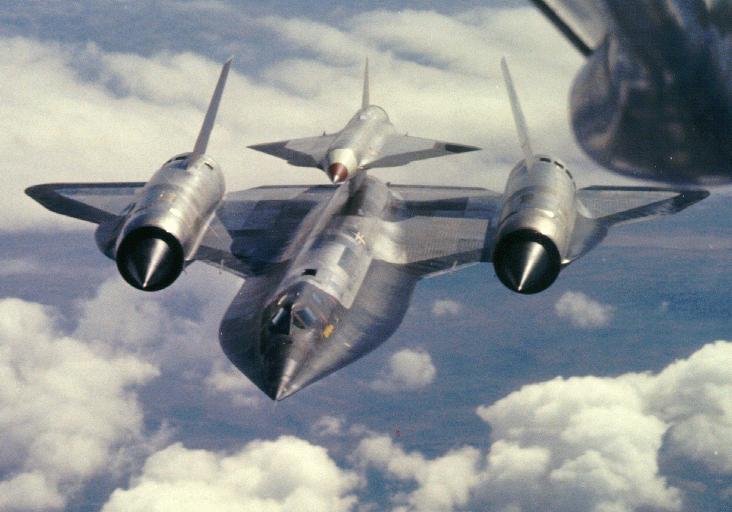
The Lockheed Skunk Works has earned its place in 20th-century US aerospace history for building America's most reliable reconnaissance aircraft, most notably the U-2 Dragon Lady (which was shot down over the USSR in May 1960 and also set the stage for the 1962 missile crisis by photographing Soviet SS-4 "Sandal" missiles in Cuba) and the SR-71 Blackbird, the fastest-ever US military aircraft. However, one aspect of Lockheed's aerospace history that some aerospace historians tend to overlook is the fact that generations before NASA and the US Air Force undertook development and flight testing of hypersonic air-breathing technology, the Lockheed Skunk Works undertook development, testing, and deployment of unmanned air vehicles able to travel at high supersonic speeds (Mach 3 to 4), most notably the D-21 Tagboard. Recently, in late 2018, I finally got to see the D-21 in person at the March Field Air Museum. Therefore, I thought it would be appropriate to give an overview of multi-sonic UAVs developed by the Lockheed Skunk Works.

Top: Lockheed X-7 ramjet-powered test vehicle
Bottom: Lockheed Q-5/AQM-60 high-speed target drone

Lockheed's foray into aerospace vehicles able to travel faster than Superman (at speeds exceeding Mach 2.5) started in December 1946 when the US Army Air Force (US Air Force after September 18, 1947) issued a requirement for an unmanned experimental vehicle to investigate air-breathing flight at speeds of the Mach 3. Lockheed immediately responded with a proposal for an unmanned Mach 3 technology demonstrator, the L-171, which was 15 feet long and was to be powered by a Marquardt RJ37 ramjet, which would sustain itself at speeds of Mach 2.3-3.0 for 3 minutes. The performance estimates for the X-7 were rather remarkable, because the L-171 itself was designed several months before Chuck Yeager broke the sound barrier in the Bell X-1 on October 14, 1947. The Air Material Command favorably responded to Lockheed L-171 proposal and assigned it the MX-883 designator in January 1947. The original L-171 design was judged too small to achieve its desired performance targets, so Lockheed refined its MX-883 design to produce a larger test vehicle with better performance. The MX-883 was initially designated PTV-A-1 by the USAF (the prefix "PTV" stood for "Propulsion Test Vehicle"), but later redesignated X-7 in 1951. The first flight of the X-7 took place on April 26, 1951, and a total of 130 test flights were conducted until July 20, 1960. All X-7 test vehicles were launched from B-29 and B-50 motherships, relying on solid-fuel rockets for the boost to Mach 4, and a ramjet for sustained Mach 4 cruise; one X-7 test flight reached an altitude of 106,000 feet, while another reached Mach 4.31 (2,881 miles per hour; 4,636 km/h). The X-7 later evolved into a dedicated high-speed target drone, the Q-5 Kingfisher (redesignated AQM-60 in 1963), which had one Marquardt RJ43 ramjet and two Thiokol XM45 solid-fuel rockets. The Kingfisher was intended to simulate America's anti-aircraft missiles, including the Nike Ajax, Nike Hercules, and Bomarc, and it . Despite being the first air-breathing supersonic drone built in the US, the Kingfisher proved faster than the missiles it simulated, embarrassing the Air Force establishment and some sectors of the US aerospace industry, and by the mid-1960s, the Kingfisher program was axed.


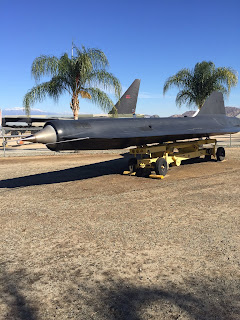
Upper left: D-21 on display at the March Field Air Museum in Riverside, California
Upper right: D-21B being boosted to high supersonic speed by a solid-fueled rocket booster, late 1960s.
Bottom: Lockheed M-21 (s/n 60-6940) carrying a D-21 drone.


The Lockheed D-21, however, stands out as the best-known high-speed UAV ever developed by the Lockheed Skunk Works. In October 1962, the Lockheed Skunk Works proposed a Mach 3+ reconnaissance UAV under the company designation Q-12 for long-range reconnaissance missions or spy missions over enemy territory that were deemed too dangerous for the A-12 or SR-71. Like the Blackbird, the D-21 was made from titanium and radar-absorbent composites. For spy missions, the Q-12 was to be launched from the back of a modified A-12. The Q-12 was later designated D-21 in late 1963 to avoid confusion with the A-12 designator, and two A-12s on contract were modified as launch platforms for the D-21 and designated M-21 (M=Mother). The D-21, codenamed Tagboard by the CIA, utilized a Marquardt RJ43 ramjet for sustained high-supersonic flight, and the drone's fuselage is reminiscent of a stovepipe. The D-21 would be launched from the M-21 at high altitude, coast to Mach 3.8 with the ramjet and scour an enemy target with a Hycon high-resolution camera, eventually releasing a hatch with the onboard camera over a predetermined overwater area to be retrieved by a mid-air recovery system.

Captive carry flights of the D-21 began in December 1964 and continued into 1965; the first free flight of the D-21 occurred on March 5, 1966, and two additional launches followed. On the fourth launch, on July 30, 1966, a D-21 hit the tail of the M-21 mothership shortly after separation, causing both aircraft to crash and the death of one of the M-21 crewmembers. Due to the risks associated with the D-21/M-21 launch procedure, Lockheed opted for launching D-21 drones from the underwing pylon of a B-52H. Given the slower release speed from a B-52H, all D-21s under construction were equipped with a large solid-propellant rocket booster for acceleration to Mach 3+ speeds and designated D-21B. Two B-52Hs were modified as D-21 motherships, each carrying two D-21s. Twelve D-21B test launches were conducted from September 1967 to July 1969, and when the last two of those launches were deemed successes, the Air Force cleared the D-21 for operational missions over the Lop Nur nuclear weapons test site in Xinjiang, China, under codename SENIOR BOWL. Four D-21 overflights of the nuclear weapons test site were conducted from November 1969 to March 1971, but none were successful; the first mission ended in mishap when the D-21 veered off course and crashed in Siberia, the second and third missions completed their flights, but the hatches with the cameras weren't recovered, while the final D-21 mission ended crashed in Yunnan province. Because of the poor success of Operation Senior Bowl and Richard Nixon's finalization of his diplomatic opening to the People's Republic of China, the Tagboard program was cancelled in July 1971. Several D-21 drones that were built but not used in the Tagboard and Senior Bowl programs are now on display at museums in the US, including the one I saw at the March Field Air Museum. (In an interesting footnote, the D-21 that crashed in Siberia after veering off course during its first operational mission was used by the Tupolev Design Bureau as a basis of a planned reverse-engineered drone, the Voron [Raven], which never left the drawing board. More info on the Voron drone can be found in Gordon and Rigmant [2005, pp. 325-327].)

References:

Gordon, Y., & Rigmant, V., 2005. OKB Tupolev: A History of the Design Bureau and its Aircraft.  Hinckley, UK: Midland Publishing.  

Miller, J., 2001. The X-Planes: X-1 to X-45. Hinckley, UK: Midland Publishing.

Peebles, C., 1999. Dark Eagles: A History of Top Secret U.S. Aircraft Programs (Revised ed.). Novato, CA: Presidio Press.

Saturday, February 8, 2020

Takeaways from visit to Western Museum of Flight, January 2020, part 2: Northrop and Teledyne Ryan drones

Northrop Grumman has emerged as a key player in the non-combat and combat unmanned air vehicle market since the late 1990s with the RQ-4 Global Hawk and "RQ-180" high-altitude reconnaissance UAVs and X-47B Pegasus UCAV technology demonstrator. However, Northrop actually entered the unmanned aircraft business in 1952 when it acquired the Van Nuys-based Radioplane Company which had produced large quantities of OQ-2/3/7/13/14/TDD target drones in World War II, continuing the manufacturing activities of Radioplane in Van Nuys before moving its UAV business to Newbury Park in Ventura County in 1962, after which Radioplane Division was renamed Northrop-Ventura. Another major player in American subsonic drone development during the Cold War was the Ryan Aeronautical division of Teledyne, which built the Firebee, Lightning Bug, and Firefly drones, and it undertook the design of the RQ-4 high-altitude unmanned reconnaissance drone and RQ-8 Fire Scout rotorcraft in the first decade after the Cold War's end. Since the Radioplane/Northrop Ventura and Teledyne Ryan were key players in US military subsonic UAV development during the Cold War, and the Ryan Aeronautical Division of Teledyne would later become part of Northrop Grumman (which mean that the RQ-4 and RQ-8 became Northrop Grumman products, I've decided to discuss in this post a number of Northrop- and Teledyne Ryan-built drones that I saw at the Western Museum of Flight when it visited the museum last month.


An RP-71/MQM-57 Falconer (aka SD-1) on display at the Western Museum of Flight, photographed by me in January 2020.

The first drone on display at the Western Museum of Flight that deserves discussion is the Northrop (Radioplane) RP-71 Falconer propeller-driven drone (redesignated MQM-57 after 1963). Developed in 1955 from Radioplane's prolific Quail drone (called OQ-19 by USAAF/US Air Force and KD2R-1/2/3/4 by US Navy; later redesignated MQM-33), it was designed for battlefield reconnaissance in support of ground troops and had a slightly bigger fuselage than the Shelduck. The MQM-57 was also called the SD-1 because the US Army allocated the designation AN/USD-1 to the surveillance UAV system that included the drone itself. The Falconer carried a KS-54 or KS-61 camera system (including a KA-39A or KA-30 still picture camera, respectively), flare ejectors, and an AN/DPN-32 (later AN/DPN-62(V)) radar beacon, and it was tracked on the ground using the AN/MPQ-29 radar system. The MQM-57 was launched from a ground-based zero-length launcher and boosted to altitude by a RATO booster, and it could release flares to illuminate the night sky on night reconnaissance missions. After a reconnaissance flight, a Falconer would be recovered by parachute. About 1,500 Falconers were built, and they served the US Army and other armies of main US allies until the 1970s.


Left: Northrop KD2R-5/MQM-36 Shelduck at Western Museum of Flight.
Right: A pair of MQM-36 Shelducks aboard the USS Kearsarge, 1966.

Another early Northrop/Radioplane drone displayed at the museum worthy of discussion, related to the above-discussed Falconer drone, is the KD2R-5 Shelduck (later redesignated MQM-36). It was similar to the naval version of the Quail drone (KD2R-1/2/3/4) in having a McCulloch O-100 piston engine and being launched from a mobile platform, but had an improved autopilot and altitude-hold unit. The Shelduck entered service with the US Navy in the mid-1950s, and it became a training target for anti-aircraft missiles including the Hawk, Sidewinder, Nike, Tigercat, Redeye, Blowpipe, and Sparrow. The last MQM-36 drones were retired in the late 1980s.

Left: Teledyne Ryan AQM-34K (Model 147SRE) at Western Museum of Flight
Right: AQM-34L (Model 147SC) on a reconnaissance flight over North Vietnam, 1969.

The Teledyne Ryan Model 147 Lightning Bug drone I saw at the museum was a photo-reconnaissance adaptation of the Ryan Firebee, one of the most successful jet-powered American drones of the Cold War era. Impressed by the success of the Firebee, the US Air Force in 1961 instructed Teledyne Ryan to develop a reconnaissance version of Firebee, the Model 147 Lightning Bug, under Project Firefly. Four BQM-34A Firebees were converted into the first Lightning Bugs and internally called Model 147A, and the first of these flew in this iteration in April 1962. The Model 147B which flew in 1964 was the first high-altitude version of the Lightning Bug, having a longer fuselage and a far greater wingspan than the Model 147A. The Lightning Bug began flying operational missions in a wartime capacity after the US began military involvement in Vietnam in August 1964, and they were launched from DC-130 drone carrier versions of the Hercules tactical airlifter on spy flights over North Vietnam during the Vietnam War, performing tasks such as photo-reconnaissance, signals intelligence, and electronic warfare. While a comprehensive overview of different variants of the Lightning Bug is outside the scope of this post, I should mention that the AQM-34 designation was assigned to some versions of the Model 147. The Lightning Bug on display at the Western Museum of Flight is of the AQM-34K (Model 147SRE) night reconnaissance version of the Model 147S low-altitude day reconnaissance variant of the Model 147. Although the AQM-34K had the short wings of the BQM-34A Firebee, it had the longer fuselage of the Model 147G and 147J, which were powered by a slightly more powerful version of the Continental J69 turbojet, and because the AQM-34K was designed for night operations, it used an infrared strobe barely noticeable from ground view and infrared film, while relying on an improved guidance system with Doppler navigation radar. Other low-altitude versions of the Lightning Bug versions with the AQM-34 designation were the AQM-34J (Model 147NC(M1)) derivative of the AQM-34G/H (Models 147NA and 147NC), the AQM-34L (Model 147SC), and AQM-34M (Model 147SD) with a real-time datalink. Twenty AQM-34Ks along with more than 400 AQM-34Ls and 87 AQM-34Ms were manufactured, and the AQM-34K flew operational missions over North Vietnam from November 1968 to October 1969, while the AQM-34L variant served in Vietnam from 1969 to 1973 and achieved a survivability rate of 87.2% with respect to overflights of North Vietnam. When the Vietnam War ended, all AQM-34K/L/M drones were retired and put in storage. The preserved AQM-34K was acquired by the Western Museum of Flight in 2001, after spending 15 years at the California Science Center.


Top: Northrop NV-144 prototype multirole drone
Bottom: Display panel for NV-144, including 3-view drawing

One last drone design I saw at the Western Museum of Flight during my visit there in January 2020 is the NV-144. In early 1980, after the US Navy initiated a requirement for a new high subsonic target drone (designated BQM-126) to replace the Firebee and Chukar drones Northrop initiated design of a subsonic reconnaissance drone derived from the Chukar, designated NV-144. Four NV-144 prototypes were constructed, and captive carry tests were conducted in early 1984, with the NV-144's first free flight occurring on February 24, a Grumman A-6 Intruder serving as a launch platform for the drone. However, the BQM-126 production contract was awarded to the Beechcraft Model 997, a derivative of the Beechcraft MQM-107 Streaker first flown in March 1984. Unfortunately, production plans for the BQM-126 (the Navy hoped to procure 700 drones) were axed, perhaps due to a lack of funds. Northrop later adapted the NV-144 design to a 1986 requirement by the Air Force, Navy, and Marine Corps for a medium range reconnaissance drone by conceiving a battlefield surveillance version of the NV-144, the NV-144R, which carried cameras, an infrared linescanner, and other reconnaissance equipment inside the nose. The NV-144R and a rival design by Beechcraft and Martin Marietta for a BQM-126 derivative were down-selected for prototyping in 1987, with a fly-off and contract award planned for late 1988, but the medium-range reconnaissance RPV program was shelved before the NV-144R could be built. Northrop also conceived the NV-151 derivative of the NV-144 with a slightly longer fuselage and wings as well as a 1,000 lb (4.45 kN) thrust turbojet for the US Air Force, sometime in 1982/1983 and little else is known about the NV-151's development, although it can be surmised that it does not seem to have advanced beyond the prototype stage. 

References:

Taylor, J.W.R., 1984. Jane's All the World's Aircraft 1984-1985. Coulsdon, UK: Jane's Information Group.

Taylor, J.W.R., 1986. Jane's All the World's Aircraft 1986-1987. Coulsdon, UK: Jane's Information Group.

Friday, January 31, 2020

Takeaways from visit to Western Museum of Flight, January 2020, part 1: desktop models of exotic SoCal aircraft

While visiting the Western Museum of Flight in Torrance, I had finished discussing with the museum staff my previous blog posts on advanced 1950s Northrop flying wing bomber designs and Northrop cargo transport projects, as well as the recent maiden launch of the Boeing CST-100 Starliner last year, and eventually I was touring the museum's main building when a trio of desktop models of planes developed in Southern California caught my eye while touring the museum's displays. Although the glass case displays at the museum contain notable Northrop products like the YF-23 Black Widow II/Grey Ghost prototype stealth fighter that lost to the F-22 Raptor as well as the Northrop YF-17 Cobra prototype lightweight fighter and 1940s flying wings, but also desktop models of the North American X-15 and Douglas C-124 Globemaster II heavy airlifter, the three desktop models I came across had never been displayed in a glass case before during my previous visits of the Western Museum of Flight. 

Left: Desktop model of the North American F-107 prototype fighter-bomber (donated to WMoF by Donald Spaulding)
Bottom: First F-107 prototype (serial number 55-5118) in flight over the Mojave Desert, southern California 

The first of the three desktop models that caught my eye while visiting the Western Museum of Flight worth discussing is a 1/40 scale desktop model of the North American F-107 prototype fighter-bomber donated by Donald Spaulding. While gazing at a glass case containing memorabilia and artifacts concerning the history of aviation development in Southern California, I happened to notice an F-107 desktop model inside a glass case containing photos of the U-2 Dragon Lady and SR-71 Blackbird spyplanes but also a copy of a memoir by Ben Rich (1925-1995) detailing his years as head of the Lockheed Skunk Works from 1975-1991. The F-107 is a plane that most military aviation gurus don't think about too much, but it was one of the most advanced US combat planes built by North American Aviation apart from the B-70 Valkyrie trisonic heavy bomber. North American Aviation made its mark on US military aviation history with the WW2-era P-51 Mustang that escorted vast armadas of B-17 and B-24 bombers over Nazi-occupied Europe, the F-86 Sabre swept-wing jet fighter of Korean War fame, and the first US supersonic jet fighter, the F-100 Super Sabre. The F-107 began life as an advanced variant of the F-100, the F-100B (company designation NA-212) in response to a USAF requirement for supersonic fighter-bomber to replace the F-84F Thunderstreak. Although supersonic like the F-100, the F-100B differed in having an engine intake atop the fuselage and pointed nose for housing the  interception radar, leading the USAF to redesignate the F-100B as the F-107. Three prototypes were built, the first one taking to the skies on September 10, 1956. The F-107 performed well in flight tests, but the USAF selected the Republic F-105 Thunderchief over the F-107 as the next American fighter-bomber in 1957. Fortunately, two of the three F-107 prototypes survived the breaker's torch and are now in museums in the US, with 55-5118 displayed at the Pima Air & Space Museum in Arizona, and 55-5119 on display at the National USAF Museum near Wright-Patterson Air Force Base in Dayton, Ohio. North American pitched a carrier-based derivative of the F-107 to the US Navy in 1955, unofficially dubbed "FJ-5" and "Improved FJ-4" by the company, but this proposal did not materialize.


Top: Northrop X-21 desktop model at Western Museum of Flight.
Bottom: Northrop X-21 serial number 55-0408 in flight over the Mojave Desert.

Another desktop model of a plane built in southern California that was worth getting my attention at the Western Museum of flight is of the Northrop X-21 experimental aircraft. The X-21 was basically a technology demonstrator for a large transport aircraft equipped featuring long-span wings with laminar flow control surfaces, being based on the airframe of the Douglas WB-66D Destroyer. Northrop believed that a large aircraft sporting a wing with laminar flow control properties could have better fuel efficiency, greater range, and higher endurance, pointing out that an 80 percent laminar wing might reduce overall drag by 25 percent. Therefore, two WB-66Ds (serial numbers 55-0408 and 55-0410) were modified by Northrop to feature a new wing with laminar flow control systems spanning 93 feet 6 inches (28.51 meters) and the underwing Allison J71 turbojets removed and replaced by two General Electric J79 turbojets mounted on the sides of the rear fuselage underneath the horizontal stabilizer, thus being designated X-21. The first flight of the X-21 took place on April 18, 1963, but experience from flight testing suggested that the laminar flow control system were prone to damage from ice, rain, dirt, and dust. Consequently, the US Air Force and NASA decided that application of the laminar flow wing to civil and military transport aircraft was impractical. Both X-21s survive in a derelict state at Edwards Air Force Base, but neither has been restored for display at air museums in southern California.

Desktop model of the McDonnell Douglas MD-91 propfan airliner project

The third and final desktop model worthy of discussion that caught my eye while I was at the Western Museum of Flight is of the McDonnell Douglas MD-91, a proposed propfan airliner design of the 1980s. Given the high price of oil in the 1980s, the McDonnell Douglas company, capitalizing on the MD-80 twin-jet airliner, envisaged derivatives of the MD-80 series with two propfan engines (either General Electric GE36 or Pratt & Whitney/Allison 578) under the designations MD-91 and MD-92. Propfan technology (turbofans with swept-blade propellers) was seen by the aeronautical community as offering the benefits of both turbofans and turboprops, combining the fuel economy of turboprop engines with the speed and performance of turbofans in order to offer better fuel economy than turbofan engines. The MD-91 design was to seat 110-120 passengers, while the 157 foot long MD-92 would have seated 165 passengers. An all-new McDonnell Douglas propfan-powered airliner, the MD-94, was similar in size to the MD-92 and could seat 160-180 passengers. Entry into airline service for the MD-91, MD-92, and MD-94 was planned for 1991, 1992, and 1994 respectively. There was also a project for a maritime patrol version of the MD-91 (informally called "P-9D") as a successor to the Lockheed P-3 Orion, but that proposal lost out to the Lockheed P-7 Orion II for the P-3 replacement contract, even though the P-7 would later be cancelled in July 1990 due to cost overruns. McDonnell Douglas modified a number of MD-80s as testbeds for the propfan engines planned for the MD-91, MD-92, and MD-94, and tests were conducted in 1988. Tests with the General Electric GE36 and Pratt & Whitney/Allison 578 seemed to validate the suggested benefits of propfans, but falling oil prices in 1989 caused the airline industry to lose interest in propfan airliners, leading to the axing of the MD-91, MD-92, and MD-94 projects. For these same reasons, another US propfan airliner project, the Boeing 7J7 (J standing for Japan) was cancelled without reaching the hardware phase.

[EDIT: It came to my attention recently that North American proposed a navalized version of the F-107 under the company labels "Improved FJ-4" and "FJ-5", thanks to a detailed monograph on this project by Zichek (2011).]

References:

Zichek, J.A., 2011. North American FJ-5 Fighter: A Navalized Derivative of the F-107A (American Aerospace Archive Number 2). La Jolla, CA: American Aerospace Archive.

Thursday, January 2, 2020

Little-known Northrop flying wings of 1940s-early 1950s, part 3: commercial and military transport designs

For over four decades, US aerospace companies like Boeing, Lockheed Martin, and Northrop Grumman (in concert with NASA) have tinkered with the notion of blended wing body (BWB) aircraft that could be used as airliners, air freighters, or airlifters, recognizing that a BWB design could offer greater carrying capacity and better fuel efficiency than conventional American long-range airliners like the Boeing 747, 777, and 787. However, the notion of adapting a flying wing or blended wing body design for use as a commercial airliner, cargo carrier, or airlifter is not a recent phenomenon; in the late 1940s and early 1950s, the Northrop Corporation investigated the possibility of using flying wings to carry passengers and cargo, producing the first designs for commercial flying wings.

*McDonnell Douglas (absorbed by Boeing in August 1997) tinkered with studies for flying wing/BWB designs that could carry hundreds of passengers or freight loads beginning in the late 1970s. Boeing took stewardship of design studies into passenger and commercial freight BWB aircraft that McDonnell Douglas had conceived beginning in 1988 after acquiring McDD in 1997, so I've omitted mention of McDonnell Douglas in the first paragraph of the post for convenience.

Rising Cold War tensions and the aftershocks of the Berlin Airlift prompted the United States Air Force to stress the importance of strategic heavy airlift in overseas US military operations, considering that World War II had seen American troops ferried to Europe and the Pacific via troopship. The Douglas C-74 Globemaster I and Boeing C-97 Stratofreighter designed in the WW2 era came too late for the war, but the USAF learned the hard way when dealing with the question of hauling large loads of troops and military equipment to faraway war zones in a short space of time. Meanwhile, mass air freight was very much in its infancy, with air freight being carried out largely by mail planes, and the technology of the jet airliner had just come into being with the first flight of the de Havilland D.H.106 Comet in 1949. Perhaps sensing the growing importance of heavy airlift in the post-WW2 era and the vastly enhanced carrying capacity offered by a flying wing/BWB design, Northrop decided to look into adapting its flying wing designs for use as airliners, air freighters, and airlifters.

Left: Cutaway view of the interior of the airliner version of the Northrop YB-49 flying wing jet bomber
Right: Interior of the mock-up of the airliner version of the YB-49

Beginning in the late 1940s, Jack Northrop investigated adapting the YB-49 flying wing jet bomber for use as a jet airliner. His company hired a Hollywood film studio to make a film touting the benefits of a jet airliner based on the YB-49, including the creation of a full-size mockup complete with rolling food carts and beautifully dressed actors posing as passengers. The airliner version of the B-49 would have had accommodated 50-80 passengers. However, the proposed flying wing airliner wasn't taken seriously by the airline industry in light of longitudinal instability experienced by the YB-49 during flight testing, so it never went beyond the drawing board. If Northrop had managed to get its airliner derivative of the B-49 into the hardware phase, it would have been the first US jetliner rather than Boeing 707, considering that the YB-49 derived flying wing airliner was envisaged around the time that Boeing proposed America's first design for a jetliner, the Model 473.

Left: Northrop cargo pod-carrying flying wing transport design study, 1949
Right: Three-drawing of a Northrop flying wing transport with four Allison T40 turboprops, April 1950

As I mentioned in the post about the EB-35B, Northrop had conceived a transport version of the XB-35 under the N-10 designation, but that project never came to fruition. However, by 1949, thanks to the Berlin airlift having highlighted the importance of strategic heavy airlift, Northrop returned to adapting the N-9 series for used as strategic airlifters, this time proposing a spree of flying wing airlifter designs powered by turboprop engines. One Northrop flying wing airlifter design dated April 27, 1949 had the same wingspan and outer wing panels as the B-35 and B-49 but was powered by two Allison T40 turboprops and had a raised center section housing a 75-foot long cargo pod that could accommodate either 84 combat troops or a bombardment crew and nuclear weapons (drawings in Chong, p. 69, and Cox & Kaston, p. 174). An alternative airlifter design, powered by two Northrop XT37 turboprops, retained the flat wing profile and wingspan of the N-9 development lineage and was to carry two cargo pods outboard of the T37 turboprops. Northrop's designs for cargo flying wings for the commercial market were basically based on the N-31 medium bomber design in terms of a forward fuselage section protruding from the wing and came in two iterations, one powered by four Allison T40s and another with two T37s. The Northrop commercial flying wing freighters dispensed with the external pods for cargo carriage and instead relied on hauling transit vans and they both had a cruising speed of 380-400 mph (612-644 km/h) as well as a higher aspect ratio wing to deliver greater fuel economy and range (Cox and Kaston, pp. 175-176). The T40-powered flying wing freighter was 102 feet 9 inches (31.32 meters) long with a wingspan of 184 feet 2 inches (56.11 meters), a wing area of 5,018 square feet (466.68 sq. meters), and a payload of 70,000 pounds (31,751.5 kg). The Turbodyne-powered proposal would have had the same wingspan as the B-35 and B-49 but with a slightly longer fuselage measuring 80 feet 2 inches (24.43 meters) in length, and it was to carry a payload of 66,000 pounds (29,940 kg).

Despite a marketing blitz by the Northrop Corporation trumpeting the advantages of its commercial and military cargo flying wing designs, unsurprisingly, neither the US Air Force nor the civil aviation industry had any genuine interest in these flying wing projects. And if minimal customer interest weren't enough, the Allison T40 turboprop that would have powered the four-engine Northrop flying wing transport proposals was beset by teething troubles and proved to be a complete engineering failure when it came to usage on several aircraft it powered, including the Convair P5Y and R3Y Tradewind flying boats, Douglas A2D Skyshark attack aircraft, Republic XF-84H Thunderscreech, and North American XA2J Super Savage prototype carrier-based strategic bomber. Nevertheless, the design philosophy embodied by Northrop commercial flying wing freighter designs of 1949-1950 lives on in the many designs for flying wing and blended wing body designs that have been worked on (and continue to be investigated) since the late 1970s by Boeing, Lockheed Martin, McDonnell Douglas, and Northrop Grumman.

References:

Chong, T., 2016. Flying Wings & Radical Things: Northrop's Secret Aerospace Projects & Concepts 1939-1994. Forest Lake, MN: Specialty Press. 

Cox, G., and Kaston, C., 2019. American Secret Projects 2: U.S. Airlifters 1941 to 1961. Manchester, UK: Crécy Publishing.

Little-known Northrop flying wings of 1940s-early 1950s, part 2: N-31 medium bomber

In the first part of a trio of posts discussing little-known Northrop designs for large flying wing aircraft, I discussed in detail Northrop's scheme to convert a YB-35 airframe under construction into a testbed for the Northrop XT37-NA-3 turboprop engine under the designation EB-35B, considering how Northrop touted the EB-35B as potentially leading to a fuel-efficient gas turbine-powered B-35 derivative with greater range than the jet-powered B-49. However, even though the United States Air Force cancelled the B-49 program in 1949, the Northrop Corporation continued to look into designs for advanced flying wing bombers in hopes of remedying the shortcomings of the jet-powered YB-49.

The first advanced Northrop combat flying wing from the 1940s-early 1950s interval that is worthy of discussion is the N-31 medium bomber. Even before the second YB-49 crashed over Muroc Dry Lake in June 1948, Northrop was starting to realize that it would have to start anew with novel flying wing bomber designs that could theoretically correct problems inherent in earlier Northrop flying wings like the B-35 and B-49 if it hoped to convince the US Air Force of the viability of flying wing bombers. With the Soviet Union having detonated its first nuclear weapon in present-day Kazakhstan in August 1949, Northrop was eager to develop a flying wing bomber with a bomb bay big enough to carry America's available nuclear weapons and ultimately the in-development hydrogen bomb. Multiple flying wing bomber and reconnaissance designs with either turbojet or turboprop engines were investigated under the N-31 company designation with two, four, or six engines.

Image result for northrop n-31 flying wing"
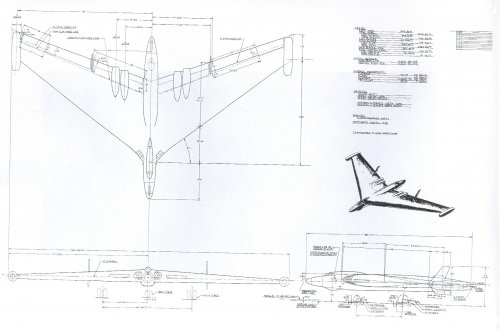
3-view drawing of the Westinghouse J40-powered N-31, with accompanying specification at the top right corner

The first flying wing bomber design studied under the N-31 label was a strategic bomber powered by six Westinghouse J40-WE-6 turbojets (each with 7,500 pounds of thrust), conceived in February 1947. It was similar to the YB-49, YRB-49A, RB-49, and EB-35B in featuring vertical stabilizers on the trailing edge of the wing, but differed in having a blended wing body layout with a forward fuselage section reminiscent of the delta-wing Avro Vulcan bomber. The arrangement of the turbojets in the turbojet-powered N-31 design iteration was quite unorthodox; four of the J40s were buried between the center section of the aircraft and the vertical stabilizers, but the other two were placed on the wingtips. The jet N-31 design had a wingspan of 128 feet 4 inches (39.11 meters) and a length of 74 feet 11 inches (22.83 meters), with a crew of five and provisions for twin 20 mm cannons (0.50 caliber) in nose and tail barrel turrets. It was intended to have a combat radius of 2,022 miles (3,254 km) with a 10,000-pound bomb load, a cruising speed of 502 mph (808 km/h), and a top speed of 608 mph (978 km/h).

Image result for northrop n-31"
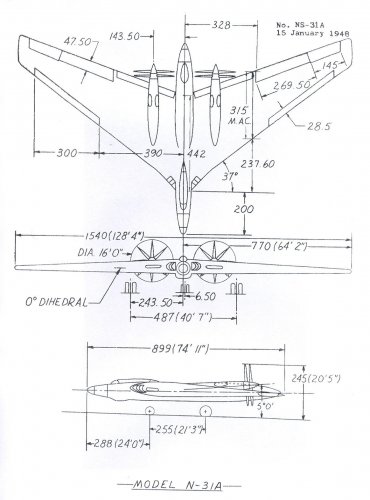
3-view drawing from Northrop company documents of N-31A design with two Allison T40 turboprop engines. Note the absence of upright vertical stabilizers.

The N-31A design (envisaged January 1948) had the same wingspan, length, armament, gross weight, and wing sweep and baseline N-31, but returned to some aspects of the design layout of the XB-35, especially the lack of vertical stabilizers, and it was powered by two 7,500 hp Allison T40 turboprops, possessing an operational range of 2,600 miles (4,441 km) with a 10,000-pound bomb load. The N-31B, would have been similar to the baseline N-31 but with an all-wing configuration and just the four wing-mounted turbojets, while the N-31C proposed in late April 1948 would have had two Turbodyne T37s, and the N-31F was to be a a photo-reconnaissance derivative of the N-31B (see Buttler 2010, pp. 19-20, for more details). In May 1950, two additional N-31A proposals were conceived, one with two 10,000 hp Turbodyne T37 turboprops each driving six-bladed counter-rotating propellers, a cruising speed of 500 mph (804 km/h), a top speed of 518 mph (833 km/h), a range of 2,760 miles (4,441 km) when unrefueled or 5,580 miles (8,980 km) when refueled, an empty weight of 161,540 pounds (73,227 kg), a gross weight of 222,710 pounds (101,019 kg), and a maximum altitude of 43,000 feet (13,106 meters), and another with four T40s each driving six-bladed counter-rotating propellers, an empty weight of 175,400 pounds (79,560 kg), a gross weight of 212,000 pounds (96,206 kg), a cruising speed of 506 mph (814 km/h), and an altitude of 37,000 feet (11,277 meters) (Rose 2010, p. 84). The combat radius of the T40-powered design when unrefueled was similar to that of the T37-powered proposal but had lower range with in-flight refueling were lower (4,027 miles for Allison-powered version vs. 5,580 miles for T37-powered design). 

But the N-31 was all for naught, despite offering potential remedies to the stability and range problems that made the YB-49 unsuitable as a bombing platform and ineligible to carry large nuclear and thermonuclear weapons. Continued concerns about longitudinal instability of flying wings combined with evolving air defense priorities meant that the N-31 was never green-lighted for full-scale development by the US Air Force, so it remained a paper project only.
   
References:

Buttler, T., 2010. American Secret Projects: Bombers, Attack, and Anti-Submarine Aircraft 1945-1974. Hersham, UK: Ian Allan Publishing.

Chong, T., 2016. Flying Wings & Radical Things: Northrop's Secret Aerospace Projects & Concepts 1939-1994. Forest Lake, MN: Specialty Press.

Rose, B., 2010. Secret Projects: Flying Wings and Tailless Aircraft. Hersham, UK: Ian Allan Publishing.
   

Wednesday, January 1, 2020

Little-known Northrop flying wings of 1940s-early 1950s, part 1: Northrop EB-35B turboprop testbed flying wing

What a better way to start the new year with a blog post about the development of the original flying wing bombers designed by Jack Northrop in the 1940s and early 1950s?  

The story of the original flying bombers designed and built by the Northrop company in the 1940s is well-documented in literature on flying wings and US military aviation in World War 2 and the Cold War, as highlighted by the Northrop XP-79 prototype flying wing fighter and the Northrop B-35 and B-49 flying wing bombers. However, lost in talk regarding the development of the B-35/B-49 flying wing bomber development lineage and large Northrop flying wings in general is the fact that Jack Northrop considered modifying one B-35 airframe for testing his company's homegrown design for a turboprop engine (designation EB-35B) but also flying wing bombers more advanced than B-35 and B-49 as well as passenger/cargo flying wing projects. Tony Chong's recently published book Flying Wings & Radical Things: Northrop's Secret Aerospace Projects & Concepts 1939-1994 (Specialty Press, 2016) has helped to illuminate these little-noticed Northrop flying wings by providing a wealth of previously published and unpublished This post will be the first part of a three-part blog post series about unbuilt Northrop flying wing projects, and intends to touch upon the Northrop B-35 testbed for the Turbodyne XT37 turboprop, the EB-35B.

Beginning in 1939, the newly formed Northrop Corporation in Hawthorne, California, began a private venture aimed at developing a turboprop engine, and in 1941 the company was awarded a joint US Army/US Navy contract for design, analysis, and fabrication of a prototype turboprop engine, the Turbodyne I (company designation: N-10). (The contract was eventually amended to cover the construction of two turboprop prototypes.) The Turbodyne I Given its lack of experience in making aircraft engines with its nascent financial resources, Northrop formed a joint venture with the Joshua Hendy Iron Works of Sunnyvale, California, the Northrop-Hendy Corporation, to manufacture the Turbodyne I prototypes. The Turbodyne I prototype turboprops were completed on schedule and the engine began test runs in 1944. However, both prototypes failed during test runs and the Navy withdrew from the Turbodyne program in early 1945. Meanwhile, the US Army Air Force awarded Northrop a contract to build a more advanced version of the Turbodyne I under Wright Field Air Material Command designation MX 562, which was to have an output of 4,000 hp at 500 miles per hour. This turboprop engine design, given the company designation N-19 by Northrop, became known by its official designation XT37. The XT37-NA-3 was intended to deliver 10,000 shp.*

*Since this post is only intended to be a systematic treatment of the Northrop EB-35B, I have opted to only give some brief details on the powerplant intended for the Northrop (Turbodyne) XT37 turboprop.

The Northrop (Turbodyne) XT37 turboprop, which was intended to power the EB-35B.

In the late 1940s, with the XB-35 flying wing bomber design already made obsolete by the Jet Age thanks to its use of piston engines, and the jet-powered YB-49 having a lower operating range with a decent bombload than the B-35, Northrop investigated proposals for equipping the B-35 airframe with turboprop propulsion in hopes of combining the range of the B-35 with the speed of the B-49. Given that test runs of the latest version of the XT37 found the engine to approach the expected 10,000 shp output, the United States Air Force saw the XT37-NA-3 as a potentially fuel-efficient alternative to the turbojet, so on November 1, 1948, a contract was issued authorizing conversion of the first XB-35 prototype to a testbed for the XT37 under the designation ERB-35B (company designation: N-45) (note: the letter "E" stood for "Exempt", not "Electronic"). The proposed conversion of the first XB-35 to ERB-35B configuration entailed replacing four of the eight buried Allison J35s with two XT37s and placing two of the eight J35s in pods under the wings; the propellers for the XT37s would be mounted in pusher configuration, and the engine inlets were to protrude from the leading edge of the center section of the aircraft. After the Air Force cancelled its production contract for the RB-49 photo-reconnaissance version of the YB-49 on January 14, 1949, the November 1948 contract was emended whereby the XB-35 was to be salvaged, the ERB-35B was redesignated EB-35B, and the last YB-35 airframe (serial number 42-102378) was earmarked for conversion to the EB-35B. Northrop planned to have the EB-35B conduct the first 30 hours of its flight testing with one XT37 installed, with a later scheme to have the EB-35B fitted with both XT37s during the next 30 flight testing hours (Chong, p. 60).

The EB-35B was not the only iteration of the B-35/B-49 development lineage that was contemplated by Northrop to be fitted with Turbodyne turboprops. One design iteration of the planned RB-49, the RB-49C (company designation: N-37B), was to have two XT-37-NA-3 turboprops alongside two General Electric J47 turbojets, and Northrop envisaged additional variants of the RB-49 using the XT37-NA-3 turboprop under the company designations N-46 and N-47. However, none of these studies progressed beyond the design phase.

Top: 3-view drawing of the Northrop EB-35B testbed for the Northrop XT37 turboprop engine.
 Bottom left: Northrop EB-35B under construction at Northrop plant in Hawthorne, California, October 27, 1949.
Bottom right: Desktop model of the Northrop EB-35B at the Planes of Fame Museum, Chino, California.

Unfortunately, the EB-35B, despite potentially offering the promise of a gas turbine powered derivative of the B-35 with greater range than the B-49, was not to be. On March 30, 1950, the EB-35B was nearing completion at the Northrop plant in Hawthorne when the USAF ordered the EB-35B to be scrapped, presumably concerned that the EB-35B might be plagued by the same vibration troubles with the long propeller shafts that had bedeviled the XB-35 during flights. Despite offers from Northrop employees to have the EB-35B completed just for the sake of testing the XT37 in flight, Jack Northrop declined that suggestion because he knew the Air Force would not be happy if the EB-35B were not broken for scrap. Consequently, the EB-35B was destroyed by the breaker's torch without ever having had the chance to fly. As the EB-35B was consigned to California aviation history's dustbin, so was the Turbodyne, for in September 1950 Northrop sold the designs and patents for the Turbodyne engine to General Electric.

In an interesting footnote to this post, Chong (2016, pp. 27-28) notes that the N-10 designation allocated to the Turbodyne I turboprop was also used for a Northrop design for a cargo flying wing looking like a scaled down XB-35 with a wingspan of 114 feet and a crew of four (pilot, co-pilot, navigator, loadmaster). The N-10 flying wing project had flaps running the full length of the wing from the outboard of the propeller shaft nacelles to the wingtips, and cargo bay doors might have slid or dropped open to allow for cargo to be loaded into or unloaded from the cargo bay of the aircraft. It is unclear why the N-10 designation was re-used for Northrop's cargo flying wing proposal; Chong (p. 28) suggests that Northrop conceived this design for the 1941 USAAC/USAAF transport competition but never submitted it as a bid and instead supplanted it with the Navy Turbodyne contract.

References:

Chong, T., 2016. Flying Wings & Radical Things: Northrop's Secret Aerospace Projects & Concepts 1939-1994. Forest Lake, MN: Specialty Press.

Supersonic Firebees

The Firebee drone family is unquestionably the most versatile jet-powered unmanned air vehicle family developed and built during the Cold Wa...